


Tóm Tắt Nội Dung Bài Viết
On the journey to mastering English, listening is often a major hurdle for many learners. To overcome this barrier, the dictation method has proven to be an incredibly effective tool. In this article, ECE will provide you with a comprehensive overview of how to use dictation to boost your skills.
1. Introduction to the Dictation Method
Dictation is an active listening practice where you listen to an audio clip and transcribe exactly what you hear. This is more than just a simple listening test; it is a comprehensive training process that helps you:
- Enhance sound recognition: Practice distinguishing English phonemes, especially those that are difficult or easily confused.
- Improve vocabulary and grammar: Naturally memorize spelling and sentence structures through context.
- Get used to native speaking speeds: Focus on listening and processing information quickly, leading to better reflexes in real-life communication.
- Develop patience and attention to detail: It requires high concentration and the ability to self-check and correct errors.

2. Step-by-Step Guide to Dictation Practice
For the best results, follow these steps:
Step 1: Choose appropriate source material
- Criteria: Prioritize sources with clear audio, a moderate pace, and content that matches your level and interests.
- Recommended sources: (Detailed in section 4)
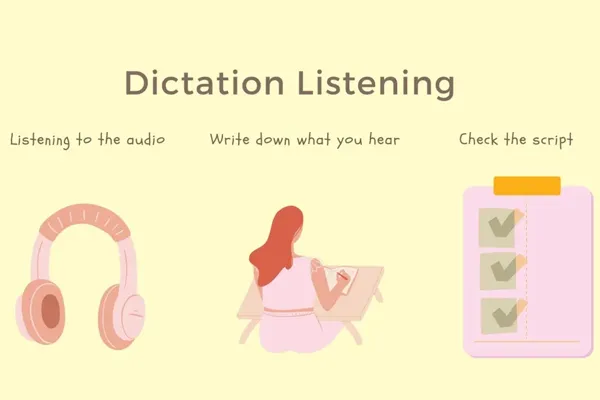
Step 2: Listen and transcribe
- First listen: Listen to the entire clip to grasp the main idea.
- Second listen: Start transcribing. Pause after each phrase or short sentence to give yourself enough time to write. Don’t worry if you don’t catch everything; just write down what you hear.
- Third listen (and beyond): Listen again multiple times and try to fill in the gaps.
- Compare with the transcript: Check for errors and underline the parts you missed or transcribed incorrectly.
Step 3: Mimic and record
- Review the transcript: Read along while listening to get familiar with native pronunciation and intonation.
- Shadowing: Listen and repeat sentence by sentence or phrase by phrase, trying to mimic the intonation, speed, and emphasis.
- Record yourself: Record your own voice and compare it to the original. Identify differences and keep practicing to improve.
Related article: Strategies for IELTS Listening Part 4
3. Why should you practice dictation?
Comprehensive listening development: Beyond just listening for comprehension, dictation helps you refine sound recognition, vocabulary retention, and grammatical structure.
Identify and fix weaknesses: Through the transcription process, you will pinpoint the specific sounds, words, or structures you struggle with, allowing for targeted study.
Boost concentration: The process of listening and writing requires intense focus, which helps train your ability to concentrate and retain information.
Build confidence: As you become more accurate in your transcriptions, you will feel more confident in your overall listening ability.
4. Recommended Dictation Resources
Here are some dictation resources categorized by three levels, from beginner to advanced:
Beginner/Elementary:
- Breaking News English (Level 0-2): Short news articles with simple vocabulary, slow speed, transcripts, and exercises. (breakingnewsenglish.com)
- ESL Games Plus: Short dialogues on relatable topics at a slow pace, perfect for beginners. (eslgamesplus.com)
- VOA Learning English (Level 1): News and English learning programs designed specifically for learners, featuring slow speeds, basic vocabulary, and transcripts. (learningenglish.voanews.com)
Intermediate:
- Breaking News English (Level 3 – 5): News articles with increasing difficulty, richer vocabulary, and faster speeds.
- Spotlight English: Short radio programs focusing on culture and society, spoken at a pace slower than natural native speech, with transcripts. (spotlightenglish.com)
- TED Talks: Short presentations on various topics with subtitles, helping you get used to different voices and speaking styles. (ted.com) – Note: Choose talks with English subtitles for easier tracking and checking.
Advanced:
- Breaking News English (Level 6): Challenging news articles with specialized vocabulary and fast speeds.
- BBC Learning English: Diverse English learning programs, including news, interviews, and debates, exposing you to various accents and styles. (bbc.co.uk/learningenglish)
- Podcasts: Choose podcasts on topics you enjoy, such as news, business, science, or culture. Recommended podcasts:
- The Daily (The New York Times): Daily news from The New York Times.
- Stuff You Should Know: A podcast explaining a wide range of topics, from history to science.
- TED Radio Hour: A compilation of the best talks from TED.
5. Tips for Beginners

– Start small: Don’t try to pick material that is too difficult right away. Start with content that matches your current level and gradually increase the difficulty over time.
– Be consistent: Dictation is a process that requires persistence and effort. Dedicate at least 15-30 minutes every day to see noticeable progress.
– Use supporting tools: There are many apps and websites that assist with dictation, such as Voice Notebook (speech-to-text), which can save you time and effort.
– Combine with other methods: While dictation is an effective tool, it shouldn’t be your only one. Mix it up with other listening practices like watching movies, listening to music, or joining English clubs to keep your learning diverse and engaging.
Good luck on your journey to mastering English listening skills!
Related article: 5 Common Mistakes in IELTS Listening




 Khai giảng Khóa học Hè cực HOT.
No comments yet!