
Tóm Tắt Nội Dung Bài Viết
Are you struggling with Short Answer Questions (SAQ) in IELTS Reading? This question type requires you to locate specific information and provide concise, direct answers from the text. Don’t worry! ECE Language Center is here to help you navigate this task and turn SAQs into a scoring opportunity for your exam.
This article provides a comprehensive overview, a step-by-step strategy, common pitfalls to avoid, and expert tips to help you confidently conquer Short Answer Questions.
1. Overview of Short Answer Questions (SAQ) in IELTS Reading
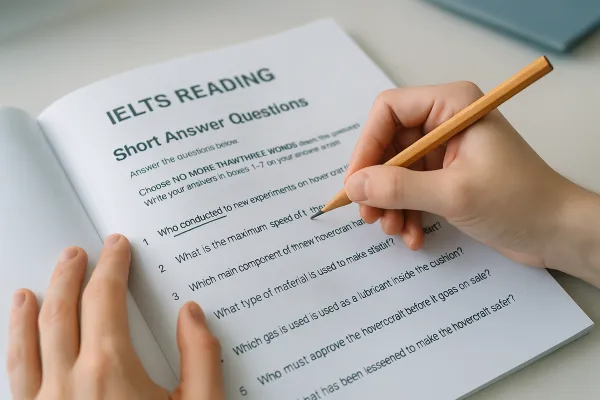
Short Answer Questions (SAQ) require you to find a specific word or short phrase directly from the reading passage to answer an open-ended question.
This task tests your ability to:
- Locate information quickly: You must identify the exact section where the required information is mentioned.
- Understand details: Grasp the core message of the question and find the corresponding data.
- Summarize information: Select the most concise word or phrase that retains the full meaning.
Rules you MUST STRICTLY FOLLOW:
- Extract information DIRECTLY from the passage: This is crucial. You must not use synonyms or paraphrase the answer. If the instructions say “from the passage/text,” copy the words exactly as they appear.
- Adhere to the WORD LIMIT: The instructions will specify a maximum number of words (e.g., “NO MORE THAN ONE WORD,” “NO MORE THAN THREE WORDS AND/OR A NUMBER”).
- How to count words: Hyphenated words (e.g., well-known) count as one word. A number (e.g., 1999 or twenty) also counts as one word.
- Example: If the limit is “NO MORE THAN TWO WORDS,” the answer “climate change” (2 words) is acceptable, but “global climate change” (3 words) is not.
- Answers follow the order of the passage: This is a major advantage. The answer to Question 2 will always appear after the answer to Question 1 in the text, and so on.
- Questions may be paraphrased: While the answer must be copied exactly, the question itself will likely use different wording to test your comprehension.
2. A 5-Step Strategy for Finding SAQ Answers Efficiently
To optimize your efficiency and speed, apply the following five steps:
Pro tip: Many IELTS experts recommend tackling Short Answer Questions last (after completing other types like Multiple Choice or True/False/Not Given). By then, you will have already read much of the text, making it faster and easier to locate specific SAQ answers.
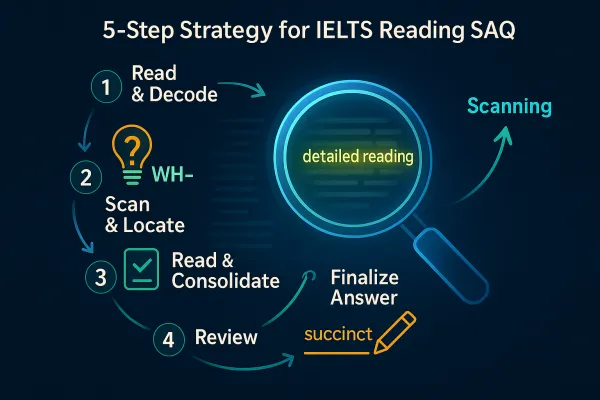
Step 1: Analyze the Instructions & Decode the Question
Start by understanding the rules and the question’s intent.
- Note the word limit: This is the most important first step. Circle or highlight the word count requirement (e.g., “ONE WORD ONLY,” “NO MORE THAN TWO WORDS AND/OR A NUMBER”).
- Identify the type of information needed: The question word (WH-question) helps you predict the part of speech or type of information required.
- Examples:
- “What is the primary benefit…?” -> Look for a noun or noun phrase describing a benefit.
- “When did the event occur?” -> Look for a time or year.
- “How did the process change…?” -> Look for an adjective, adverb, or prepositional phrase describing a method.
- “Who proposed this idea?” -> Look for a name or title.
- Examples:
- Underline keywords in the question: Identify main keywords (nouns, verbs, important adjectives) to help you scan the passage.
Step 2: Scan the Passage and Locate the Information
Now, move to the reading passage to find the relevant section.
- General Skimming: Quickly read the title and the first sentence of each paragraph to understand the main idea of each section.
- Keyword Scanning: Use the underlined keywords from the question to scan the text. When you find a keyword or related information, stop and focus on that area.
- Use the “Order of Appearance” rule: Since answers appear sequentially, find the answer to Question 1 first, then look for Question 2 from that point forward. This prevents unnecessary re-reading.
Step 3: Read Closely & Identify Potential Answers
Once you have located the relevant section, read for detail to pinpoint the answer.
- Read the surrounding sentences carefully: Focus on the sentences containing your keywords.
- Simplify the sentence: If a sentence is too long or complex, try stripping away non-essential modifiers (like long relative clauses or bulky adverbial phrases) to grasp the core meaning.
- Example:
- Complex original: “The groundbreaking research, meticulously conducted over a five-year period by an international team of marine biologists, ultimately confirmed a significant, previously unobserved, alteration in the migratory patterns of whale sharks.”
- Simplified: “Research confirmed a shift in migratory patterns of whale sharks.”
- Core meaning: The study confirmed changes in whale shark migration.
- Example:
- Match the meaning: Find the information in the text that matches the (paraphrased) meaning of the question. Then, identify the exact original word/phrase from the text to use as your answer.
Step 4: Finalize the Precise Answer
Once you have matched the information:
- Select the exact word/phrase: Choose the specific words from the text that directly answer the question.
- Check the word limit: Ensure your chosen answer DOES NOT exceed the word limit. This is the most common reason for losing points.
Example: If the question is “What type of energy source is becoming popular?” and the text says “renewable energy sources,” if the limit is “NO MORE THAN ONE WORD,” you must choose “renewable” or “energy.” Read the context carefully to select the most essential word.
- Ensure it answers the prompt: The answer must directly address the question word (What, When, How, etc.).
Step 5: Final Review
Before moving on or submitting your paper, check the following:
- Grammar: Ensure the answer is grammatically correct (either on its own or when placed back into the context of the question). Occasionally, you may need to ensure the form of the word fits the question’s context.
- Spelling: Always double-check your spelling. A single typo will result in zero points for that question.
- Logic: Re-read the question and your answer to ensure they form a logical and meaningful pair.
3. Detailed Example and Walkthrough
Practice with the following example to better understand the SAQ process:
Passage: The Development of Early Writing Systems
A The earliest forms of writing emerged independently in several ancient civilizations, primarily driven by the need to keep administrative records for complex economies. Before formalized systems, societies used various mnemonic devices, such as knotted ropes or carved tallies, to aid memory, particularly for tracking goods and transactions. The inherent limitations of these methods, however, became apparent as trade networks expanded and populations grew.
B One of the earliest known true writing systems, Sumerian cuneiform, developed in Mesopotamia around 3400 BCE. Initially, it comprised pictographs representing objects, which were later simplified into wedge-shaped marks pressed onto clay tablets. This evolution allowed for the representation of more abstract concepts and grammatical elements, moving beyond simple record-keeping to include laws, literature, and historical accounts.
C In ancient Egypt, hieroglyphic writing appeared shortly after cuneiform, around 3200 BCE. While visually distinct, it also combined pictorial elements with phonetic symbols. Unlike cuneiform, which was typically inscribed on clay, hieroglyphs were often carved into stone monuments or painted on papyrus, serving religious, monumental, and administrative purposes. The discovery of the Rosetta Stone in 1799 provided the key to deciphering these complex symbols.
D The development of alphabetic systems marked a significant revolution in writing. Phoenicians, a maritime trading people from the Levant, are widely credited with creating the first widely adopted alphabet around 1050 BCE. Their system consisted solely of consonants, making it simpler and more adaptable for different languages than the logographic or syllabic systems that preceded it. This simplicity facilitated its spread across the Mediterranean world through trade.
Questions 1 – 3 Answer the questions below. Choose NO MORE THAN TWO WORDS from the passage for each answer. Write your answers in boxes 1-3 on your answer sheet.
- What was a primary reason for the initial creation of writing systems?
- Which writing material was commonly used for ancient Egyptian hieroglyphs?
- What was a key feature of the alphabet developed by the Phoenicians?
Analysis & Answers:
Step 1: Analyze Instructions & Decode Questions
- Requirement: NO MORE THAN TWO WORDS.
- 1. What was a primary reason for the initial creation of writing systems?
- Question word: “What” (looking for a noun/noun phrase for a reason).
- Keywords: primary reason, initial creation, writing systems.
- Prediction: Find the original cause for the birth of writing.
- 2. Which writing material was commonly used for ancient Egyptian hieroglyphs?
- Question word: “Which writing material” (looking for a specific material).
- Keywords: writing material, commonly used, ancient Egyptian hieroglyphs.
- Prediction: Find what ancient Egyptians wrote on.
- 3. What was a key feature of the alphabet developed by the Phoenicians?
- Question word: “What” (looking for a noun/noun phrase for a characteristic).
- Keywords: key feature, alphabet, developed, Phoenicians.
- Prediction: Find a defining trait of the Phoenician alphabet.
Steps 2 & 3: Scan, Locate & Read Closely (In Order)
- Paragraph A:
- Scan Paragraph A. Keywords found: “earliest forms of writing”, “driven by the need to keep administrative records for complex economies”.
- Analysis: This sentence directly answers Question 1.
- Matching: “primary reason” matches “driven by the need.” “initial creation of writing systems” matches “earliest forms of writing emerged.”
- Select Answer: Limit is 2 words. “administrative records” is the direct phrase from the text and fits the limit.
- Answer 1: administrative records
- Paragraph B: (No direct info for Q2 & Q3. Discusses Sumerian cuneiform).
- Move to Paragraph C.
- Paragraph C:
- Scan Paragraph C. Keywords found: “ancient Egypt”, “hieroglyphic writing”, “carved into stone monuments or painted on papyrus”.
- Analysis: This sentence directly answers Question 2.
- Matching: “writing material commonly used” matches “carved into stone monuments or painted on papyrus.”
- Select Answer: Limit is 2 words. “stone monuments” (2 words) or “papyrus” (1 word). “Papyrus” is a more standard writing material and is concise.
- Answer 2: papyrus (or stone monuments).
- Paragraph D:
- Scan Paragraph D. Keywords found: “alphabetic systems”, “Phoenicians”, “system consisted solely of consonants”, “simpler and more adaptable”.
- Analysis: This sentence directly answers Question 3.
- Matching: “key feature of the alphabet developed by the Phoenicians” matches “Their system consisted solely of consonants” and “simplicity.”
- Select Answer: Limit is 2 words. “solely of consonants” (3 words – too long). “simplicity” (1 word) or “consonants” (1 word). “Consonants” is the core structural feature.
- Answer 3: consonants (or simplicity).
Results:
- administrative records
- papyrus
- consonants
4. Common Pitfalls to Avoid in SAQs
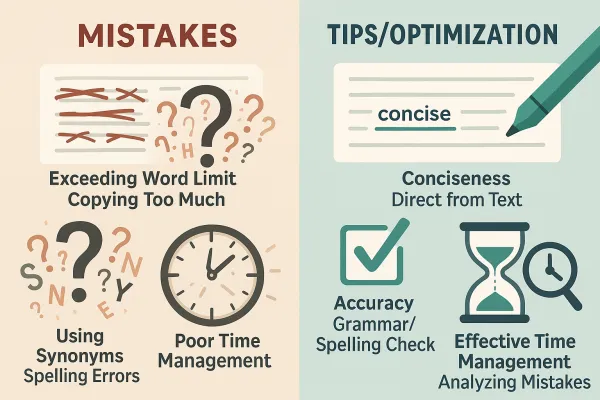
SAQs can be tricky if you aren’t careful:
- Spelling and Grammar Errors: Even if you find the right word, a small spelling mistake or a grammatical mismatch (e.g., missing an “s” for a plural noun) will cost you the point.
- Exceeding the Word Limit: This is the most frequent error. Even if the information is correct, adding one extra word makes the entire answer wrong.
- Using Synonyms: You must use the exact words from the passage. Even a perfect synonym is considered incorrect if it does not appear in the original text.
- Copying Unnecessary Words: SAQs require brevity. Do not lift an entire long sentence; extract only the core answer.
- Ignoring Context: Sometimes a keyword appears, but the context of the sentence in the passage differs from what the question is asking. Always ensure you understand the question’s intent.
5. Advanced Tips to Maximize Your Score
To master Short Answer Questions, apply these expert tips:
- Master Paraphrasing (to understand the question): You must quickly recognize the meaning of a question even when it uses different vocabulary. Practice identifying different ways to express the same idea when reading any English material.
- Practice Summarizing: Train yourself to condense key information into the allowed word count. Try summarizing long sentences into 1-3 words.
- Effective Time Management: This task is relatively fast if you know the rules. Aim for about 1 minute per question. If you are stuck for more than 1.5 minutes, skip it and come back later.
- Analyze Your Mistakes: Don’t just look at the right/wrong mark. Analyze *why* you got it wrong—was it a failure to locate information, a word limit violation, or using words not found in the text? Learn from these errors.
- Read Diverse Topics: IELTS passages cover science, sociology, history, and more. Wide reading familiarizes you with various vocabularies and contexts.
Short Answer Questions are a comprehensive test of your detailed reading comprehension and attention to detail in IELTS Reading. ECE Language Center believes that with consistent practice using this 5-step strategy, combined with sharp information-locating skills and effective time management, you will not only overcome your fear but turn this task into a major advantage for your target band score. Start your journey to improvement today!





 Khai giảng Khóa học Hè cực HOT.
Chưa có bình luận nào!