


Tóm Tắt Nội Dung Bài Viết
Hello everyone! This reading passage about the life and career of Dr. Martin Luther King Jr. is not only a deeply historical document but also an excellent source of vocabulary related to the topic of Human Rights & Social Movements.
In this article, ECE Language Center will provide the full reading content, a bilingual translation, and detailed explanations for the answers to help you follow along easily.
Reading Passage & Questions
Martin Luther King
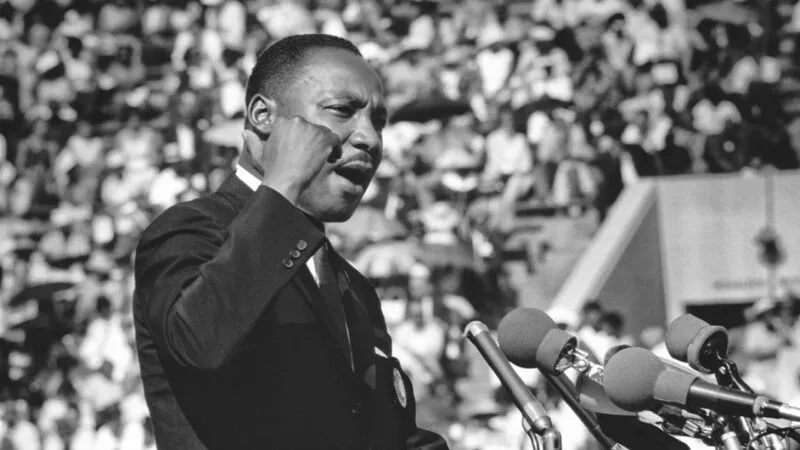
A. Martin Luther King was born on January 15, 1929, in Atlanta, Georgia. He was the son of the Reverend Martin Luther King Sr. and Alberta Williams King. He had an older sister, Willie Christine King, and a younger brother, Alfred Daniel Williams King. Growing up in Atlanta, King attended Booker T. Washington High School. He skipped the ninth and twelfth grades and entered Morehouse College at age fifteen without formally graduating from high school. From the time Martin was born, he knew that Black people and white people had different rights in certain parts of America. If a Black family wanted to eat at a restaurant, they had to sit in a separate section. They had to sit at the back of the cinema and even use separate toilets. Worse, and perhaps even more humiliating, in many southern states, if a Black man was on a bus and all the seats were taken, he would have to endure the indignity of relinquishing his own seat to a white man. King could never understand the terrible injustice of this. In 1948, he graduated with a Bachelor of Arts degree in sociology. Later, King began doctoral studies in systematic theology at Boston University and received his Doctor of Philosophy on June 5, 1955. King married Coretta Scott on June 18, 1953, and they had four children.
B. Returning to the South to become pastor of a Baptist Church in Montgomery, Alabama, King first achieved national renown when he helped mobilize the Black boycott of the Montgomery bus system in 1955. This was organized after Rosa Parks, a Black woman, refused to give up her seat on the bus to a white man – in the segregated South, Black people could only sit at the back of the bus. The 382-day boycott led the bus company to change its regulations, and the Supreme Court declared such segregation unconstitutional.
C. In 1957, King was active in the organization of the Southern Christian Leadership Conference (SCLC), formed to co-ordinate protests against discrimination. He advocated non-violent direct action based on the methods of Gandhi, who led protests against British rule in India, culminating in India’s independence in 1947. In 1963, King led mass protests against discriminatory practices in Birmingham, Alabama, where the white population was violently resisting desegregation. The city was dubbed ‘Bombingham’ as attacks against civil rights protesters increased, and King was arrested and jailed for his part in the protests.
D. After his release, King participated in the enormous civil rights march in Washington in August 1963 and delivered his famous ‘I have a dream’ speech, predicting a day when the promise of freedom and equality for all would become a reality in America. In 1964, he was awarded the Nobel Peace Prize. In 1965, he led a campaign to register Black people to vote. The same year, the US Congress passed the Voting Rights Act, outlawing the discriminatory practices that had barred Black people from voting in the South.
E. As the civil rights movement became increasingly radicalized, King found that his message of peaceful protest was not shared by many in the younger generation. King began to protest against the Vietnam War and poverty levels in the US. On March 29, 1968, King went to Memphis, Tennessee, in support of the Black sanitary public works employees who had been on strike since March 12 for higher wages and better treatment. In one incident, Black street repairmen had received pay for two hours when they were sent home because of bad weather, but white employees had been paid for the full day. King could not bear to stand by and let such patent acts of racism go unnoticed. He moved to unite his people, and all the peoples of America on the receiving end of discriminatory practices, to protest for their rights, peacefully but steadfastly.
F. On his trip to Memphis, King was booked into room 306 at the Lorraine Motel, owned by Walter Bailey. King was shot at 6:01 p.m. on April 4, 1968, while he was standing on the motel’s second-floor balcony. King was rushed to St. Joseph’s Hospital, where doctors opened his chest and performed manual heart massage. He was pronounced dead at 7:05 p.m. King’s autopsy revealed that although he was only 39 years old, he had the heart of a 60-year-old man.
Questions
Questions 27 – 31: Choose the correct letter A, B, C or D.
27. From a young age, Martin Luther King
A. wanted to protest for the rights of Black people.
B. could not understand why Black people were treated differently.
C. was not allowed to go to the cinema or to restaurants.
D. was aware that Black people were being humiliated in many northern states.
28. What initially made Martin Luther King famous?
A. the Black boycott of the Montgomery bus system
B. becoming a pastor at a Baptist Church
C. when Rosa Parks refused to give up her seat on a bus
D. when he persuaded Rosa Parks not to give up her bus seat to a white man
29. What influenced Martin Luther King regarding non-violence?
A. India’s independence in 1947
B. Christianity
C. the Southern Christian Leadership Conference
D. the methods of Gandhi
30. What did Martin Luther King fight for in 1965?
A. the right of Black people to vote
B. the actions of the US Congress
C. the right to win the Nobel Peace Prize
D. the right of Black people to travel abroad
31. How did Martin Luther King feel about the civil rights movement?
A. It was helping the war in Vietnam.
B. It brought the younger generation together.
C. It had been exploited by politicians who wanted to get more votes.
D. The protesters sometimes behaved too violently.
Questions 32 – 34: Do the following statements agree with the information? Write YES, NO or NOT GIVEN.
32. The Black boycott of the Montgomery bus system was a success.
33. In 1963, the white people in Alabama wanted desegregation.
34. Martin Luther King achieved a lot in his protest against the Vietnam War.
Questions 35 – 40: Choose the correct heading for each paragraph A – F.
List of Headings:
i. The memorable speech
ii. Unhappy about violence
iii. A tragic incident
iv. Protests and action
v. The background of an iconic man
vi. Making his mark internationally
vii. Difficult childhood
viii. Black street repairmen
-
Paragraph A
-
Paragraph B
-
Paragraph C
-
Paragraph D
-
Paragraph E
-
Paragraph F
Detailed Reading Translation
Paragraph A: Martin Luther King was born on January 15, 1929, in Atlanta, Georgia. He was the son of the Reverend Martin Luther King Sr. and Alberta Williams King… From the time Martin was born, he knew that Black people and white people had different rights in certain parts of America. If a Black family wanted to eat at a restaurant, they had to sit in a separate section. They had to sit at the back of the cinema and even use separate toilets. Worse, and perhaps even more humiliating, in many southern states, if a Black man was on a bus and all the seats were taken, he would have to endure the indignity of relinquishing his own seat for a white man. King could never understand the terrible injustice of this…
Paragraph B: Returning to the South to become pastor of a Baptist Church in Montgomery, Alabama, King first achieved national renown when he helped mobilize the Black boycott of the Montgomery bus system in 1955. This was organized after Rosa Parks, a Black woman, refused to give up her seat on the bus to a white man – in the segregated South, Black people could only sit at the back of the bus. The 382-day boycott led the bus company to change its regulations, and the Supreme Court declared such segregation unconstitutional.
Paragraph C: In 1957, King was active in the organization of the Southern Christian Leadership Conference (SCLC), formed to coordinate protests against discrimination. He advocated non-violent direct action based on the methods of Gandhi… In 1963, King led mass protests against discriminatory practices in Birmingham, Alabama, where the white population was violently resisting desegregation. The city was dubbed ‘Bombingham’ as attacks against civil rights protesters increased…
Paragraph D: After his release, King participated in the enormous civil rights march in Washington in August 1963 and delivered his famous “I have a dream” speech… In 1964, he was awarded the Nobel Peace Prize. In 1965, he led a campaign to register Black people to vote. The same year, the US Congress passed the Voting Rights Act, outlawing the discriminatory practices that had barred Black people from voting in the South.
Paragraph E: As the civil rights movement became increasingly radicalized, King found that his message of peaceful protest was not shared by many in the younger generation. King began to protest against the Vietnam War and poverty levels in the US… King could not bear to stand by and let such patent acts of racism go unnoticed. He moved to unite his people… to protest for their rights, peacefully but steadfastly.
Paragraph F: In his trip to Memphis, King was booked into room 306 at the Lorraine Motel… King was shot at 6:01 p.m. on April 4, 1968, while he was standing on the motel’s second-floor balcony. He was rushed to St. Joseph’s Hospital… He was pronounced dead at 7:05 p.m. King’s autopsy revealed that although he was only 39 years old, he had the heart of a 60-year-old man.
Summary of Key Vocabulary
| Vocabulary | Part of Speech | Meaning | Context in Passage |
| Humiliating | (adj) | Causing a feeling of shame | Perhaps even more humiliating still. |
| Relinquish | (v) | To give up or surrender | Relinquishing his own seat. |
| Boycott | (n/v) | Refusal to deal with an organization | The Black boycott of the bus system. |
| Unconstitutional | (adj) | Not in accordance with the constitution | Declared such segregation unconstitutional. |
| Desegregation | (n) | Ending the policy of racial separation | Violently resisting desegregation. |
| Outlaw | (v) | To ban or prohibit |
Chia sẻ:
Loading... LoginContact AdvisorError: Contact form not found. |





 Khai giảng Khóa học Hè cực HOT.
No comments yet!