
Tóm Tắt Nội Dung Bài Viết
Mobile phones are a common topic in IELTS Writing Task 2, especially when discussing their impact on individuals and society. In this article, ECE provides a detailed breakdown of the prompt, logical arguments, useful vocabulary, and a band 7.0+ sample essay to help you write with confidence. This content has been professionally reviewed by Ms. Nguyen Thi An Quyen, an 8.5 IELTS instructor at ECE. Let’s dive in!
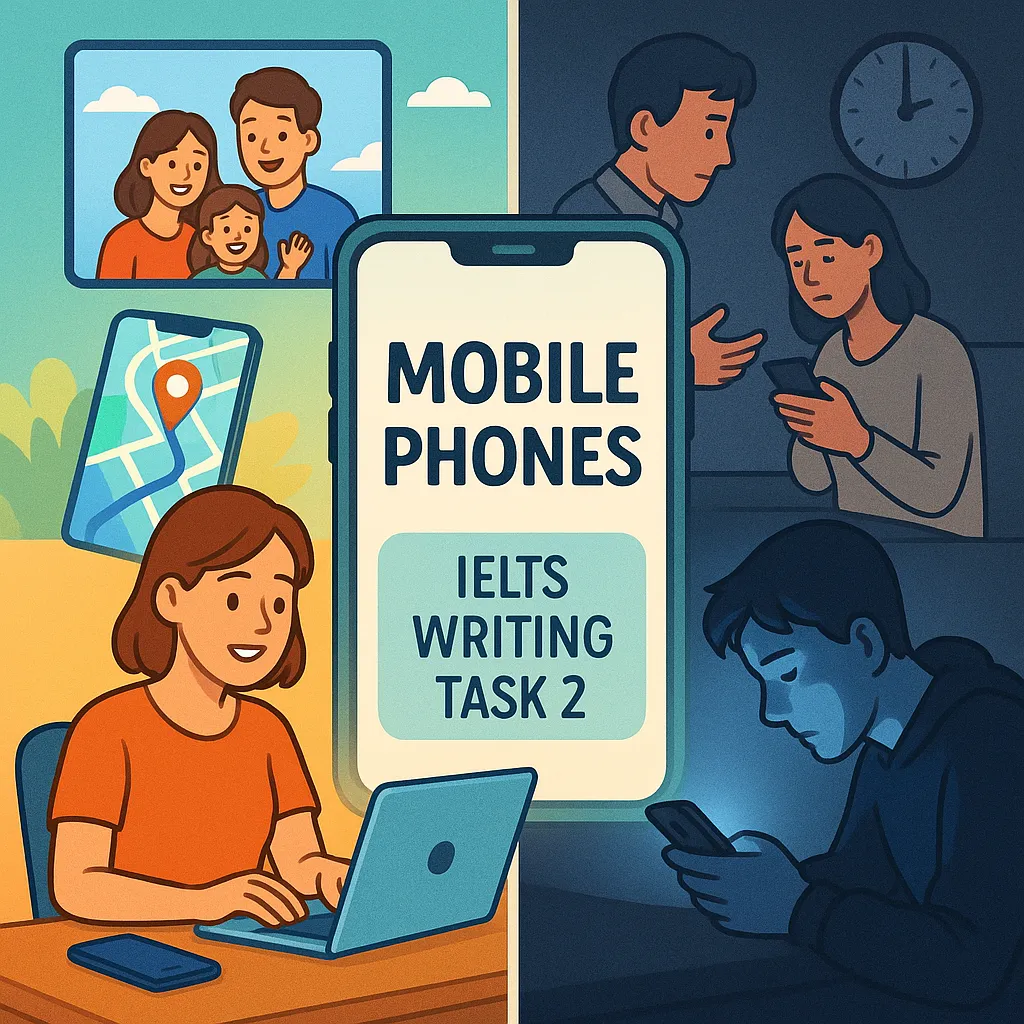
I. Analyzing the Prompt: “Are there more negative or positive effects?”
The specific prompt we will focus on is:
“Anyone can use a mobile phone to answer work calls and home calls at any place, or 7 days a week. Do you think there are more negative or positive effects on both individuals and society?”
This is an Argumentative Essay (Problem/Solution or Opinion) prompt, which requires you to take a clear stance on whether the negative or positive effects of mobile phones are more significant for individuals and society.
Tips from Ms. An Quyen:
- Introduction: Paraphrase the prompt and state clearly whether you believe the negative effects outweigh the positive ones (or vice versa).
- Body Paragraph 1: Analyze the positive effects of mobile phones (e.g., increased work efficiency, stronger relationships).
- Body Paragraph 2: Analyze the negative effects (e.g., burnout, reduced quality of relationships).
- Conclusion: Summarize your main points and restate your position.
II. Developing Ideas & Arguments
To build a cohesive essay, you need specific, logical ideas for each of your arguments.
A. Positive Effects:
- Increased work efficiency:
- Employees can address urgent issues immediately, even when away from the office.
- Prevents major delays and ensures critical decisions are made in a timely manner.
- Particularly useful in fields requiring rapid responses, such as healthcare, business, and customer service.
- Strengthening relationships:
- Helps maintain contact with family and friends regardless of geographical distance.
- Provides convenience and flexibility in both personal and professional life.
B. Negative Effects:
- Leading to burnout:
- The ability to answer work calls at any time blurs the boundary between work and personal life.
- Many employees feel pressured to respond to work messages after hours, leading to stress and exhaustion.
- Negatively impacts mental health and work-life balance.
- Reduced quality of social relationships:
- Constant availability can create a culture of overwork, leaving people with less quality time for their families.
- Excessive phone use in public settings hinders social interaction, as people focus more on their devices than on those around them.
- In the long run, this can diminish community connection and increase social isolation.
III. Useful Vocabulary
Using precise, academic vocabulary is key to boosting your score.
- work efficiency (n)
- strengthening personal relationships (v.phr)
- blur the boundary (v.phr)
- burnout (n)
- work-life balance (n)
- culture of overwork (n.phr)
- social interactions (n.pl)
- community connection (n.phr)
- social isolation (n.phr)
- stay connected (v.phr)
- urgent problems (n.phr)
- unprecedented ease (n.phr)
- constant availability (n.phr)
IV. IELTS Writing Task 2 Sample Essay (Band 7.0+)
This complete sample essay illustrates how to apply the arguments and vocabulary discussed above.
In modern life, mobile phones allow people to stay connected at all times, whether for work or personal matters. While this offers certain advantages, I believe the negative impacts are more serious.
One obvious positive effect is that mobile phones help improve work efficiency. Employees can handle urgent problems immediately, even if they are not in the office. This can prevent serious delays and ensure important decisions are made on time. It is especially useful for people working in fields like healthcare, business, or customer service, where quick responses are essential. In addition, mobile phones enable people to maintain contact with family and friends, strengthening personal relationships despite distance. In this way, mobile phones bring convenience and flexibility to both professional and private life with unprecedented ease.
However, there are two major negative effects that cannot be ignored. First, the ability to answer work calls anytime can blur the boundary between work and personal life. Many employees feel pressured to respond to work messages outside of office hours, which increases stress and leads to burnout. As a result, their mental health and work-life balance are badly affected. Second, this constant availability can harm society by creating a culture of overwork, in which people may spend less quality time with their families because they are too focused on work calls and messages. Additionally, excessive phone use in public places weakens social interactions, as people pay more attention to their devices than to those around them. In the long run, this can reduce community connection and increase social isolation.
In conclusion, although mobile phones bring some benefits, their negative effects on individuals and society are more significant.
V. Advice from an 8.5 IELTS Instructor (Ms. Nguyen Thi An Quyen)
To achieve a high band score in IELTS Writing Task 2, especially with pros/cons discussion prompts like this one, you need to pay attention to several factors. Here is detailed advice from Ms. Nguyen Thi An Quyen:
1. Thoroughly analyze the prompt: The foundation of a good essay
- Read the requirements carefully: Do not start writing until you are certain what the prompt is asking. For this type of question (“more negative or positive effects”), you must provide a clear stance and defend it throughout the essay.
- Identify the affected parties: This prompt asks about the impact on “individuals and society.” Ensure your arguments cover both aspects, rather than focusing solely on one.
- Outline in 5 minutes: Before writing, quickly sketch out the main points for each paragraph. This provides a clear roadmap and prevents you from going off-topic or missing key points.
2. Develop deep, insightful arguments
- Go beyond listing: Do not just state “the benefits are A, B, C” or “the drawbacks are X, Y, Z.” Each argument needs to be explained, elaborated upon, and, if possible, illustrated with examples or consequences.
- Example: Instead of just saying “Mobile phones improve work efficiency,” add “This allows employees to handle urgent problems immediately, even outside office hours, thus preventing serious delays and ensuring important decisions are made on time.”
- Maintain cohesion and coherence: Use linking words and phrases such as Furthermore, Moreover, Consequently, However, and In contrast to ensure your ideas flow logically within and between paragraphs.
3. Enhance your academic vocabulary
- Avoid repetition: Instead of repeating “mobile phone” or “advantages/disadvantages” too often, use synonyms or academic phrases like “ubiquitous device,” “handheld gadgets,” “positive/negative ramifications,” or “detrimental consequences.”
- Use academic collocations: These are words that naturally go together in academic writing (e.g., “blur the boundary,” “foster a sedentary lifestyle,” “diminish face-to-face interaction”). This makes your writing sound more natural and sophisticated.
4. Use a variety of grammatical structures: Scoring on GRAMMAR
- Move beyond simple sentences: Don’t just stick to simple structures. Try to incorporate complex and compound sentences, relative clauses, or passive voice where appropriate.
- Show sophistication: Use structures like inversions (e.g., “Not only do mobile phones provide instant communication, but they also…”) or concessive clauses (Although/While mobile phones offer numerous benefits…) to demonstrate grammatical flexibility.
5. Manage your exam time effectively
- Allocate your time wisely:
- 5 minutes: Analyze the prompt and outline.
- 30–32 minutes: Write the essay (Introduction, Body 1, Body 2, Conclusion).
- 3–5 minutes: Review and correct errors (grammar, spelling, punctuation).
- Don’t skip any sections: Ensure you have enough time to write all four paragraphs and don’t run out of time at the end.
ECE wishes you effective practice and a high band score on your IELTS Writing Task 2!





 Khai giảng Khóa học Hè cực HOT.
Chưa có bình luận nào!