
Tóm Tắt Nội Dung Bài Viết
The topic of Children is one of the most frequent themes in IELTS Writing Task 2, yet it remains a significant challenge due to its broad scope, covering areas such as education, parental roles, technology, and social development. To help candidates confidently tackle this topic and achieve a high band score, we have compiled and analyzed comprehensive ideas, structures, and academic vocabulary.
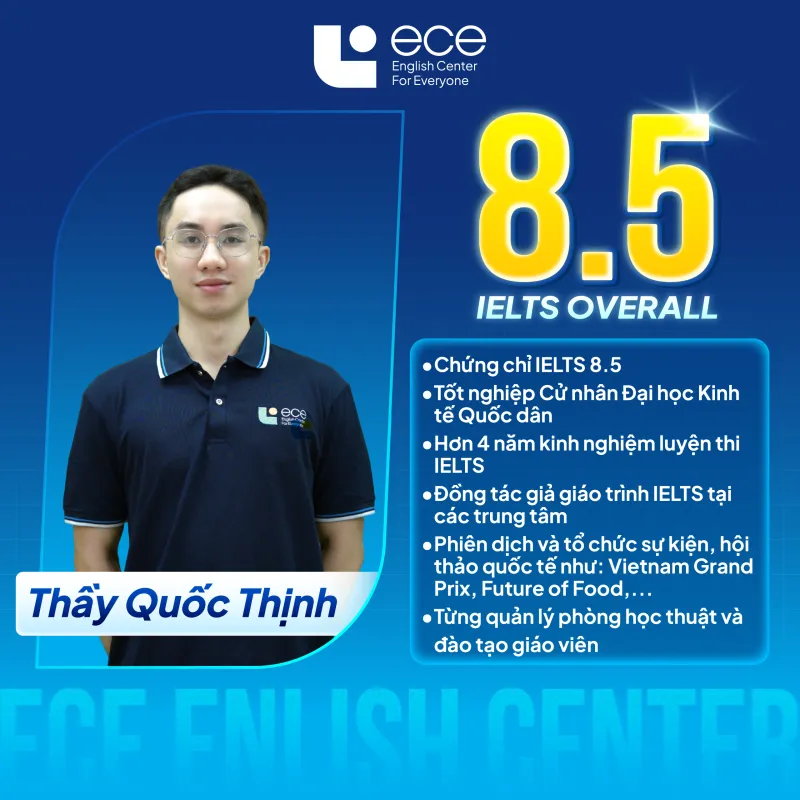
Notably, this article has been professionally reviewed by Mr. Dang Quoc Thinh, an 8.5 IELTS instructor at ECE Language Center, ensuring you receive the most effective, high-quality writing strategies to maximize your score in the exam.
4 Common Question Types for the “Children” Topic in Writing Task 2
The topic of children can appear in various question formats. Identifying the correct type will help you build an appropriate response structure.
1. Opinion Essay (To what extent do you agree or disagree?)
Requirement: State your personal opinion and support it. You can choose to strongly agree, strongly disagree, or partially agree.
Strategy:
- If you choose to strongly agree/disagree: Present two strong arguments in your body paragraphs to support one side.
- If you choose to partially agree: Use the first body paragraph for the side you agree (or disagree) with, and the second for the opposing view, while consistently reaffirming your main stance in the conclusion.
Sample prompt: Once children start school, teachers have more influence on their intellectual and social development. To what extent do you agree or disagree?
2. Discussion Essay (Discuss both views and give your opinion)
Requirement: Fairly present and analyze both opposing views mentioned in the prompt, then provide your own opinion.
Strategy:
- Body Paragraph 1: Analyze the first viewpoint (e.g., the role of parents).
- Body Paragraph 2: Analyze the second viewpoint (e.g., the role of schools).
- Conclusion: State your personal opinion (usually a balanced perspective).
Sample prompt: Some people argue that parents should be responsible for teaching children how to be good members of society, while others believe that schools should take this role. Discuss both views and give your opinion.
3. Advantages/Disadvantages
Requirement: Analyze the pros and cons of a trend or change related to children. Sometimes the prompt will ask whether the advantages outweigh the disadvantages.
Strategy:
- Body Paragraph 1: Focus on 2–3 advantages.
- Body Paragraph 2: Focus on 2–3 disadvantages.
If the prompt includes an “outweigh” question, you must dedicate 1–2 sentences in your conclusion to state whether the advantages or disadvantages carry more weight.
Sample prompt: What are the advantages and disadvantages of children spending more time on online learning?
4. Problem/Solution
Requirement: Identify the main problems arising from a specific situation (related to children) and propose feasible solutions.
Strategy:
Body Paragraph 1: Describe 2–3 of the most serious problems (e.g., lack of physical activity, reduced social interaction).
Body Paragraph 2: Propose 2–3 solutions corresponding to the problems mentioned (e.g., school policies, the role of the family).
Sample prompt: Nowadays, children spend less time playing outdoors. What problems does this cause and how can they be solved?
Summary of Ideas for the “Children” Topic
To add depth to your writing, you need a solid system of arguments. Mr. Quoc Thinh, an instructor at ECE English, suggests the following ideas across different aspects:
Sample Essay & Analysis by Mr. Quoc Thinh for the “Children” Topic
Prompt:
Once children start school, teachers have more influence on their intellectual and social development. To what extent do you agree or disagree?
Complete Sample Essay
Introduction: Some people believe that children’s cognitive and social development are influenced by teachers once children start going to school. In my view, teachers indeed play a dominant role in shaping children’s academic growth; however, parents remain the primary influence on their social development.
Body 1 (The Role of Teachers): On the one hand, the role of fostering children’s intellectual development is often considered the responsibility of teachers. Equipped with appropriate pedagogical methods and in-depth knowledge, teachers are entrusted with guiding students in understanding and applying academic concepts, thereby stimulating cognitive growth. The repetition of this process is proven to form neuronal connections in the brain, making them more intelligent and able to deal with more complicated matters. Solid evidence of this development can be seen in the progress of students in mathematics, where they can see tremendous progression throughout their school years, from remembering the multiplication table to solving integral math problems.
Body 2 (The Role of Parents): By contrast, children’s social development is more profoundly shaped by their parents. Evidence has shown that children tend to imitate their parents’ behavior, especially in their first years of life spent with them. This explains why many children’s communication styles such as verbal or non-verbal cues are partly identical to that of their parents, shaping children’s pattern of communication skills. Additionally, it is a social norm and tradition for parents to take the responsibility to provide lessons about real-life challenges, which are often not covered in the school’s curriculum. Through constant communication and guidance with their parents, children can learn a wide range of effective social skills including understanding and managing emotions or showing empathy to other people.
Conclusion: In conclusion, teachers exert a stronger influence on children’s intellectual development, while parents remain the key drivers of social growth. Since both parties are equally important, only the combined efforts of teachers and parents can ensure holistic development.
Key Vocabulary and Collocations
Using the following academic collocations will help you boost your band score under the Lexical Resource criterion:
The topic of Children in IELTS Writing Task 2 is not only familiar but also diverse in terms of the angles you can explore. By mastering the question types, building balanced arguments, and using academic vocabulary as shared by Mr. Dang Quoc Thinh, you can confidently conquer this topic and achieve your target band score. Good luck with your studies!





 Khai giảng Khóa học Hè cực HOT.
Chưa có bình luận nào!