
Tóm Tắt Nội Dung Bài Viết
Thoroughly researching the IELTS (International English Language Testing System) is the first and most crucial step for anyone looking to improve their English proficiency and expand their opportunities for study, work, or immigration in English-speaking countries. IELTS is currently one of the most prestigious and widely recognized international English language certifications.
However, before diving into the test structure, you need to have a clear understanding of the different types of IELTS tests to choose the one that aligns with your goals. Selecting the right test type not only helps you focus your preparation effectively but also ensures your certificate is accepted for your specific purpose.

Common IELTS Test Formats Today
Currently, there are two main IELTS formats (Academic and General Training) and a special version for the UK (IELTS for UKVI). Each format is designed to meet different requirements and objectives.
1.1. IELTS Academic
- Purpose: To assess English language proficiency in an academic or research environment. This is the standard test to determine if you are ready to pursue programs taught in English.
- Target Audience:
- Students wishing to pursue undergraduate or postgraduate studies (Master’s, PhD) at universities in English-speaking countries (such as the UK, Australia, USA, Canada, New Zealand).
- Professionals seeking registration (e.g., nurses, doctors) with international academic institutions or organizations.
- Content Nature: Focuses on English language skills required in academic settings, including the language used in academic materials, lectures, and research papers.
1.2. IELTS General Training
- Purpose: To assess English language proficiency in practical, everyday situations and workplace environments.
- Target Audience:
- Individuals looking to immigrate to English-speaking countries (Australia, Canada, New Zealand, UK, etc.).
- People seeking vocational training, secondary education, or employment in these countries.
- Content Nature: Focuses on English language skills necessary for daily life and work. The test evaluates your ability to understand and use English in real-world scenarios.
1.3. IELTS for UKVI (UK Visas and Immigration)
- Nature: This is not a different test in terms of content compared to IELTS Academic or General Training. Instead, IELTS for UKVI is an IELTS Academic or General Training test taken at a test center approved by the UK Home Office, adhering to specific administrative requirements set by the UK government. The testing process is more rigorous, including on-site photo and fingerprint capture to ensure security and authenticity.
- Purpose: To prove your English proficiency when applying for a visa or immigration to the UK as required by the British government.
- Target Audience: Those needing a visa for study (below degree level), work, immigration, or other specific visa categories for the UK. Always check the specific requirements for the visa you are applying for.
2. Quick Comparison: IELTS Academic vs. General Training
| Criteria | IELTS Academic |
IELTS General Training
|
| Main Purpose | Higher education (Undergraduate, Postgraduate), research |
Immigration, vocational training, secondary school, work
|
| Content | Focuses on academic and specialized language |
Focuses on practical, daily life, and workplace language
|
| Differences | Reading and Writing (Task 1) |
Reading and Writing (Task 1)
|
| Similarities | Listening and Speaking |
Listening and Speaking
|
(Note: While the general structure of Reading and Writing is similar (number of sections, timing), the content, difficulty of the reading passages, and the requirements for Writing Task 1 are significantly different.)
3. Paper-based vs. Computer-delivered IELTS
Beyond choosing your test type (Academic/General), you can also choose your delivery method:
- The test structure (number of sections, number of questions, question types, and main timing) is identical for both formats.
- The main differences lie in the experience and how you interact with the test:
- Interaction: One involves writing and filling in paper, the other involves typing on a computer.
- Listening timing: Paper-based tests include 10 minutes to transfer answers to an Answer Sheet. Computer-delivered tests include 2 minutes to review answers entered directly on the screen.
- Countdown timer: Computer-delivered tests feature a clear on-screen timer, making time management easier.
- Reading/Writing (on computer): Questions and passages are displayed directly on the screen, allowing for faster interaction (e.g., copy/paste for Writing). Test content may vary between candidates in the same room as it is randomly selected from a question bank.
4. General IELTS Test Structure
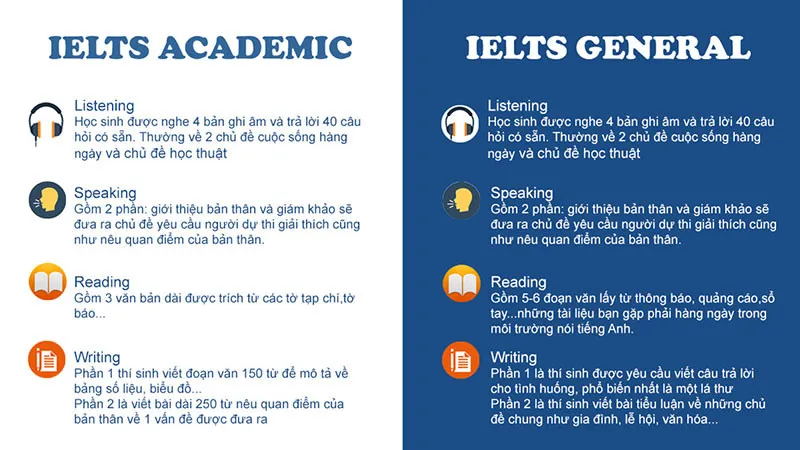
Understanding the test structure is key to effective preparation and entering the exam room with confidence. The IELTS test consists of 4 parts, with a total duration of approximately 2 hours and 45 minutes for the Listening, Reading, and Writing sections. These sections are usually taken consecutively on the same day in the order: Listening → Reading → Writing. The Speaking test may take place on the same day, or a few days before or after the other three sections.
For detailed information on the structure of each section, specific question types, scoring criteria, and in-depth strategies for both Academic and General Training, please refer to ECE’s detailed article: 👉 IELTS Test Structure.
Below is a quick summary of the structural differences between Academic and General:
5. Tips for Choosing the Right IELTS Test
Choosing the right IELTS format is paramount, as it directly impacts your preparation path and goals. Carefully consider the following factors:
5.1. Clearly define your purpose for taking IELTS
- Undergraduate/Postgraduate study: Nearly 100% of universities require IELTS Academic.
- Secondary school/vocational training, work, or immigration: Usually requires IELTS General Training.
- UK Visa application: May require IELTS for UKVI (Academic or General version), depending on the visa type and level of study/work.
5.2. Check specific requirements from institutions/universities/immigration authorities
- Never guess! Always visit the official website of the university, professional body, or immigration authority you are targeting. They will clearly state which IELTS format is accepted (Academic or General Training) and the minimum score required for each skill and overall.
- Example: Some universities may accept General Training for short-term courses or exchange programs, but the vast majority require Academic.
5.3. Consult with experts or teachers
If you are still unsure whether to choose IELTS Academic or IELTS General Training, don’t hesitate to seek advice:
- Study abroad consultants: They have experience with the requirements of many schools and countries.
- Experienced IELTS teachers: They can assess your level and goals to provide appropriate advice.
- Contact a reputable English center directly: Centers like ECE often have a team of experienced teachers and consultants to support you.
Conclusion
Understanding the different IELTS formats and choosing the right one is the first strategic step on your journey to conquering this certificate. It helps you orient your preparation correctly and ensures your efforts yield recognized results. Always be proactive in seeking information from official sources and don’t hesitate to ask experts if you have any questions.
We hope this article has provided you with a comprehensive and detailed overview of the IELTS test types. We wish you the right choice and success in achieving your goals!





 Khai giảng Khóa học Hè cực HOT.
Chưa có bình luận nào!