
Tóm Tắt Nội Dung Bài Viết
The topic of Teachers is exceptionally common and universally relevant in the IELTS Speaking test. Everyone has experiences with education, but this very familiarity often creates a trap: most test-takers give rather simple answers, sticking primarily to basic adjectives like “kind,” “friendly,” or “easy to understand.” This makes their delivery blend into the background and makes it very difficult to break through to higher band scores.
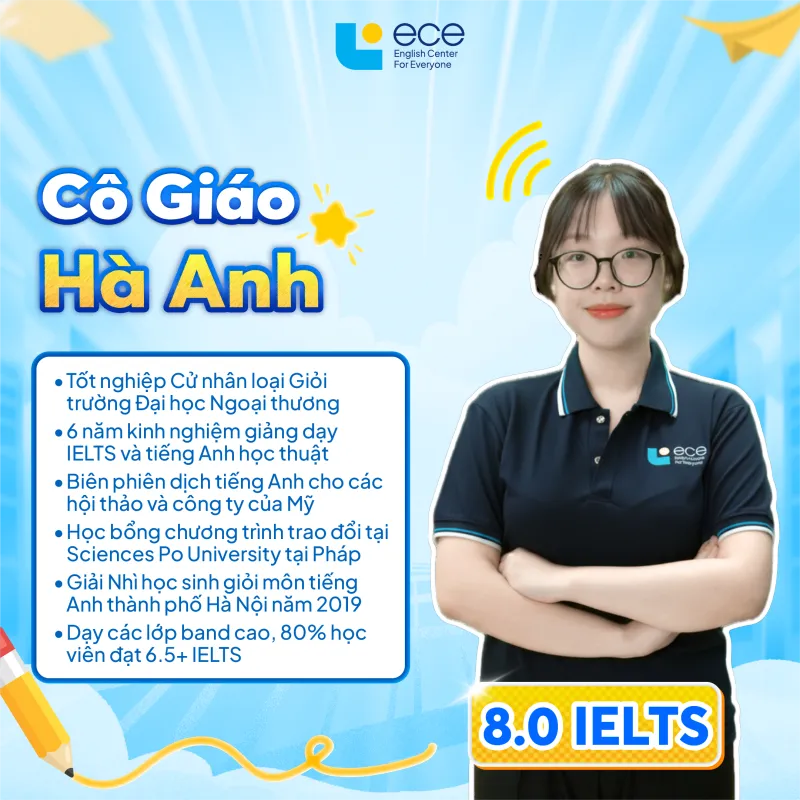
In reality, this is a great topic to showcase your linguistic capability if you know how to expand your answers, use phrases that express profound impact, and weave in personal reflections. In this article, compiled by Ms. Nguyen Ha Anh (an 8.0 IELTS Instructor at ECE), we will dive deep into essential vocabulary, analyze response strategies, and review model answers for all three parts of the test.
Advanced Vocabulary and Structures for the Teacher Topic
To avoid overusing words like “good” or “nice,” you need to equip yourself with a vocabulary bank categorized by specific aspects of a teacher. Below is a summary table of the most high-value collocations.
Roles and Influence of Teachers
Teachers are not only transmitters of knowledge but also mentors who shape mindsets. You can use the following phrases to describe this impact:
| Advanced Collocation | Vietnamese Meaning | Analysis & Context |
| Play a crucial role in shaping students’ mindset | Đóng vai trò quan trọng trong việc định hình tư duy học sinh | Used to emphasize cognitive impact, extending far beyond standard textbooks. |
| Have a profound influence on someone’s development | Có ảnh hưởng sâu sắc đến sự phát triển của ai đó | The word “profound” upgrades your phrasing compared to simply saying “big effect.” |
| Guide students both academically and personally | Hướng dẫn học sinh cả về mặt học thuật lẫn cá nhân | Demonstrates a teacher’s comprehensive care for a student’s life. |
| Act as a source of inspiration | Đóng vai trò là nguồn cảm hứng | Used when describing a teacher who strongly motivates you to pursue your passions. |
Teaching Methods and Styles
Examiners love hearing about this aspect because it requires vocabulary that describes academic activities:
| Advanced Collocation | Vietnamese Meaning | Analysis & Context |
| Adopt an engaging teaching style | Áp dụng một phong cách giảng dạy lôi cuốn | Refers to classes that are interesting, lively, and far from boring. |
| Explain complex ideas in a simple and accessible way | Giải thích những ý tưởng phức tạp một cách đơn giản và dễ tiếp cận | Highlights the exceptional communication skills of a great teacher. |
| Encourage independent thinking | Khuyến khích tư duy độc lập | Teachers who don’t just impose knowledge but push students to think for themselves. |
| Create an interactive learning environment | Tạo ra một môi trường học tập tương tác | Unlike passive learning (just listening and copying), students actively participate in discussions. |
Qualities and Personality Traits
When describing personalities, pair adjectives together to give your sentences better rhythm and deeper meaning:
-
Approachable and supportive: Easy to talk to and always ready to help.
-
Patient and understanding: Willing to listen and put themselves in your shoes.
-
Dedicated and passionate: Fully committed and deeply in love with their profession.
-
Strict but fair: Firm yet impartial (a very realistic and highly regarded quality).
Grammar Structures to Boost Fluency and Grammatical Range
Using a variety of sentence structures will make your delivery much smoother. Keep these 4 reflective patterns in mind:
1. What I appreciated most about this teacher was… -> A noun clause structure that adds complexity to your sentence.
2. Looking back, I realise that…
3. He or she not only taught me something but also helped me develop…
4. That experience had a lasting impact on me.
IELTS Speaking Part 1 Sample Answers: Teachers
In Part 1, your goal is to give natural answers of moderate length (around 3–4 sentences) that get straight to the point.
Q1: Do you have a favorite teacher?
“Yes, I do. One teacher who had a particularly strong impact on me was my high school English teacher. What I appreciated most about her was her ability to make even difficult topics easy to understand. At the same time, her enthusiasm made every lesson more engaging, which motivated me to pay more attention and participate actively.”
Detailed Analysis: Instead of saying “I like her because she is good,” the sample uses the structure What I appreciated most about her was… combined with describing a specific impact (motivated me to pay more attention).
Q2: What qualities make a good teacher?
“In my opinion, a good teacher should be both knowledgeable and approachable. It is important for them to have a solid understanding of their subject, but they also need to create a supportive environment where students feel comfortable expressing their ideas. Without that balance, learning can become either too rigid or ineffective.”
Detailed Analysis: The response is clearly divided into two sides: subject expertise (knowledgeable) and pedagogical skills (approachable, supportive environment). Weaving in an implied conditional at the end (Without that balance…) helps demonstrate tight logical thinking.
Q3: Do you think teachers are important?
“Absolutely. Teachers play a crucial role not only in helping students acquire knowledge but also in shaping their attitudes towards learning. A good teacher can inspire confidence, encourage curiosity, and influence students in ways that go far beyond the classroom.”
Detailed Analysis: Asserts importance right away with Absolutely. This section scores top points thanks to the collocation play a crucial role and the parallel listing of actions: inspire confidence, encourage curiosity, influence students.
IELTS Speaking Part 2 Sample Answer: Teachers
Cue Card: Describe a teacher who has influenced you.
You should say:
-
Who this teacher was
-
What subject they taught
-
What their teaching style was like
-
And explain why this teacher had such a profound influence on you.
Detailed Sample Answer:
One teacher who has had a profound influence on me is my high school English teacher, whom I studied with for several years.
What made her stand out was the way she approached teaching. Instead of simply following the textbook, she often encouraged us to think more deeply and express our own opinions. She would ask open-ended questions and allow us to explore different perspectives, which made the lessons far more engaging and intellectually stimulating.
Another aspect I appreciated was her patience. Whenever I struggled with a particular concept, she would take the time to explain it in a simple and accessible way that suited my level of understanding. This made me feel supported rather than pressured, which gradually built my confidence.
Looking back, I realise that she not only helped me improve my English but also changed the way I approach learning in general. She taught me to be more independent, more curious, and more willing to question things instead of simply accepting them.
Because of her influence, I developed a genuine interest in English, which later became an important part of my academic and professional path. I would say her impact has been long-lasting and meaningful.
Highlights of the Part 2 Sample:
The speech is structured exceptionally coherently in a logical progression: General introduction -> Standout teaching methods (not following the textbook, intellectually stimulating) -> Personal qualities (patience, feeling supported) -> Reflection on long-term impact (changed the way I approach learning). The length and depth of this response fully meet the criteria for a Band 8.0+ performance.
IELTS Speaking Part 3 Sample Answers: Teachers
Part 3 requires candidates to generalize issues and discuss trends in education, technology, and society.
Q1: How has the role of teachers changed in recent years?
“The role of teachers has changed significantly. In the past, they were mainly seen as the primary source of knowledge, and students depended heavily on them. Nowadays, with access to information becoming much easier, teachers are no longer just providers of knowledge. Instead, they act more as guides who help students develop critical thinking skills and learn how to use information effectively.”
Q2: Do you think technology will replace teachers in the future?
“I do not think technology will completely replace teachers. While it can support learning by providing access to a wide range of resources, it cannot replace human interaction. Teachers play an important role in motivating students, providing emotional support, and adapting lessons based on individual needs. These are aspects that technology cannot fully replicate.”
Q3: What challenges do teachers face nowadays?
“Teachers today face several challenges. One of the main issues is the increasing workload, as they are expected to handle both teaching and administrative tasks. In addition, they need to deal with students who have different learning styles and levels of motivation, which requires a great deal of flexibility. Keeping up with technological changes is also demanding, as teachers need to constantly adapt their methods.”
Q4: Should teachers be strict or friendly?
“I think an effective teacher should strike a balance between being strict but fair and being friendly. If they are too strict, students may feel uncomfortable and less willing to participate. On the other hand, if they are too relaxed, it may lead to a lack of discipline. A balanced approach helps create an interactive learning environment that is both structured and supportive.”
In short, the topic of teachers offers a fantastic opportunity for candidates to showcase profound linguistic thinking and personal perspectives on education. By replacing monotonous descriptive adjectives with advanced vocabulary concerning pedagogical methods and reflective phrasing, you will easily conquer the Lexical Resource criterion. Practice regularly with Ms. Ha Anh’s structures to develop the best reflexes in the exam room.





 Khai giảng Khóa học Hè cực HOT.
Chưa có bình luận nào!