


Tóm Tắt Nội Dung Bài Viết
Access to clean water remains one of the greatest challenges for developing nations. The IELTS reading passage “Water Filter” introduces an ingenious and practical invention that uses incredibly simple materials to address this issue. This is a classic reading passage that tests multiple skills simultaneously, including flow chart completion, T/F/NG, and multiple-choice questions. In this article, ECE English provides an in-depth analysis of the entire passage, offering detailed explanations for the answers and a summary of key vocabulary to help you confidently conquer similar question types.
Detailed Reading Passage and Questions: Water Filter
Reading Passage Content
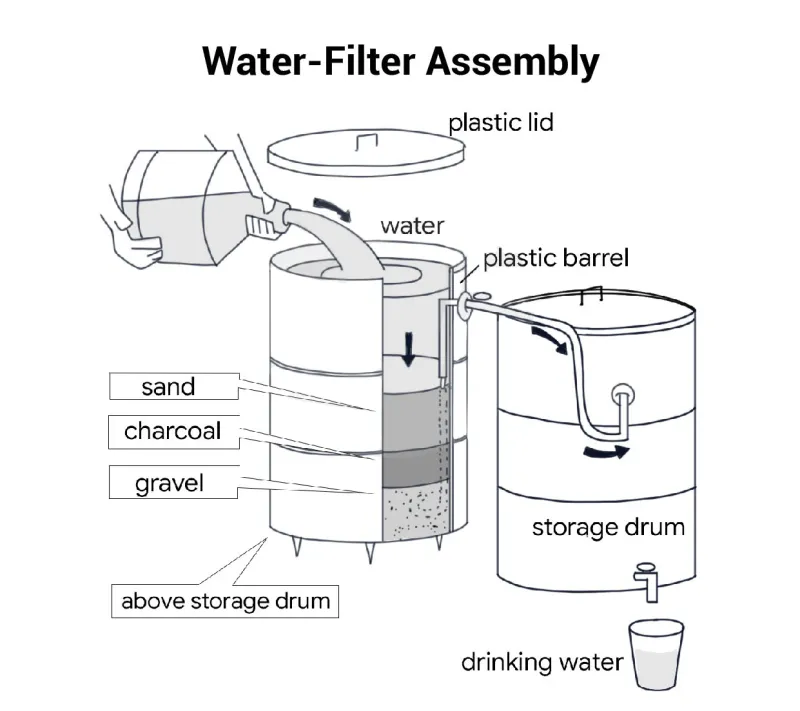
(A) An ingenious invention is set to bring clean water to the third world, and while the science may be cutting edge, the materials are extremely down to earth. A handful of clay, yesterday’s coffee grounds and some cow manure are the ingredients that could bring clean, safe drinking water to much of the third world.
(B) The simple new technology, developed by ANU materials scientist Mr. Tony Flynn, allows water filters to be made from commonly available materials and fired on the ground using cow manure as the source of heat, without the need for a kiln. The filters have been tested and shown to remove common pathogens (disease-producing organisms) including E-coli. Unlike other water filtering devices, the filters are simple and inexpensive to make.
(C) The production of the filters is extremely simple. Take a handful of dry, crushed clay, mix it with a handful of organic material, such as used tea leaves, coffee grounds or rice hulls, add enough water to make a stiff biscuit-like mixture and form a cylindrical pot… then dry it in the sun. … Next, surround the pots with straw; put them in a mound of cow manure, light the straw and then top up the burning manure as required. In less than 60 minutes the filters are finished. The walls of the finished pot should be about as thick as an adult’s index. The properties of cow manure are vital as the fuel can reach a temperature of 700 degrees in half an hour and will be up to 950 degrees after another 20 to 30 minutes.
(D) “A potter’s kiln is an expensive item and can could take up to four or five hours to get up to 800 degrees. It needs expensive or scarce fuel… With no technology, no insulation and nothing other than a pile of cow manure and a match, none of these restrictions apply,” Mr. Flynn says.
(E) It is also helpful that, like terracotta clay and organic material, cow dung is freely available across the developing world… the porosity of clay is something that potters have known about for years… The difference is that rather than viewing the porous nature of the material as a problem… his filters capitalize on this property.
(F) Other commercial ceramic filters do exist, but, even if available, with prices starting at US$5 each, they are often outside the budgets of most people in the developing world. The filtration process is simple, but effective. The basic principle is that there are passages through the filter that are wide enough for water droplets to pass through, but too narrow for pathogens. Tests with the deadly E-coli bacterium have seen the filters remove 96.4 to 99.8 per cent of the pathogen — well within safe levels.
(G) The invention was born out of a World Vision project involving the Manatuto community in East Timor. The charity wanted to help set up a small industry manufacturing water filters, but initial research found the local clay to be too fine — a problem solved by the addition of organic material. While the problems of producing a working ceramic filter in East Timor were overcome, the solution was kiln-based and particular to that community’s materials and couldn’t be applied elsewhere. Manure firing, with no requirement for a kiln, has made this zero technology approach available anywhere it is needed. With all the components being widely available, Mr. Flynn says there is no reason the technology couldn’t be applied throughout the developing world, and with no plans to patent his idea, there will be no legal obstacles to it being adopted in any community that needs it. “Everyone has a right to clean water…” says Mr. Flynn.
Questions
Questions 14-19 (Flow Chart Completion) Complete the flow chart, using NO MORE THAN TWO WORDS from the Reading Passage for each answer.
Guide to Making Water Filters
- Step one: combination of 14………..and organic material, with sufficient 15……….to create a thick mixture -> sun dried
- Step two: pack 16……….around the cylinders -> place them in 17………..which is used as burning fuel for firing (maximum temperature: 18………..) -> filter being baked in under 19……….
Questions 20-23 (True/False/Not Given)
20. It takes half an hour for the manure to reach 950 degrees.
21. Clay was initially found to be unsuitable for pot making.
22. Coffee grounds are twice as effective as other materials.
23. E-coli is the most difficult bacteria to combat.
Questions 24-26 (Multiple Choice)
24. When making the pot, the thickness of the wall
A. is large enough to let the pathogens to pass.
B. varied according to the temperature of the fuel.
C. should be the same as an adult’s forefinger.
D. is not mentioned by Mr. Flynn.
25. What is true about the charity, it
A. failed in searching the appropriate materials.
B. successfully manufactured a kiln based ceramic filter to be sold worldwide.
C. found that the local clay was good enough.
D. intended to help build a local filter production factory.
26. Mr. Flynn’s design is purposely not being patented
A. because he hopes it can be freely used around the world.
B. because he doesn’t think the technology is perfect enough.
C. because there are some legal obstacles.
D. because the design has already been applied thoroughly.
Summary of the “Water Filter” Passage
This passage introduces a breakthrough invention by materials scientist Tony Flynn: a simple, low-cost water filter that can be produced anywhere in the developing world. The invention uses easily accessible materials like clay, coffee grounds, and, notably, dried cow manure as fuel. The production process requires no expensive kiln; instead, the clay filters are fired in a mound of burning cow manure, which can reach very high temperatures.
The filter operates on the principle of porosity, allowing water to pass through while trapping dangerous pathogens like E-coli. This idea originated from a project in East Timor and was developed to be widely applicable. The inventor has no intention of patenting the design, driven by the belief that everyone has a right to clean water.
Key Vocabulary and Structures
- Ingenious (adj): Clever, original, and inventive.
- Down to earth (idiom): Practical and realistic.
- Pathogens (n): Microorganisms that can cause disease.
- Porosity (n): The state of having small holes that allow liquid or air to pass through.
- Capitalize on (v): To take advantage of something to gain an benefit.
- Kiln (n): A furnace or oven for burning, baking, or drying something, especially ceramics.
- Patent (v/n): To obtain a government license for an invention / The license itself.
- Legal obstacles (n. phrase): Legal barriers or difficulties.
Suggested Answers and Detailed Explanations
Questions 14-19
14. clay
- Evidence (Paragraph C): “Take a handful of dry, crushed clay, mix it with a handful of organic material…”
- Explanation: The first step is the combination of “clay” and organic material.
15. water
- Evidence (Paragraph C): “…add enough water to make a stiff biscuit-like mixture…”
- Explanation: Enough “water” is needed to create a stiff mixture.
16. straw
- Evidence (Paragraph C): “Next, surround the pots with straw…”
- Explanation: The next step is to pack “straw” around the cylinders.
17. cow manure
- Evidence (Paragraph C): “…put them in a mound of cow manure…”
- Explanation: The pots are placed in “cow manure” to be fired.
18. 950 degrees
- Evidence (Paragraph C): “…and will be up to 950 degrees after another 20 to 30 minutes.”
- Explanation: This is the maximum temperature the fuel can reach.
19. 60 minutes
- Evidence (Paragraph C): “In less than 60 minutes the filters are finished.”
- Explanation: The firing and completion process takes less than 60 minutes.
Questions 20-23
20. FALSE
- Evidence (Paragraph C): “…can reach a temperature of 700 degrees in half an hour and will be up to 950 degrees after another 20 to 30 minutes.”
- Explanation: The manure takes half an hour to reach 700 degrees, and another 20-30 minutes to reach 950 degrees. Therefore, it is false to say it reaches 950 degrees in half an hour.
21. TRUE
- Evidence (Paragraph G): “…initial research found the local clay to be too fine — a problem solved by the addition of organic material.”
- Explanation: Initially, the local clay was found to be “too fine,” meaning it was unsuitable for the intended purpose.
22. NOT GIVEN
- Evidence (Paragraph C): “According to Mr. Flynn, used coffee grounds have given the best results to date.”
- Explanation: The passage states coffee grounds give the best results, but it does not quantify them as being “twice as effective” as other materials.
23. NOT GIVEN
- Evidence (Paragraph F): “Tests with the deadly E-coli bacterium have seen the filters remove 96.4 to 99.8 per cent of the pathogen…”
- Explanation: The passage uses E-coli as an example of a dangerous bacterium the filter can handle, but it does not state that it is the “most difficult” to combat.
Questions 24-26
24. C. should be the same as an adult’s forefinger.
- Evidence (Paragraph C): “The walls of the finished pot should be about as thick as an adult’s index.”
- Explanation: “Index” refers to the index finger (forefinger).
25. D. intended to help build a local filter production factory.
- Evidence (Paragraph G): “The charity wanted to help set up a small industry manufacturing water filters…”
- Explanation: Setting up a “small industry manufacturing water filters” is synonymous with building a local production factory.
26. A. because he hopes it can be freely used around the world.
- Evidence (Paragraph G): “…with no plans to patent his idea, there will be no legal obstacles to it being adopted in any community that needs it.”
- Explanation: The lack of a patent ensures there are no legal barriers, allowing the technology to be adopted freely wherever it is needed.
Conclusion
The “Water Filter” passage is an excellent example of how IELTS utilizes real-world topics in science and social innovation. By analyzing this passage, we have practiced three essential question types: flow chart completion, True/False/Not Given, and multiple choice. The key takeaway is to always read the word limit requirements carefully and pay attention to small details in the text to verify information. We hope that with these detailed analyses from ECE, you will feel more confident when facing similar reading passages.
You may also want to check out the answers for other IELTS Reading tests:
Flying Tortoises IELTS Reading
Fatal Attraction IELTS Reading




 Khai giảng Khóa học Hè cực HOT.
No comments yet!