


Tóm Tắt Nội Dung Bài Viết
The reading passage “The Cane Toad in Australia” is a classic IELTS Reading text that chronicles the story of the cane toad—an invasive species that has caused severe environmental damage across Australia. In this article, the ECE language center provides a detailed analysis of the toad, from its biological characteristics to its ecological impact, while offering effective strategies for tackling the associated question types. Let’s dive in!
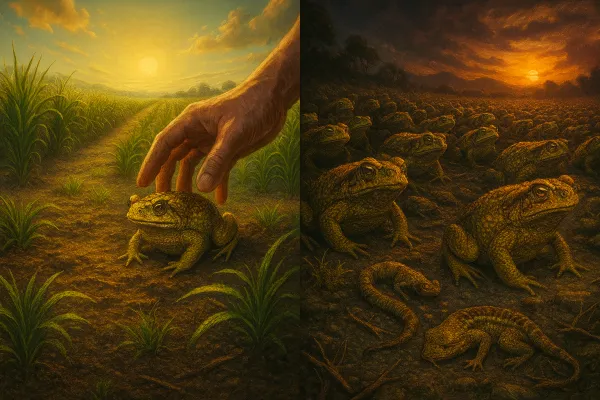
The Cane Toad in Australia
Paragraph A
The cane toad was introduced into Australia in 1935 to control sugar cane pests in Queensland. One hundred and one cane toads arrived at Edmonton in June 1935. Breeding occurred almost immediately. The cane toad is tough and adaptable, as well as being poisonous throughout its life cycle, and has few predators in Australia.
Paragraph B
Cane toads are large, heavily-built amphibians with dry, warty skin. They have a bony head and, over their eyes, bony ridges that meet above the nose. They sit upright and move in short, rapid hops. Their hind feet have leathery webbing between the toes, and their front feet are unwebbed. Adult cane toads have large swellings—the parotoid glands—on each shoulder behind the eardrum. Cane toads may be grey, yellowish, olive-brown, or reddish-brown, and their bellies are pale with dark mottling. Average-sized adults are ten to fifteen centimetres long. The largest female measured in Queensland was twenty-four centimetres long and weighed 1.3 kilograms. Male cane toads are smaller and wartier than females. During the breeding season, males develop dark lumps (nuptial pads) on their first two fingers; these help them cling to a female while mating. Their mating call is a long, loud, purring trill. Cane toad spawn is unique in Australia. It is laid in long strings of transparent jelly enclosing double rows of black eggs. The spawn tangles in dense, dark masses around water plants and hangs in ropy strands if picked up.
Paragraph C
The natural range of cane toads extends from the southern United States to tropical South America. In 2002, cane toads occurred throughout the eastern and northern half of Queensland and have extended their range to the river catchments surrounding Kakadu National Park in the Northern Territory. In New South Wales, they occur as far south as Yamba and Port Macquarie.
Paragraph D
Cane toads tolerate a broad range of environmental and climatic conditions and appear to be able to adjust and survive in almost any environmental system, including seawater for short periods of time. This, to a large extent, explains their success in spreading across Australia. Cane toads are found in environments ranging from sand dunes and coastal heath to the margins of rainforests and mangroves. They are most abundant in open clearings in urban areas, and in grasslands and woodlands.
Paragraph E
Cane toads eat almost anything they can swallow, including pet food, carrion, and household scraps, but most of their food consists of living insects. Beetles, honey bees, ants, winged termites, crickets, and bugs are eaten in abundance. Marine snails, smaller toads and native frogs, small snakes, and small mammals are occasionally eaten by cane toads. The tadpoles of cane toads eat algae and other aquatic plants, which they rasp off with five rows of tiny, peg-like teeth. They also filter organic matter from the water. Large tadpoles sometimes eat cane toad eggs.
Paragraph F
Cane toads were introduced to Australia to eat the French’s Cane Beetle and the Greyback Cane Beetle. The white-grub larvae of these beetles eat the roots of sugar cane and kill or stunt the plants. The Australian Bureau of Sugar Experimental Stations imported about a hundred toads from Hawaii to the Meringa Experimental Station near Cairns. The toads bred quickly, and more than three thousand were released in the sugar cane plantations of north Queensland in July 1935. At that time, some naturalists and scientists warned of the dangers of liberating cane toads in Australia. Their protests resulted in a brief moratorium on the release of toads, but releases resumed in 1936. The protestors were right. Firstly, cane toads compete for the resources of native animals, such as food, which affects native populations. Secondly, cane toads do not have as many established predators as native animals, so their population grows quickly. Finally, some native animals that would normally feed on frogs try to eat toads and get poisoned.
Paragraph G
All stages of the cane toad’s life cycle are poisonous. No humans have died in Australia from cane toad poison, but overseas, people have died after eating toads and even soup made from boiled toad eggs. Cane toads are also poisonous to pets. In Hawaii, up to fifty dogs a year have died after having cane toads in their mouths. Signs of dogs being poisoned through ingestion include profuse salivation, twitching, vomiting, shallow breathing, and collapse of the hind limbs. Death may occur by cardiac arrest within fifteen minutes. A cane toad responds to a threat by turning side-on so its parotoid glands are directed towards the attacker. The poison usually oozes out of the glands, but toads can squirt a fine spray for a short distance if they want. The poison is absorbed through mucous membranes such as the eyes, mouth, and nose, and in humans, it may cause intense pain, temporary blindness, and inflammation.
Questions 1 – 6
The reading passage The Cane Toad in Australia has paragraphs (A – G).
From the list of headings below (i – X) choose the most suitable headings for paragraphs B – G.
Write the appropriate number (i – X) in boxes 1-6 on your answer sheet.
NB There are more headings than paragraphs, so you will not use them all.
| Example | Answer |
| Paragraph A | v |
| i | Diet |
| ii | Habitat |
| iii | Pollution Effects |
| iv | Danger |
| V | Arrival In Australia |
| Vi | Food for Snakes |
| vii | Identification |
| viii | Captivity |
| ix | Distribution |
| x | Environmental Impacts |
| 1 | Paragraph B |
| 2 | Paragraph C |
| 3 | Paragraph D |
| 4 | Paragraph E |
| 5 | Paragraph F |
| 6 | Paragraph G |
Questions 7-10
Reading Passage The Cane Toad in Australia has 7 paragraphs (A – G). Which paragraphs offer information on the following ideas? Write the appropriate letters (A – G) in boxes 7-10 on your answer sheet.
7 Male cane toads grow protuberances during mating periods.
8 The cane toad’s unique way of laying eggs in Australia.
9 Opposition to the introduction of cane toads in Australia.
10 The danger of eating cane toad eggs.
Questions 11-13
Complete each of the following statements (Questions 11-13) with words taken from the box below.
Write your answers in boxes 38 – 40 on your answer sheet.
11. When suspended, the eggs of the cane toad resemble 11
12. Cane toads were introduced into Australia in order to stop beetle young eating sugar cane 12
13. The text says that dogs affected by cane toad poisoning may have problems with 13
| flowers | hearing | hair | walking |
| leaves | roots | smelling | tadpoles |
| stalks | rope | seeds | sleeping |
Overview of the Reading Passage
The reading passage “The Cane Toad in Australia” tells a complex and unfortunate scientific story about human intervention in an ecosystem.
- Paragraph A introduces the reasons for and the timing of the cane toad’s introduction to Australia (1935) to control sugar cane pests, along with their adaptability and toxicity.
- Paragraph B provides a detailed description of the cane toad’s appearance and identifying features, including size, color, poison glands, and reproductive habits.
- Paragraph C discusses the natural distribution range of the cane toad (from the US to South America) and their rapid spread across Australia.
- Paragraph D explains the cane toad’s incredible ability to adapt to various environments and climatic conditions, from deserts to mangroves, which explains their success.
- Paragraph E outlines the diverse diet of the cane toad, ranging from insects and small animals to human food scraps.
- Paragraph F delves into the initial motivation for introducing the cane toad, the warnings from scientists, and the negative impacts they have caused on the native ecosystem.
- Paragraph G focuses on the toxicity of the cane toad, the level of danger to animals and humans, and the symptoms of poisoning.
Useful Vocabulary & Structures in The Cane Toad in Australia
Suggested Answers and Detailed Explanations
a. Task: Matching Headings
- Question 1 (Paragraph B):
Analysis: Paragraph B describes the physical appearance, color, and body structure of the cane toad in detail. These are identifying features.
Answer: vii. Identification.
- Question 2 (Paragraph C):
Analysis: Paragraph C discusses the natural range and the spread of the cane toad in Australia.
Answer: ix. Distribution.
- Question 3 (Paragraph D):
Analysis: Paragraph D explains the cane toad’s ability to adapt and survive in various environments.
Answer: ii. Habitat.
- Question 4 (Paragraph E):
Analysis: Paragraph E lists the types of food consumed by cane toads, from insects to small animals.
Answer: i. Diet.
- Question 5 (Paragraph F):
Analysis: Paragraph F presents the original purpose of the introduction and the negative impacts on the environment.
Answer: x. Environmental Impacts.
- Question 6 (Paragraph G):
Analysis: Paragraph G discusses the toxicity of the cane toad, the danger to humans and pets, and symptoms of poisoning.
Answer: iv. Danger.
b. Task: Matching Paragraphs
- Question 7:
Male cane toads grow protuberances during mating periods.
Location: Paragraph B states: “During the breeding season males develop dark lumps (nuptial pads) on their first two fingers…”
Answer: B.
- Question 8:
The cane toad's unique way of laying eggs in Australia.
Location: Paragraph B states: “Cane toad spawn is exclusive in Australia. It is laid in long strings of transparent jelly…”
Answer: B.
- Question 9:
Opposition to the introduction of cane toads in Australia.
Location: Paragraph F states: “…some naturalists and scientists warned of the dangers of liberating cane toads in Australia. Their protests resulted in a brief moratorium…”
Answer: F.
- Question 10:
The danger of eating cane toad eggs.
Location: Paragraph G states: “…overseas, people have died after eating toads and even soup made from boiled toad eggs.”
Answer: G.
c. Task: Sentence Completion
- Question 11:
When suspended, the eggs of the cane toad resemble 11
Location: Paragraph B states: “The spawn tangles in dense dark masses around water plants, and hangs in ropy strands if picked up.”
Answer: rope.
- Question 12:
Cane toads were introduced into Australia in order to stop beetle young eating sugar cane 12
Location: Paragraph F states: “The white-grub larvae of these beetles eat the roots of sugar cane and kill or stunt the plants.”
Answer: roots.
- Question 13:
The text says that dogs affected by cane toad poisoning may have problems with 13
Location: Paragraph G states: “Signs of dogs being poisoned through ingestion include profuse salivation, twitching, vomiting, shallow breathing, and collapse of the hind limbs.” The “collapse of the hind limbs” refers to mobility issues.
Answer: walking.
The reading passage “The Cane Toad in Australia” is not just an IELTS practice text but a meaningful biological and environmental story. It clearly illustrates the unforeseen consequences of ignorant intervention in an ecosystem. By mastering the structure of the reading passage, identifying technical vocabulary, and applying test-taking skills, you will not only achieve a high score but also broaden your perspective on global environmental issues.
We invite you to check out more IELTS Reading practice tests compiled by ECE:
How stress affects your judgement





 Khai giảng Khóa học Hè cực HOT.
No comments yet!