“The Lost City” is a classic IELTS Reading passage that recounts explorer Hiram Bingham’s discovery of Machu Picchu. This passage tests not only your reading comprehension but also your ability to analyze and compare information across different historical perspectives.
To help you master this passage, this article provides a summary, a breakdown of high-scoring vocabulary and structures, and a detailed answer key with explanations for every question.
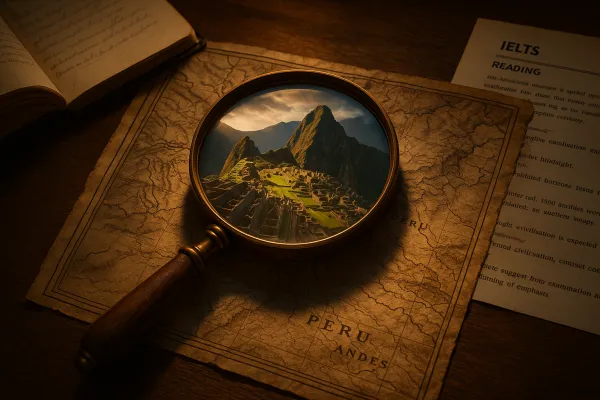
An explorer’s encounter with the ruined city of Machu Picchu, the most famous icon of the Inca civilisation
A
When the US explorer and academic Hiram Bingham arrived in South America in 1911, he was ready for what was to be the greatest achievement of his life: the exploration of the remote hinterland to the west of Cusco, the old capital of the Inca empire in the Andes mountains of Peru. His goal was to locate the remains of a city called Vitcos, the last capital of the Inca civilisation.
Cusco lies on a high plateau at an elevation of more than 3,000 metres, and Bingham’s plan was to descend from this plateau along the valley of the Urubamba river, which takes a circuitous route down to the Amazon and passes through an area of dramatic canyons and mountain ranges.
B
When Bingham and his team set off down the Urubamba in late July, they had an advantage over travellers who had preceded them: a track had recently been blasted down the valley canyon to enable rubber to be brought up by mules from the jungle. Almost all previous travellers had left the river at Ollantaytambo and taken a high pass across the mountains to rejoin the river lower down, thereby cutting a substantial corner, but also therefore never passing through the area around Machu Picchu.
C
On 24 July they were a few days into their descent of the valley. The day began slowly, with Bingham trying to arrange sufficient mules for the next stage of the trek. His companions showed no interest in accompanying him up the nearby hill to see some ruins that a local farmer, Melchor Arteaga, had told them about the night before. The morning was dull and damp, and Bingham also seems to have been less than keen on the prospect of climbing the hill. In his book Lost City of the Incas, he relates that he made the ascent without having the least expectation that he would find anything at the top.
D
Bingham writes about the approach in vivid style in his book. First, as he climbs up the hill, he describes the ever-present possibility of deadly snakes, ‘capable of making considerable springs when in pursuit of their prey’; not that he sees any. Then there’s a sense of mounting discovery as he comes across great sweeps of terraces, then a mausoleum, followed by monumental staircases and, finally, the grand ceremonial buildings of Machu Picchu. ‘It seemed like an unbelievable dream the sight held me spellbound ’, he wrote.
E
We should remember, however, that Lost City of the Incas is a work of hindsight, not written until 1948, many years after his journey. His journal entries of the time reveal a much more gradual appreciation of his achievement. He spent the afternoon at the ruins noting down the dimensions of some of the buildings, then descended and rejoined his companions, to whom he seems to have said little about his discovery. At this stage, Bingham didn’t realise the extent or the importance of the site, nor did he realise what use he could make of the discovery.
F
However, soon after returning it occurred to him that he could make a name for himself from this discovery. When he came to write the National Geographic magazine article that broke the story to the world in April 1913, he knew he had to produce a big idea.
He wondered whether it could have been the birthplace of the very first Inca, Manco the Great, and whether it could also have been what chroniclers described as ‘the last city of the Incas’. This term refers to Vilcabamba the settlement where the Incas had fled from Spanish invaders in the 1530s. Bingham made desperate attempts to prove this belief for nearly 40 years. Sadly, his vision of the site as both the beginning and end of the Inca civilisation, while a magnificent one, is inaccurate. We now know, that Vilcabamba actually lies 65 kilometres away in the depths of the jungle.
G
One question that has perplexed visitors, historians and archaeologists alike ever since Bingham, is why the site seems to have been abandoned before the Spanish Conquest. There are no references to it by any of the Spanish chroniclers – and if they had known of its existence so close to Cusco they would certainly have come in search of gold.
An idea which has gained wide acceptance over the past few years is that Machu Picchu was a moya, a country estate built by an Inca emperor to escape the cold winters of Cusco, where the elite could enjoy monumental architecture and spectacular views. Furthermore, the particular architecture of Machu Picchu suggests that it was constructed at the time of the greatest of all the Incas, the emperor Pachacuti (1438-71). By custom, Pachacuti’s descendants built other similar estates for their own use, and so Machu Picchu would have been abandoned after his death, some 50 years before the Spanish Conquest.
Questions 1-7
Reading Passage has seven paragraphs, A-G.
Choose the correct heading for each paragraph from the list of headings below.
Write the correct number, i-viii, in boxes 1-7 on your answer sheet.
List of Headings
i. Different accounts of the same journey
ii. Bingham gains support
iii. A common belief
iv. The aim of the trip
v. A dramatic description
vi. A new route
vii. Bingham publishes his theory
viii. Bingham’s lack of enthusiasm
Question 8 – 11
Do the following statements agree with the information given in the Reading Passage?
In boxes 21-24 on your answer sheet, write
TRUE if the statement agrees with the information
FALSE if the statement contradicts the information
NOT GIVEN if there is no information on this
Questions 12-13
Complete the sentences below.
Choose ONE WORD ONLY from the passage for each answer.
Write your answers in boxes 25-26 on your answer sheet.
12. The track that took Bingham down the Urubamba valley had been created for the transportation of
13. Bingham found out about the ruins of Machu Picchu from a in the Urubamba valley.
Overview & Summary
The “The Lost City” passage recounts the story of American explorer Hiram Bingham and his greatest discovery – the city of Machu Picchu.
- Paragraphs A & B: Introduce Bingham’s initial 1911 goal: to find Vitcos, the last capital of the Inca. He chose a new, less-traveled route along the Urubamba river valley, a decision that inadvertently led him to the area of Machu Picchu.
- Paragraphs C & D: Describe the moment of discovery. Initially, Bingham was neither enthusiastic nor expectant when climbing the hill based on a local farmer’s tip. However, he was overwhelmed and spellbound by the grandeur of the terraces, temples, and architecture at Machu Picchu, which he described dramatically in his book.
- Paragraphs E & F: Compare two versions of the story. His book, “Lost City of the Incas,” was written years later with the perspective of someone who realized the magnitude of his discovery. In contrast, his journals from the time show he did not fully grasp the site’s importance. Later, seeking to make a name for himself, he attempted to prove it was Vilcabamba – the “last city of the Incas,” a theory we now know is incorrect.
- Paragraph G: Presents the most widely accepted modern theory about Machu Picchu. Historians believe it was not a typical city but a royal estate (moya) built by the Inca emperor Pachacuti to escape the cold winters of Cusco. After his death, the site was abandoned, which explains why there are no records of it from the Spanish invaders.
Key Vocabulary & Structures
1. Vocabulary
- Civilisation (n): A complex human society.
- Hinterland (n): Remote or less developed areas.
- Descend (v): To move downwards.
- Circuitous (adj): Longer than the most direct way.
- Preceded (v): To come before in time.
- Prospect (n): The possibility or likelihood of some future event.
- Ascent (n): A climb or walk to the summit of a mountain or hill.
- Vivid (adj): Producing powerful feelings or strong, clear images.
- Mausoleum (n): A building housing a tomb or tombs.
- Monumental (adj): Great in importance, extent, or size.
- Spellbound (adj): Having one’s attention held as if by a spell.
- Hindsight (n): Understanding of a situation or event only after it has happened.
- Appreciation (n): Recognition and enjoyment of the good qualities of someone or something.
- Chroniclers (n): People who write accounts of important or historical events.
- Perplexed (adj): Completely baffled; very puzzled.
- Conquest (n): The subjugation and assumption of control of a place or people.
- Estate (n): An extensive area of land in the country.
- Elite (n): A select group that is superior in terms of ability or qualities.
2. Structures
- His goal was to locate the remains of…: A simple, effective structure for stating an objective.
Example: His goal was to locate the remains of a city called Vitcos.
- thereby cutting a substantial corner: Using “thereby + V-ing” to indicate the result of a previous action.
Example: …taken a high pass across the mountains…, thereby cutting a substantial corner.
- without having the least expectation that…: A structure used to emphasize a complete lack of expectation.
Example: …he made the ascent without having the least expectation that he would find anything at the top.
- not that he sees any: A casual way to add information or a disclaimer.
Example: …the ever-present possibility of deadly snakes…; not that he sees any.
- nor did he realise…: Inversion with “nor” to emphasize a negative point.
Example: Bingham didn’t realise the extent or the importance of the site, nor did he realise what use he could make of the discovery.
Answer Key & Detailed Explanations
Questions 1-7: Matching Headings
- 1. Paragraph A: iv – The aim of the trip
Explanation: Paragraph A clearly states Bingham’s goal: “His goal was to locate the remains of a city called Vitcos, the last capital of the Inca civilisation.”
- 2. Paragraph B: vi – A new route
Explanation: Paragraph B describes the route Bingham took, which differed from previous travelers: “Almost all previous travellers had left the river at Ollantaytambo and taken a high pass… but also therefore never passing through the area around Machu Picchu.”
- 3. Paragraph C: viii – Bingham’s lack of enthusiasm
Explanation: Paragraph C shows Bingham’s initial lack of interest: “The morning was dull and damp, and Bingham also seems to have been less than keen on the prospect of climbing the hill.”
- 4. Paragraph D: v – A dramatic description
Explanation: Paragraph D describes Bingham’s vivid writing style in his book: “Bingham writes about the approach in vivid style in his book.”
- 5. Paragraph E: i – Different accounts of the same journey
Explanation: Paragraph E compares his later book with his contemporary journals: “Lost City of the Incas is a work of hindsight… His journal entries of the time reveal a much more gradual appreciation of his achievement.”
- 6. Paragraph F: vii – Bingham publishes his theory
Explanation: Paragraph F discusses Bingham publishing his theory to build his reputation: “He wondered whether it could have been the birthplace of the very first Inca… Bingham made desperate attempts to prove this belief…”
- 7. Paragraph G: iii – A common belief
Explanation: Paragraph G presents a widely accepted modern theory: “An idea which has gained wide acceptance over the past few years is that Machu Picchu was a moya, a country estate…”
Questions 8-11: True / False / Not Given
- 8. TRUE: Bingham went to South America in search of an Inca city.
Explanation: Paragraph A confirms his goal was “to locate the remains of a city called Vitcos, the last capital of the Inca civilisation.”
- 9. FALSE: Bingham chose a particular route down the Urubamba valley because it was the most common route used by travelers.
Explanation: Paragraph B states his route was new, contrary to the common one: “Almost all previous travellers had… taken a high pass…, thereby never passing through the area around Machu Picchu.”
- 10. FALSE: Bingham understood the significance of Machu Picchu as soon as he saw it.
Explanation: Paragraph E indicates he did not realize it immediately: “At this stage, Bingham didn’t realise the extent or the importance of the site…”
- 11. NOT GIVEN: Bingham returned to Machu Picchu in order to find evidence to support his theory.
Explanation: Paragraph F says Bingham tried to prove his theory for 40 years, but there is no information stating he returned to Machu Picchu to find evidence.
Questions 12-13: Sentence Completion
- 12. rubber
Location: Paragraph B.
Explanation: “a track had recently been blasted down the valley canyon to enable rubber to be brought up by mules from the jungle.”
- 13. farmer
Location: Paragraph C.
Explanation: “…some ruins that a local farmer…”
By analyzing “The Lost City,” we learn an important lesson: information in a reading passage is not always the final truth. This passage teaches us to follow a story through multiple lenses: from the initial discovery and the attempt to prove a theory, to the understanding of modern historians. This is a core skill for IELTS Reading – not just reading for data, but reading to understand context and perspective. Apply this analytical method to other passages, and you will see your ability to process complex information improve significantly.


No comments yet!