
Tóm Tắt Nội Dung Bài Viết
Diagram Completion is a familiar question type in IELTS Reading that requires candidates to possess both reading comprehension skills and the ability to accurately identify and summarize information. The “The Boeing 787” passage is a classic example of this task. In today’s article, ECE will provide a detailed analysis of the passage, along with the answers, thorough explanations, and a summary of key vocabulary to help you confidently master this question type.
Reading Passage and Questions: The Boeing 787
Reading Passage: The Boeing 787
The Boeing 787 ‘Dreamliner’ has been described as the airliner of the future. We look at the technology that makes it different.
Until now, airliner fuselages have been made of aluminium sheets. Large aircraft can have 1,500 of these sheets with between 40,000 and 50,000 metal fasteners. The 787 is the first airliner to be built with a one-piece fuselage made from a special material called ‘composite’. Not only does this make the airliner quicker and easier to build, but it also makes it a lot lighter.
The advantage of this weight reduction is that the 787 uses 20 percent less fuel than other airliners of a similar size, which makes it much more environmentally friendly. The reduced weight also means that the Boeing 787 can fly further than many other airliners of a similar size, carrying 210 passengers or more up to 15,200 kilometres before refuelling.
Sometimes an airliner needs to change from one type of engine to another. This is a difficult and time-consuming process. The 787 has a revolutionary engine attachment on the wing which means that the engines can be changed in a much shorter time. The case containing the engine is also different from those on other airliners. It has been designed to cut down the noise from the engine, making it less noisy for passengers in the cabin as well as for people on the ground.
In addition to a quieter cabin, passengers will also benefit from windows which are 65 percent larger than those on other airliners, giving them a much better view of the world passing by below them. The windows also have a unique facility which allows passengers or cabin crew to control the amount of light that enters them. This is thanks to a liquid in the window which reacts to an electric current. When a passenger or cabin crew member presses a button, the current causes a chemical reaction in the window which darkens the liquid.
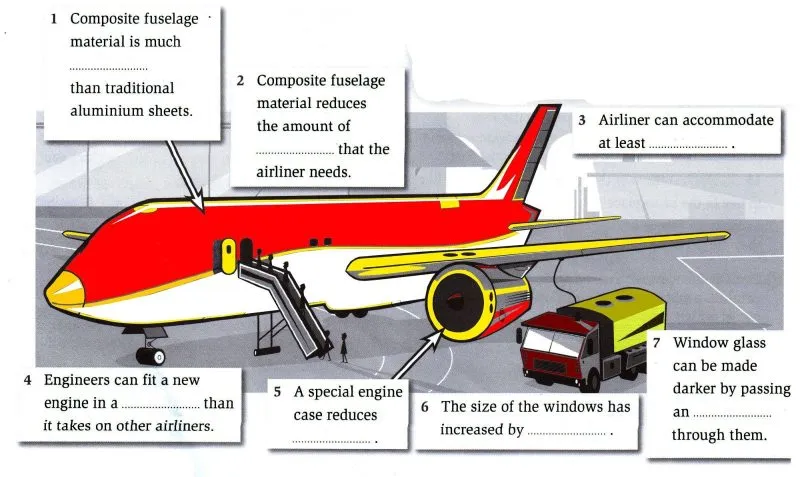
Questions: Complete labels (1-7) on the diagram. Choose NO MORE THAN TWO WORDS AND/OR A NUMBER from the passage for each answer.
- Composite fuselage material is much __________ than traditional aluminium sheets.
- Composite fuselage material reduces the amount of __________ that the airliner needs.
- Airliner can accommodate at least __________.
- Engineers can fit a new engine in a __________ than it takes on other airliners.
- A special engine case reduces __________.
- The size of the windows has increased by __________.
- Window glass can be made darker by passing an __________ through them.
Passage Summary
This passage describes the breakthrough technologies of the Boeing 787, dubbed the “airliner of the future.” Key points include:
- Fuselage material: Instead of traditional aluminium sheets, the Boeing 787 uses a one-piece “composite” material, making the aircraft significantly lighter.
- Fuel efficiency and range: The weight reduction allows the 787 to use 20% less fuel, making it more environmentally friendly and capable of flying further with a capacity of 210 passengers or more.
- Engine technology: The 787’s engines can be replaced in a much shorter time compared to other aircraft. The engine casing is also specially designed to reduce noise.
- Passenger comfort: Passengers on the Boeing 787 benefit from a quieter cabin, windows that are 65% larger, and the ability to adjust light levels using an electric current.
Key Vocabulary and Structures
- Fuselage (noun): The main body of an aircraft.
- Example: “Until now, airliner fuselages have been made of aluminium sheets.”
- Composite (noun/adjective): A material made from two or more constituent materials with significantly different physical or chemical properties.
- Example: “…a special material called ‘composite‘.”
- Weight reduction (noun phrase): The process of making something lighter.
- Example: “The advantage of this weight reduction is that the 787 uses 20 percent less fuel…”
- Environmentally friendly (adjective): Not harmful to the environment.
- Example: “…which makes it much more environmentally friendly.”
- Revolutionary (adjective): Involving or causing a complete or dramatic change.
- Example: “The 787 has a revolutionary engine attachment on the wing…”
- Cut down (phrasal verb): To reduce the size, amount, or quantity of something.
- Example: “It has been designed to cut down the noise from the engine…”
- Cabin crew (noun phrase): The members of an aircraft crew who attend to passengers.
- Example: “…allows passengers or cabin crew to control the amount of light that enters them.”
Answer Key and Detailed Explanations
1. lighter
- Keywords: Composite fuselage material, much… than, traditional aluminium sheets.
- Evidence (Paragraph 2): “…but it also makes it a lot lighter.”
- Explanation: The passage directly compares composite material to traditional materials, stating it is “a lot lighter.” Filling in “lighter” creates the phrase “much lighter,” which fits perfectly grammatically and contextually.
2. fuel
- Keywords: reduces, amount of.
- Evidence (Paragraph 3): “…the 787 uses 20 percent less fuel than other airliners of a similar size…”
- Explanation: Reducing weight allows the aircraft to use less fuel. Therefore, the composite material helps reduce the amount of “fuel” required.
3. 210 passengers
- Keywords: accommodate, at least.
- Evidence (Paragraph 3): “…carrying 210 passengers or more up to 15,200 kilometres…”
- Explanation: “210 passengers or more” means the aircraft can accommodate “at least” 210 passengers.
4. shorter time
- Keywords: fit a new engine, in a … than.
- Evidence (Paragraph 4): “…the engines can be changed in a much shorter time.”
- Explanation: The text states that engines can be changed in a “much shorter time.” This phrase fits the two-word limit.
5. the noise
- Keywords: special engine case, reduces.
- Evidence (Paragraph 4): “It has been designed to cut down the noise from the engine…”
- Explanation: The engine case is designed to “cut down the noise.” “Reduces” is a synonym for “cut down.”
6. 65 percent
- Keywords: size of the windows, increased by.
- Evidence (Paragraph 5): “…passengers will also benefit from windows which are 65 percent larger than those on other airliners…”
- Explanation: The passage explicitly states the windows are 65% larger. “Increased by” is equivalent to “larger than” in this context.
7. electric current
- Keywords: window glass, darker, passing an… through.
- Evidence (Paragraph 5): “…a liquid in the window which reacts to an electric current. When a passenger or cabin crew member presses a button, the current causes a chemical reaction… which darkens the liquid.”
- Explanation: The windows darken due to a chemical reaction triggered by an “electric current.”
Conclusion
We hope this detailed breakdown of the IELTS Reading “The Boeing 787” passage has helped you understand how to approach diagram completion questions. The key to success lies in identifying the correct keywords in the questions, locating the information accurately in the text, and strictly adhering to the word count limits. Keep practicing with other ECE reading materials to master this skill and achieve your target IELTS score!





 Khai giảng Khóa học Hè cực HOT.
Chưa có bình luận nào!