


Tóm Tắt Nội Dung Bài Viết
When night falls, instead of surrendering to the natural darkness of the moon and stars, we immerse ourselves in a sea of artificial light. What we perceive as progress and safety is actually creating a “silent enemy”: light pollution. The IELTS reading passage “Light Pollution” not only exposes the severity of this issue but also analyzes its devastating impact on the natural world and even on humans themselves. This is a reading passage that demands sharp focus and the ability to grasp fine details.
Let’s join ECE in exploring the key arguments, decoding the question types, and equipping yourself with the vocabulary needed to conquer this challenging text.
Reading Content & Questions
Light pollution
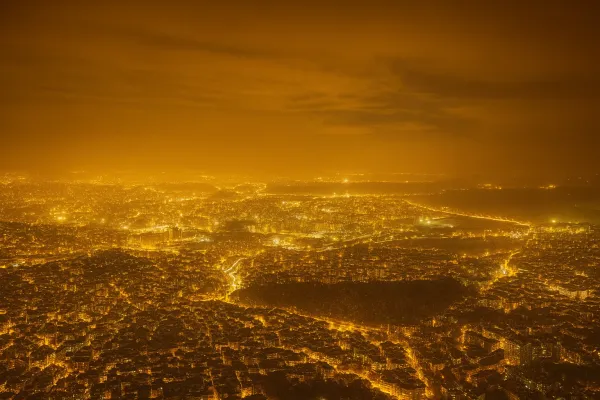
(A) If humans were truly at home under the light of the moon and stars, we would go into darkness happily… Instead, we are diurnal creatures, with eyes adapted to living in the sun’s light. This is a basic evolutionary fact… Yet it’s the only way to explain what we’ve done to the night: We’ve engineered it to receive us by filling it with light.
(B) This kind of engineering is no different than damming a river. Its benefits come with consequences—called light pollution—whose effects scientists are only now beginning to study. Light pollution is largely the result of bad lighting design, which allows artificial light to shine outward and upward into the sky, where it’s not wanted, instead of focusing it downward, where it is. Ill-designed lighting washes out the darkness of night and radically alters the light levels and light rhythms—to which many forms of life, including ourselves, have adapted.
(C) Now most of humanity lives under intersecting domes of reflected, refracted light, of scattering rays from overlit cities and suburbs, from light-flooded highways and factories. Nearly all of nighttime Europe is a nebula of light, as is most of the United States and all of Japan. In the south Atlantic the glow from a single fishing fleet—squid fishermen pursuing their prey with metal halide lamps—can be seen from space, burning brighter, in fact, than Buenos Aires or Rio de Janeiro.
(D) We’ve lit up the night as if it were an unoccupied country when nothing could be further from the truth. Among mammals alone, the number of nocturnal species is astonishing. Light is a powerful biological force, and in many species, it acts as a magnet… The effect is so powerful that scientists speak of songbirds and seabirds being “captured” by searchlights on land or by the light from gas flares on marine oil platforms, circling and circling in the thousands until they drop. Migrating at night, birds are apt to collide with brightly lit tall buildings; immature birds on their first journey suffer disproportionately.
(E) Insects, of course, cluster around streetlights, and feeding at those insect clusters is now ingrained in the lives of many bat species. In some Swiss valleys, the European lesser horseshoe bat began to vanish after streetlights were installed, perhaps because those valleys were suddenly filled with light-feeding pipistrelle bats. Other nocturnal mammals—including desert rodents, fruit bats, opossums, and badgers—forage more cautiously under the permanent full moon of light pollution because they’ve become easier targets for predators.
(F) Some birds—blackbirds and nightingales, among others—sing at unnatural hours in the presence of artificial light. Scientists have determined that long artificial days—and artificially short nights—induce early breeding in a wide range of birds. And because a longer day allows for longer feeding, it can also affect migration schedules. One population of Bewick’s swans wintering in England put on fat more rapidly than usual, priming them to begin their Siberian migration early. The problem, of course, is that migration, like most other aspects of bird behaviour, is a precisely timed biological behaviour. Leaving early may mean arriving too soon for nesting conditions to be right.
(G) Nesting sea turtles, which show a natural predisposition for dark beaches, find fewer and fewer of them to nest on. Their hatchlings, which gravitate toward the brighter, more reflective sea horizon, find themselves confused by artificial lighting behind the beach. In Florida alone, hatchling losses number in the hundreds of thousands every year. Frogs and toads living near brightly lit highways suffer nocturnal light levels that are as much as a million times brighter than normal, throwing nearly every aspect of their behaviour out of joint, including their nighttime breeding choruses.
(H) Of all the pollution we face, light pollution is perhaps the most easily remedied. Simple changes in lighting design and installation yield immediate changes in the amount of light spilt into the atmosphere and, often, immediate energy savings.
(I) It was once thought that light pollution only affected astronomers… And, in fact, some of the earliest civic efforts to control light pollution—in Flagstaff, Arizona, half a century ago—were made to protect the view from Lowell Observatory… Flagstaff has tightened its regulations since then, and in 2001 it was declared the first International Dark Sky City. By now the effort to control light pollution has spread around the globe. More and more cities and even entire countries, such as the Czech Republic, have committed themselves to reducing unwanted glare.
(J) Unlike astronomers, most of us may not need an undiminished view of the night sky for our work, but like most other creatures we do need darkness. Darkness is as essential to our biological welfare, to our internal clockwork, as light itself. The regular oscillation of waking and sleep in our lives, one of our circadian rhythms—is nothing less than a biological expression of the regular oscillation of light on Earth. So fundamental are these rhythms to our being that altering them is like altering gravity.
Question 1 – 6
The reading Passage has ten paragraphs A-J. Which paragraph contains the following information?Write the correct letter A-J, in boxes 1-6 on your answer sheet.
- A reason that contributes to light pollution.
- A city has lessened light pollution successfully.
- The importance of darkness.
- The popularity of light pollution in the world.
- Methods to reduce light pollution.
- The reason why we have changed the night.
Question 7 – 8
Choose the correct letter, A, B, C, or D.Write your answers in boxes 7-8 on your answer sheet.
7. How does light pollution influence creatures?
A. by bad lighting design
B. by changing the cities and suburbs creatures are used to
C. by changing the directions of light
D. by changing the light creatures are used to
8. Some aspects of animals’ lives are affected by unwanted light, EXCEPT:
A. Migration
B. Reproduction
C. Natural life span
D. Feeding
Question 9 – 13
Light pollution has affected many forms of life. Use the information in the passage to match the animals with the relevant information below.Write the appropriate letters A-G in boxes 9-13 on your answer sheet.
9. Songbirds
10. Horseshoe bat
11. Nightingales
12. Bewick’s swans
13. Sea turtles
List of Information
A. eat too much and migrate in advance.
B. would not like to sing songs at night.
C. is attracted by the light and then a crash happens.
D. suffers from food shortages because of competitors.
E. have become easier targets for predators.
F. be active at unusual times.
G. have trouble inbreeding.
Summary of “Light Pollution”
The “Light Pollution” reading provides a comprehensive overview of the issue, from its causes to its far-reaching impacts on the environment and living organisms.
- Human nature and the night: Humans are diurnal creatures with eyes adapted to sunlight, yet we have “engineered” the night by filling it with light to suit our needs.
- Definition and causes: Light pollution is the result of poor lighting design, which directs artificial light upward into the sky rather than downward, significantly altering natural light levels and rhythms.
- Prevalence: Nearly all of Europe, most of the United States, and all of Japan are bathed in artificial light at night. The glow from a single fishing fleet can be brighter than major cities when viewed from space.
- Impact on wildlife:
- Birds: Attracted to light, they circle until exhausted or collide with illuminated buildings.
- Insects: Cluster around streetlights, attracting insectivorous bats.
- Horseshoe bats: Populations decline due to competition for food with light-adapted bat species.
- Other nocturnal mammals: Forage more cautiously as they become easier targets for predators.
- Songbirds (blackbirds, nightingales): Sing at unnatural hours; breeding and migration cycles are disrupted (e.g., Bewick’s swans gain fat faster and migrate earlier).
- Sea turtles: Struggle to find dark beaches for nesting; hatchlings are confused by artificial light behind the beach.
- Frogs and toads: High nocturnal light levels disrupt all aspects of their behavior, including mating calls.
- Solutions: Light pollution is perhaps the most easily remedied form of pollution. Simple changes in lighting design and installation can immediately reduce wasted light and save energy.
- The importance of darkness: Darkness is as essential to our biological welfare and internal clockwork as light. Altering day-night cycles affects human circadian rhythms.
- Mitigation efforts: Initially driven by astronomers (e.g., Flagstaff, Arizona, becoming the first International Dark Sky City in 2001), these efforts have now spread globally.
Key Vocabulary
- Diurnal creatures (noun phrase): Animals active during the day.
- Nocturnal species (noun phrase): Animals active at night.
- Engineered (verb): Designed or created through technical means.
- Bad lighting design (noun phrase): Poorly planned lighting.
- Refracted light (noun phrase): Light that has been deflected from a straight path.
- Nebula of light (noun phrase): A metaphorical term for a glowing, hazy area of light (referring to cities).
- Disproportionately (adverb): To an extent that is out of balance or unfair.
- Ingrained (adjective): Deeply fixed or established.
- Forage (verb): To search for food.
- Predisposition (noun): A natural tendency or inclination.
- Hatchlings (noun): Recently hatched animals (e.g., baby turtles).
- Gravitate toward (phrasal verb): To be attracted to or move toward something.
- Throw out of joint (idiom): To disrupt or disturb.
- Easily remedied (adjective phrase): Simple to fix.
- Circadian rhythms (noun phrase): The 24-hour internal biological clock.
Suggested Answers & In-depth Analysis
1. B
- Evidence (Paragraph B): “Light pollution is largely the result of bad lighting design…”
2. I
- Evidence (Paragraph I): “…in Flagstaff, Arizona, half a century ago—were made to protect the view… Flagstaff has tightened its regulations since then, and in 2001 it was declared the first International Dark Sky City.”
3. J
- Evidence (Paragraph J): “Darkness is as essential to our biological welfare, to our internal clockwork, as light itself.”
4. C
- Evidence (Paragraph C): “Nearly all of nighttime Europe is a nebula of light, as is most of the United States and all of Japan.”
5. H
- Evidence (Paragraph H): “Simple changes in lighting design and installation yield immediate changes…”
6. A
- Evidence (Paragraph A): “…it’s the only way to explain what we’ve done to the night: We’ve engineered it to receive us by filling it with light.”
7. D. by changing the light creatures are used to
Evidence (Paragraph B): “…radically alters the light levels and light rhythms—to which many forms of life, including ourselves, have adapted.”
Explanation: Light pollution alters the “light levels and light rhythms” that organisms have evolved to rely on.
8. C. Natural life span
Evidence (Paragraphs D, E, F, G): The passage discusses impacts on Migration (birds, swans), Reproduction (early breeding, turtles, frogs/toads), and Feeding (bats, other mammals). However, there is no mention of light pollution affecting the natural life span of animals.
9. C. is attracted by the light and then a crash happens.
Evidence (Paragraph D): “…songbirds and seabirds being “captured” by searchlights… Migrating at night, birds are apt to collide with brightly lit tall buildings…”
10. D. suffers from food shortages because of competitors.
Evidence (Paragraph E): “…the European lesser horseshoe bat began to vanish after streetlights were installed, perhaps because those valleys were suddenly filled with light-feeding pipistrelle bats.” (Pipistrelle bats act as competitors for food).
11. F. be active at unusual times.
Evidence (Paragraph F): “Some birds—blackbirds and nightingales, among others—sing at unnatural hours in the presence of artificial light.”
12. A. eat too much and migrate in advance.
Evidence (Paragraph F): “One population of Bewick’s swans wintering in England put on fat more rapidly than usual, priming them to begin their Siberian migration early.”
13. G. have trouble inbreeding.
Evidence (Paragraph G): “Nesting sea turtles… find fewer and fewer of them to nest on. Their hatchlings… find themselves confused by artificial lighting behind the beach.” (Difficulty finding nesting grounds leads to reproductive issues).
The “Light Pollution” reading is an excellent example of how the IELTS exam uses environmental topics to test deep reading comprehension. It requires the ability to identify cause-and-effect relationships, track specific examples, and grasp the main idea of each paragraph. Through analyzing this passage, ECE hopes you have sharpened your ability to capture information quickly and accurately, while becoming familiar with common question types. Remember, understanding the impacts of light pollution not only helps you in the exam but also raises awareness of a critical environmental issue.
For more practice, check out these additional IELTS Reading samples compiled by ECE:
The natural world IELTS Reading
The secret of staying young IELTS Reading




 Khai giảng Khóa học Hè cực HOT.
No comments yet!