


Tóm Tắt Nội Dung Bài Viết
In 1845, 129 brave explorers set sail for the Arctic on two of the most modern ships of the era, searching for the legendary Northwest Passage… and then vanished without a trace. What happened to them? The IELTS reading passage “Franklin’s Lost Expedition” is more than just an English test; it is a dramatic historical investigation that takes us through over a century of theories, searches, and scientific discoveries. Join ECE English as we unveil this mystery and master the challenging question types found in this reading.
Reading Content & Questions
Franklin’s Lost Expedition
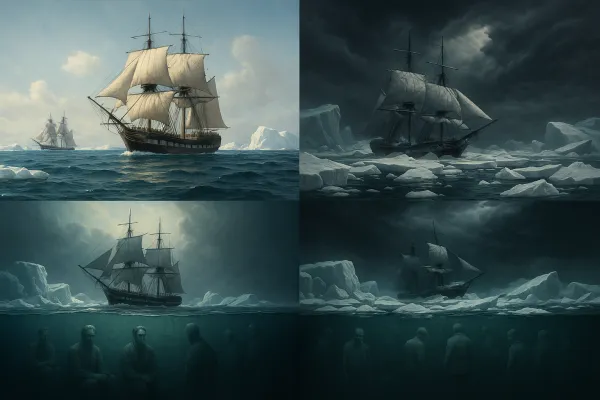
(A) What could have resulted in the deaths of 129 men and officers aboard the ship in Franklin’s lost expedition? … Sir John Franklin and his crew set sail from England in 1845 in search of the Northwest Passage, a sea route that was rumored to connect the continents of Europe and Asia. Two ships, HMS Erebus and HMS Terror, headed the expedition…
(B) All of these searches… were unsuccessful… That same year, searcher John Rae reported to the Admiralty that according to Inuit information and some discovered items, it seemed that Franklin and the crew had perished. In a desperate last attempt to survive, some may have even taken up cannibalism. Rae was given what would be about $400,000 Canadian dollars today as a reward.
(C) However, Lady Franklin did not give up there, and in 1857 she began commissioning another search with Leopold McClintock as its leader. It was McClintock who found many corpses on King William Island, along with a journal which outlined the journey… On May 1847… the ships were stuck in ice.
(D) Researchers, scientists and historians have continued to ponder this mystery for over 160 years. What had happened which had caused the men to abandon ship, rather than wait for the ice to melt? …
(E) In 1981, along the western coast of King William Island, the University of Alberta-led Franklin Expedition Forensic Anthropology Project dug up human remains. Forensic testing at the time suggested that the cause of death was likely either lead poisoning and scurvy. Lead poisoning has continued to persist as a possible explanation… However, proving this is not so simple, as surgeons’ journals (the “sick books”) which recorded illness on board have yet to be found.
(F) Still without Franklin sick books, a team of researchers from the University of Glasgow took up a study of the sick books of Royal Naval ships which were searching for Franklin. The search ships were equipped similarly, with the same provisions as Franklin’s vessels…
(G) …within the other search ships who had similar provisions, no evidence of lead poisoning was found, despite the relatively high exposure to lead that was unavoidable on ships of the era and within the overall British population. So, unless Franklin’s ships had a particular lead source, there is no substantial proof that lead poisoning had a role… patterns in illnesses led researchers to conclude that Franklin’s men would have suffered the same respiratory and gastrointestinal disorders, injuries and exposure… Moreover, the team suggested that the abnormally high number of deaths of Franklin’s officers was probably a result of non-medical circumstances such as accidents and injuries that happened when officers accepted the risky responsibility of hunting animals…
(H) It seems possible that the 2016 discovery by the Arctic Research Foundation made recently in the wreck of HMS Terror… could finally allow access to some first-hand evidence… If a ‘sick book’ has managed to survive aboard a ship, the events that led to the lost expedition may be revealed…
Questions
Questions 15 – 21
Do the following statements agree with the information given in the reading passage? In boxes 15-21 on your answer sheet, write
TRUE if the statement agrees with the information
FALSE if the statement contradicts the information
NOT GIVEN if there is no information on this.
15. Franklin’s lost expedition was a search party attempting to find Lady Jane Franklin.
16. John Rae suspected that Franklin’s lost expedition likely suffered from a food shortage aboard the ship.
17. The leaders of the search parties commissioned by Lady Franklin returned to England after some time.
18. It was common for people living in Britain during the 19th century to be exposed to lead.
19. Most of the crew aboard Franklin’s lost expedition were trained to hunt wild animals.
20. The most recent research from University of Glasgow suggests that some of the leaders of the crew on the Franklin expedition died from lead poisoning.
21. The research into the wreck of HMS Terror may shed light on the mystery of the lost expedition.
Questions 22 – 26
Complete the sentences below.
Choose NO MORE THAN THREE WORDS from the passage for each answer.
Write your answers in 22-26 on your answer sheet.
22. The Northwest Passage is a route which connects __________ by sea.
23. As a reward for seemingly having discovered the fate of the Franklin expedition, __________ was given an amount that would equal hundreds of thousands of Canadian dollars today.
24. Forensic testing available in the 80’s suggested that either __________ or lead poisoning led to the deaths of the crew in the Franklin expedition.
25. The __________ made by doctors aboard the ships in the Franklin expedition still have not been recovered.
26. Researchers have suggested that the leaders of Franklin’s crew might not have been ill, but could have died from __________ as a result of their behaviours.
Summary of Franklin’s Lost Expedition
This reading recounts one of the greatest mysteries in maritime exploration history.
- Mission & Disappearance: In 1845, Sir John Franklin’s expedition set out to find the Northwest Passage connecting Europe and Asia, but went missing.
- Search Efforts: Numerous searches were launched. John Rae was the first to report the crew’s demise, based on Inuit accounts, suggesting they may have resorted to cannibalism to survive. Later, McClintock found bodies and a journal confirming the ships were trapped in ice.
- Scientific Hypotheses: The biggest mystery is why they abandoned ship. Scientists have proposed several theories:
- Lead poisoning: Initially thought to be the primary cause due to lead-soldered food tins.
- Scurvy: Also suggested as a possibility by forensic experts.
- Other illnesses: A recent study by the University of Glasgow, comparing data with search ships, suggests lead poisoning was not the main cause. Instead, respiratory and cardiovascular illnesses, along with hunting accidents, are more plausible explanations.
- New Hope: The discovery of the wrecks of HMS Erebus (2014) and HMS Terror (2016) has raised hopes of finding primary records, especially the “sick books,” to solve this mystery.
Key Vocabulary from the Franklin’s Lost Expedition Reading
- Expedition (noun): A journey undertaken by a group of people with a particular purpose, especially that of exploration.
- Perished (verb): Died, typically in a violent, sudden, or untimely way.
- Cannibalism (noun): The practice of eating the flesh of one’s own species.
- Dire (adjective): Extremely serious or urgent.
- Ponder (verb): To think about something carefully, especially before making a decision or reaching a conclusion.
- Forensic (adjective): Relating to the application of scientific methods and techniques to the investigation of crime or death.
- Provisions (noun): Supplies of food, drink, or equipment.
- Speculating (verb): Forming a theory or conjecture about a subject without firm evidence.
- Closure (noun): A sense of resolution or finality.
Answer Key & In-depth Analysis
15. FALSE
- Evidence (Paragraph A): “Sir John Franklin and his crew set sail from England in 1845 in search of the Northwest Passage…”
- Explanation: Franklin’s voyage was to find the Northwest Passage, not to search for Lady Jane Franklin.
16. TRUE
- Evidence (Paragraph B): “In a desperate last attempt to survive, some may have even taken up cannibalism.”
- Explanation: Cannibalism is an act of desperation, strongly implying they were suffering from a severe food shortage.
17. NOT GIVEN
- Evidence (Paragraph B): “Collinson eventually found his way back to England, while McClure was found and returned back in 1854.”
- Explanation: The text mentions McClure and Collinson, who led other search parties. There is no information regarding whether the leader of the search commissioned by Lady Franklin (Leopold McClintock – paragraph C) returned.
18. TRUE
- Evidence (Paragraph G): “…the relatively high exposure to lead that was unavoidable on ships of the era and within the overall British population.”
- Explanation: This clearly states that high-level lead exposure was unavoidable for the general British population at the time.
19. NOT GIVEN
- Evidence (Paragraph G): “…officers accepted the risky responsibility of hunting animals to provide food…”
- Explanation: The text only states that officers took on the risk of hunting; there is no information stating that “most” of the crew were “trained” to do so.
20. FALSE
- Evidence (Paragraph G): “…no evidence of lead poisoning was found… researchers to conclude that Franklin’s men would have suffered the same respiratory and gastrointestinal disorders… a result of non-medical circumstances such as accidents and injuries…”
- Explanation: The University of Glasgow study refuted the lead poisoning theory and proposed other causes like illness and accidents.
21. TRUE
- Evidence (Paragraph H): “It seems possible that the 2016 discovery… could finally allow access to some first-hand evidence… the events that led to the lost expedition may be revealed…”
- Explanation: The discovery of the wreck could provide first-hand evidence and “shed light on” the mystery.
22. Europe and Asia
- Evidence (Paragraph A): “…a sea route that was rumored to connect the continents of Europe and Asia.”
23. John Rae
- Evidence (Paragraph B): “Rae was given what would be about $400,000 Canadian dollars today as a reward.”
24. scurvy
- Evidence (Paragraph E): “…suggested that the cause of death was likely either lead poisoning and scurvy.”
25. sick books
- Evidence (Paragraph E): “…surgeons’ journals (the “sick books”) which recorded illness on board have yet to be found.”
26. accidents and injuries
- Evidence (Paragraph G): “…a result of non-medical circumstances such as accidents and injuries that happened when officers accepted the risky responsibility of hunting animals…”
The mystery of Franklin’s expedition is a compelling story of courage, tragedy, and the relentless scientific pursuit of the truth. In terms of skills, this passage is an excellent exercise in tracking a complex historical narrative with multiple timelines and overlapping theories. It requires careful reading to distinguish between confirmed facts, hypotheses, and information that is not mentioned at all. We hope that through this “expedition” into the reading passage with ECE, you have gained valuable experience to conquer the IELTS exam.
For more IELTS Reading practice materials compiled by ECE, please refer to:
I Contain Multitudes IELTS Reading





 Khai giảng Khóa học Hè cực HOT.
No comments yet!