
Tóm Tắt Nội Dung Bài Viết
When it comes to high-quality IELTS preparation materials, the “IELTS Practice Tests Plus” series from Pearson Longman is a name that cannot be overlooked. Renowned for its realistic difficulty level and structure that closely mirrors the actual exam, this series has become a trusted companion for thousands of candidates on their journey to conquering their IELTS goals.
In this article, the ECE language center provides a comprehensive overview of the “IELTS Practice Tests Plus” series to help you evaluate and select the most suitable study materials.
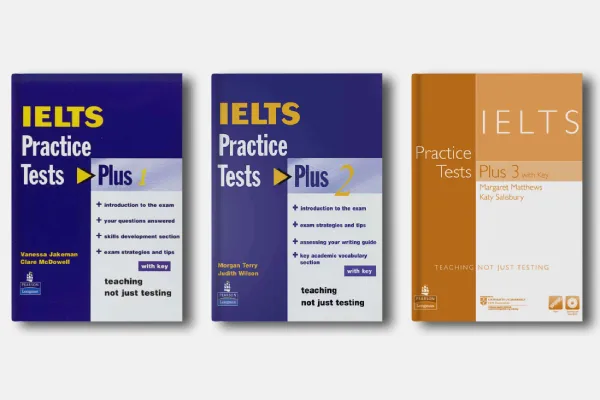
1. Overview of the IELTS Practice Tests Plus Series
- Full name: IELTS Practice Tests Plus (a 3-book series including Plus 1, Plus 2, and Plus 3, with decreasing difficulty).
- Publisher: Pearson Longman. As one of the world’s leading educational publishers, they are famous for high-quality English learning and test preparation materials compiled by experienced experts.
- Authors: The series is developed by a team of IELTS specialists. Rather than highlighting individual authors, the focus is on the Pearson brand and the “Plus” product line.
- What does the series include? The traditional and most popular “IELTS Practice Tests Plus” set consists of three main books, numbered sequentially:
- IELTS Practice Tests Plus 1
- IELTS Practice Tests Plus 2
- IELTS Practice Tests Plus 3.
Each book typically comes with a CD (for the Listening section) or an access code for online audio (in newer editions) and detailed answer keys.
- Reference price: The price for each “IELTS Practice Tests Plus” book (including CD/online audio) in the Vietnamese market typically ranges from:
- 150,000 – 250,000 VND per book. Prices may vary depending on the supplier, edition (original, imported, or licensed reprints in Vietnam), and promotional offers. We recommend purchasing from reputable major bookstores or trusted e-commerce platforms.
2. Who Should Use This Series?
The “IELTS Practice Tests Plus” series is primarily designed for the following learners:
- Candidates in the IELTS practice phase: This is the primary target audience. Once you have built a foundation in vocabulary, grammar, and are familiar with IELTS question types, this series provides complete practice tests to hone your skills and time management.
- Learners wanting to familiarize themselves with the structure and difficulty of the actual exam: The “Plus” series is famous for accurately simulating the format and challenge of the real IELTS test.
- Learners aiming for a band score of 5.5 or higher: While lower-level learners can use it for familiarization, to get the most out of the book—especially the answer explanations and test-taking tips—a relatively solid English foundation is recommended.
- Students at IELTS preparation centers: Due to its standard-setting nature, this series is frequently used by IELTS instructors for teaching and homework assignments.
- Self-study learners: With detailed answer keys and clear explanations (especially in versions “with key and guidance”), learners can effectively study at home.
Note: If you are just starting your IELTS journey or have a weak foundation, you should begin with foundational books (such as Complete IELTS or Get Ready for IELTS) before moving on to intensive practice with “IELTS Practice Tests Plus”.
3. Detailed Review of the “IELTS Practice Tests Plus” Series
A standout feature across all three “IELTS Practice Tests Plus” books is their structure and goal of providing a realistic test-taking experience. Each book typically includes:
- Number of Tests: 5 to 6 complete Practice Tests, providing an abundant source of material for learners to practice.
- Test Types: The books generally provide tests for both formats:
- Academic: The majority, usually containing about 4 full tests.
- General Training: Provides about 2 separate tests for Reading and Writing (Listening and Speaking may share the same modules as the Academic version or have separate modules depending on the edition).
- All 4 Skills: Each test accurately simulates the structure of the 4 skills (Listening, Reading, Writing, Speaking) of the real IELTS exam, including timing, number of questions, and typical task types.
- Introduction and Strategy Guidance:
- Exam Overview/Introduction: Provides general information about the IELTS exam, test structure, and scoring. Notably, the Plus 1 book often focuses on “Skills for IELTS,” while Plus 2 and 3 may focus more on “Test Overview.”
- “Tip Strips” and Guidance Sections: These are among the most valuable assets of the series. Before or interspersed with the tests, the books provide tips, strategies for approaching specific question types, analysis of common mistakes, and useful language for Writing and Speaking.
- Detailed Answer Keys and Support Materials:
- Answer Key & Explanations: Beyond just providing the correct answers, the “Plus” series is known for detailed explanations, which are especially helpful for the Reading section, where the book often points out exactly where the information for the answer can be found in the text. This helps learners understand the “why” behind each answer.
- Audio Scripts (Tapescripts): Full transcripts for all listening tests, supporting review and vocabulary/pronunciation study after completing the exercises.
- Model Answers (Writing): High-quality sample essays for both Task 1 and Task 2 (Academic & General Training), often accompanied by examiner’s comments or detailed analysis of idea development, vocabulary, and grammar.
- Sample Responses/Ideas for Speaking: Provides ideas, vocabulary, and suggested sentence structures for the Speaking sections, giving learners a clear direction for their responses.
- Audio: Accompanied by a CD (for older versions) or an access code for online audio (for newer versions) with good sound quality (though some feedback exists regarding inconsistent audio quality in older print runs).
One of the most discussed aspects of the “Plus” series is its difficulty. Generally, the community and many teachers consider this series to be about 0.5 band higher than the actual IELTS exam. This means that if you perform well on these tests, you will likely feel more confident and find the actual exam easier to handle.
To approach the series effectively and avoid feeling overwhelmed, the recommended path is to work in order of increasing difficulty: Plus 3 (considered the easiest) -> Plus 2 (medium difficulty) -> Plus 1 (considered the most challenging). Practicing in this order allows learners to gradually familiarize themselves, improve their skills, and systematically face increasingly difficult challenges.
4. Key Advantages of the Series
- High Difficulty, Challenging, and Realistic: This is the biggest advantage recognized by many. The tests are generally rated as 0.5 band harder than the real exam, helping candidates get used to high pressure, hone their skills in handling complex questions, and feel more confident when facing the actual test.
- Superior Intensive Reading Practice: The series is particularly strong in Reading skills. Many believe the long passages, rich academic vocabulary, and diverse question structures are a “treasure trove” for those aiming for high band scores in this skill.
- Detailed Guidance and “Tip Strips”: A unique feature of this series is the “Tip Strip” and guidance sections, which provide specific, useful strategies for each question type, helping learners accumulate experience and effective methods.
- Clear Answer Keys and Thorough Explanations: A major plus is the detailed answer explanation, which goes beyond just providing the correct answer. Especially for Reading, the book often highlights the exact location of the information, helping learners understand deeply and learn from their mistakes.
- Scientifically Increasing Difficulty (Plus 3 -> Plus 1): The books are arranged in increasing order of difficulty, allowing learners to follow a structured training path and improve their level systematically.
- Time Management and Exam Pressure Training: Practicing with full, timed tests helps candidates get used to real-world time pressure and learn how to allocate time reasonably for each section.
- Good Writing Model Answers and Speaking Suggestions: The books provide sample essays for Writing and suggestions/ideas for Speaking, giving learners additional references to develop their language production skills.
- Reputation of Pearson Longman: Ensures academic quality and content integrity.
5. How to Study Effectively with “IELTS Practice Tests Plus”
To maximize the value of this series, you should apply a structured study strategy:
- Assess your level and set goals: Before starting, identify your current level and target band score to create a suitable study plan.
- Take tests under exam conditions:
- Strictly follow timing: Use a stopwatch and try to complete each section within the allotted time.
- Create a quiet space: Minimize distractions to focus as you would in an exam room.
- Take it seriously: Do not use a dictionary or any outside help during the test (unless you are in the early familiarization stage and want to look things up to learn).
- Check answers and self-score:
- Use the Answer Key to check your Listening and Reading scores.
- For Writing and Speaking, self-evaluate based on model answers, IELTS grading criteria (which you can research further), or ask a teacher/experienced person for feedback.
- Analyze mistakes and learn (Most important!):
- For Listening and Reading: Find out why you chose the wrong answer. Was it because you couldn’t hear/read the information, misunderstood the question, encountered new vocabulary, or fell for a trap? Note these down and learn from them. Read the book’s answer explanations.
- For Writing: Compare your essay with the model answer. Pay attention to idea development, structure, academic vocabulary, grammar, and coherence. Rewrite sentences or paragraphs that were not up to par.
- For Speaking: Record your answers and listen to them. Compare them with the book’s suggestions. Focus on fluency, pronunciation, vocabulary, and grammar.
- Make the most of the Guidance/Top Tips: Read the strategies and tips provided in the book carefully. Apply them to your next practice sessions.
- Learn from model answers and Audio Scripts:
- Analyze word usage and sentence structures in the model Writing essays.
- Read along with the Audio Scripts to improve pronunciation and get used to natural speaking speed.
- Plan regular practice: Don’t try to finish all the tests in a short time. Break them down—for example, 1-2 tests per week—and allow enough time for thorough analysis after each test.
- Combine with other materials: Use “IELTS Practice Tests Plus” primarily for testing and tracking progress. Combine it with separate vocabulary, grammar, and skill-building books if necessary.
- Stay motivated and persistent: The IELTS preparation process can be challenging. Stay persistent, learn from every test, and trust in your own progress.
Conclusion
The “IELTS Practice Tests Plus” series from Pearson Longman is well-deserving of being a top choice for your final sprint preparation. With its realistic difficulty, detailed guidance, and high-quality model answers, this series will help you feel much more confident before entering the official IELTS exam. Remember, the key to success lies not just in doing many tests, but in analyzing your mistakes, learning from them, and applying test-taking strategies intelligently.
ECE wishes you an effective study process and the IELTS results you expect!





 Khai giảng Khóa học Hè cực HOT.
Chưa có bình luận nào!