
Tóm Tắt Nội Dung Bài Viết
Have you ever heard someone confidently brag about scoring an 8.0 or 9.0 on their IELTS, only to find yourself wondering how to verify it? Or perhaps you are an employer who needs to confirm an applicant’s IELTS results to ensure they are authentic? This is a critical issue, as there is currently no public database for looking up IELTS scores.
In this article, ECE provides a detailed guide on valid, secure, and evidence-based ways to verify someone else’s IELTS score, helping you steer clear of fraudulent information.
Quick Summary: Who can view IELTS scores?
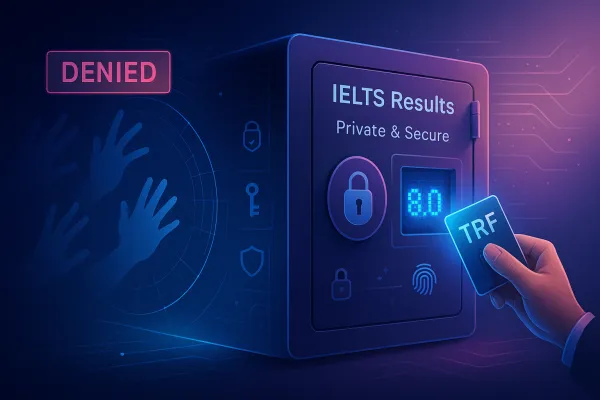
In short, you cannot look up someone else’s IELTS score publicly online. IELTS policy strictly protects the privacy of test-takers.
- Test-takers: Can view their own results via the Test Taker Portal and receive a physical Test Report Form (TRF).
- Organizations: Schools, businesses, and immigration authorities can verify an applicant’s score through the official IELTS Results Service using the TRF number, or by receiving results directly from the test center.
Any valid verification must be authorized by the test-taker, who must provide the necessary information.
Key terms used in this article
- TRF (Test Report Form): The official physical certificate of your IELTS score.
- eTRF (Electronic TRF): The electronic version (PDF) of the TRF, which holds the same validity as the physical copy.
- TRF number: A unique identification number on each TRF used for verification.
- Test Taker Portal: The personal online portal for test-takers.
- IELTS Results Service: A free verification portal for organizations.
- Additional TRF: A service to send scores directly from the test center to a specific organization.
Two valid ways to verify IELTS scores
Depending on your role, there are two primary ways to verify an IELTS score legitimately.
1. If you are an individual (small business owner, partner, etc.)
Since you do not have access to the internal IELTS system, the only way is to request proof from the applicant.
- Request the original TRF or eTRF: Ask the applicant to provide their physical TRF or the electronic eTRF. This is the official certificate containing their full name, date of birth, test date, test center, individual skill scores, Overall band score, and the unique TRF number.
- Cross-check with ID: Always compare the information on the TRF/eTRF with the applicant’s government-issued ID to ensure they are the same person.
- Request direct verification (if necessary): For 100% certainty, you can ask the applicant to contact their test center to have the results sent directly to your email or mailing address. This is the “Additional TRF” service, which ensures the results come straight from the official source.
Note: Never accept screenshots or scans that are missing information. Temporary online result previews have no legal standing and are easily forged.
2. If you are an organization (school, large corporation, agency)
IELTS-recognized organizations can register to use the free and secure results verification service.
- Register and use the IELTS Results Service: This is a dedicated portal for organizations. Once logged in, you simply enter the TRF number provided by the applicant to look up the result in the official database.
- Download eTRF: This system allows you to verify the authenticity of the score and download the official eTRF (if available) for your records.
Standard procedure for verifying IELTS scores (Step-by-step)
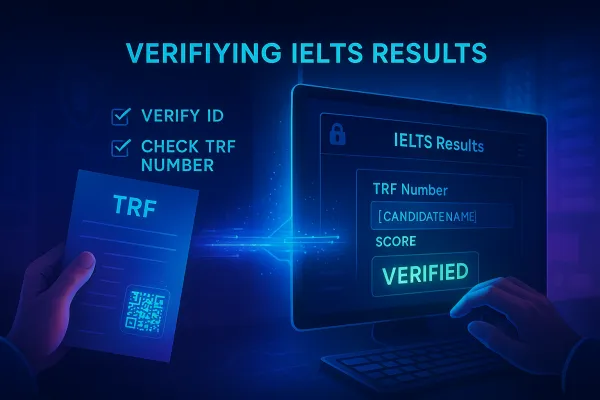
Verifying someone else’s IELTS score follows two main processes depending on your role. Below is a detailed guide with additional steps and considerations.
A) For individuals (small business owners, partners, etc.)
When you lack direct access to the IELTS system, verification relies on evidence provided by the applicant.
- Request and collect evidence:
- Ask the applicant for their eTRF or a clear scan/photo of their physical TRF. This is the most official and valid form of proof.
- Required information must include: The TRF number (a unique string of numbers and letters), Full Name, Date of Birth, Test Date, and Test Center Name.
- Cross-check and validate:
- Check validity: IELTS results are only valid for two years from the test date. Check the date to ensure the certificate has not expired.
- Compare personal details: Match the name and date of birth on the TRF/eTRF with the applicant’s ID (e.g., National ID or Passport).
- Check the format: A genuine TRF features security elements like an embossed seal, the signature of the test center director, and specialized security paper. An eTRF is a PDF downloaded directly from the system, featuring a standard format with no signs of tampering.
- Direct verification (if needed):
- This is optional but offers the highest reliability. You can request that the applicant contact their test center (e.g., IDP or British Council) to use the Additional TRF service. The center will send a copy of the results directly to you, guaranteeing 100% authenticity.
B) For organizations (schools, large corporations, immigration agencies)
IELTS-recognized organizations can verify results quickly, securely, and free of charge.
- Register and access the system:
- You must register for an IELTS Results Service account. This service is specifically designed for organizations to look up results directly.
- Once logged in, you will have access to the IELTS results database.
- Look up and verify:
- Enter the TRF number provided by the applicant.
- The system will display the candidate’s full results, including individual skill scores, the Overall band score, and personal details.
- You can then compare this information with the applicant’s file.
- Record keeping:
- The system allows you to view and download the official eTRF (if available) to store securely and legally.
Signs of invalid IELTS results
- Using screenshots: Scores can be easily edited using graphic design software. Screenshots from online result portals have no legal value.
- Tampered PDF files: Genuine eTRFs can be forged by editing the PDF. Always request the original file or verify through the official IELTS system.
- Confusing “previews” with “official results”: The online result portal is only for viewing results for 28 days. This is not a valid document for official applications.
- Forgetting to check validity: Most organizations worldwide require IELTS results to be no older than two years.
To ensure the verification request process is smooth and professional, you can use the following polite email/message template:
“Dear [Candidate Name],
To complete the verification of your application, please provide your IELTS eTRF (Electronic Test Report Form) or a clear copy of your TRF showing the TRF number.
Additionally, to ensure absolute authenticity, you may contact your test center to have the results sent directly to our email address via the IELTS Results Service or the Additional TRF service (if supported by your test center).
Thank you very much.”
In summary, valid IELTS verification always relies on the TRF/eTRF as evidence. If you are an individual, request the official document from the applicant. If you are an organization, utilize the IELTS Results Service to look up and confirm authenticity. Always be cautious of unofficial evidence like screenshots to avoid unnecessary risks.





 Khai giảng Khóa học Hè cực HOT.
Chưa có bình luận nào!