
Tóm Tắt Nội Dung Bài Viết
In IELTS Writing Task 1 tasks involving time-dependent charts (Dynamic Charts such as Line Graphs, Bar Charts, Tables, and Pie Charts), accurately and flexibly describing data trends and fluctuations accounts for up to 50% of your total score across two assessment criteria: Grammatical Range and Accuracy (GRA) and Lexical Resource (LR).
Many test-takers get stuck at Band 5.5 simply because they repeatedly rely on repetitive, monotonous structures like “X increased” or “Y decreased”. In this article, ECE English will provide you with a comprehensive structural framework ranging from basic to advanced levels, preposition standardization, and practical data-mapping guides to help you master this task type immediately.
Standardizing Trend Vocabulary (Accurate Word Forms)
Before writing your sentences, you need to master proper collocations and exact word forms to avoid unnecessary score penalties from examiners.
Vocabulary Group for Fluctuating Trends (Verbs & Nouns)
| Trend | Verb | Academic Noun | Usage Nuance |
| Steady increase | rise, increase, climb, grow | a rise, an increase, a climb, growth | Used for primary upward trends |
| Sharp / Sudden increase | soar, rocket, shoot up, surge | a surge, a rocket (colloquial) | Do not pair with strong adverbs |
| Steady decrease | fall, decrease, decline, drop | a fall, a decrease, a decline, a drop | Used for general downward movements |
| Sharp / Sudden decrease | plummet, plunge, slump | a plummet, a slump | Do not pair with strong adverbs |
| Fluctuation | fluctuate, oscillate | a fluctuation, an oscillation | Frequently used with between… and… |
| Remaining stable | remain stable, stay unchanged | stability | Staying at a fixed level |
Vocabulary Group for Degree and Speed (Adjectives & Adverbs)
In sentence construction, Adjectives (Adj) modify Nouns, while Adverbs (Adv) modify Verbs.
-
High degree / Magnitude (Recommended for high bands): dramatic / dramatically, sharp / sharply, significant / significantly, substantial / substantially.
-
Moderate & steady degree: steady / steadily, gradual / gradually, moderate / moderately.
-
Small / slight degree: slight / slightly, marginal / marginally, minimal / minimally.
Basic Data-Description Structures and Preposition Rules
There are four simple sentence patterns used to describe a trend. The dividing line between average and proficient test-takers lies in the accurate use of prepositions accompanying data figures.
Structure 1: Using Verbs [S + V + Adv]
-
Preposition Rules:
-
to: indicates the final figure reached by the subject.
-
by: indicates the amount of change between the starting and ending points.
-
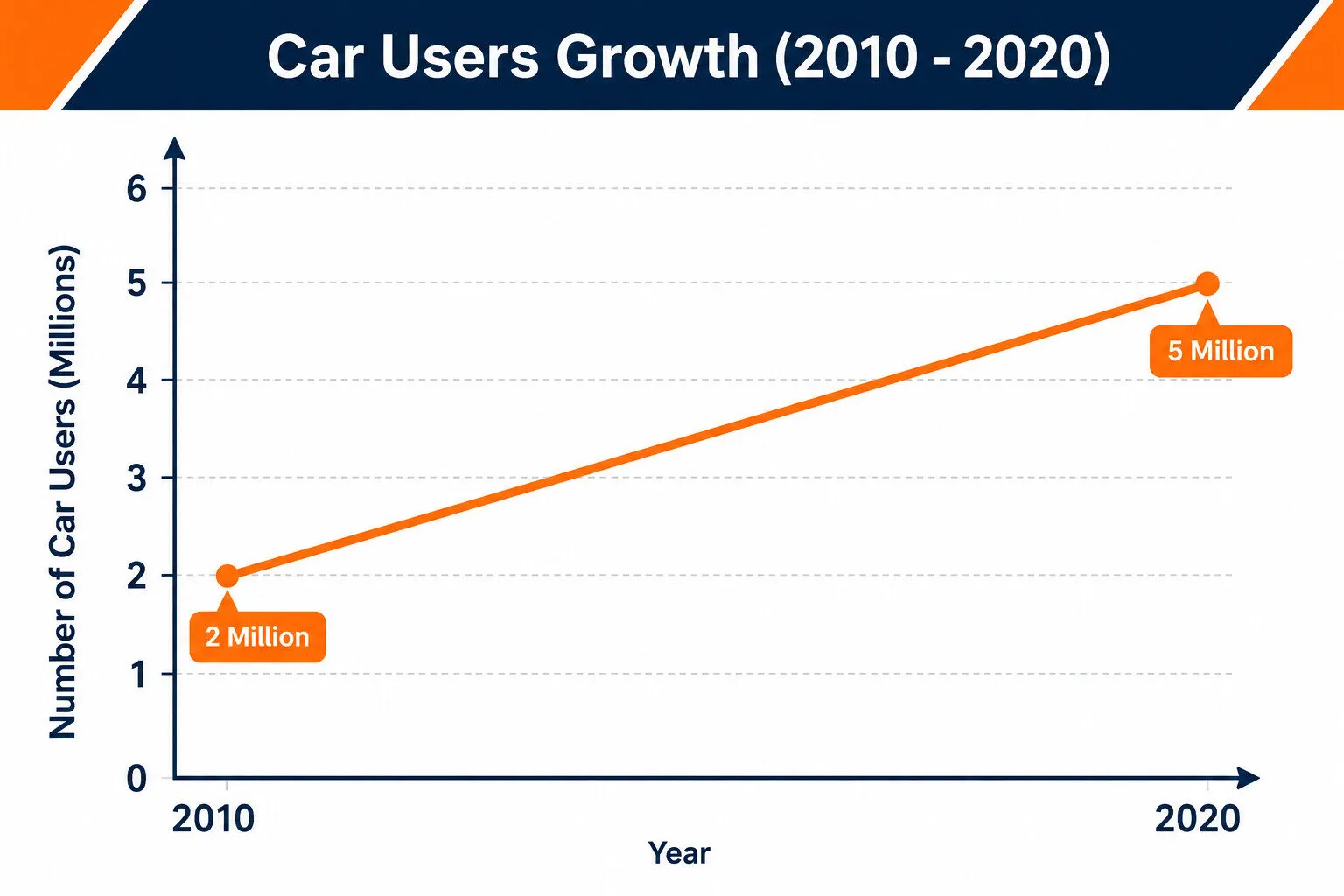
Example: The number of car users increased sharply to 5 million by 3 million between 2010 and 2020. (The number of car users increased sharply to 5 million, growing by 3 million between 2010 and 2020).
Structure 2: Using Nouns [There + be + a/an + Adj + N]
-
Preposition Rules: In this structure, the preposition of must directly follow the degree of change (it is not used with the final figure).
Example: There was a sharp increase of 3 million in the number of car users, reaching a peak of 5 million in 2020.
Structure 3: Using Subjects Indicating Place / Time [S + witness/see + a/an + Adj + N]
Example: The year 2020 witnessed a dramatic decline in the number of international tourists due to the pandemic. (The year 2020 witnessed a dramatic decline in the number of international tourists due to the pandemic.)
Structure 4: Passive Voice [A/An + Adj + N + was seen + in…]
Example: A gradual reduction was observed in the consumption of coal energy over the ten-year period. (A gradual reduction was observed in the consumption of coal energy over the ten-year period.)
Data-Mapping Guide and Preposition Shifts When Changing Structures
To prevent confusion when switching back and forth between verb-based and noun-based structures, let’s analyze the following practical set of data:
Original Data: Electricity consumption at a factory was 5,000 kW (in 2015) and rose to 6,800 kW (in 2025).
The mathematical growth gap is: 6,800 – 5,000 = 1,800 kW.
Observe closely how prepositions change alongside the numbers across both phrasing methods:
-
Method 1 – Verb-Focused (Verb-Adverb):
The amount of electricity consumed increased significantly to 6,800 kW by 1,800 kW between 2015 and 2025.
-
Method 2 – Noun-Focused (Adj-Noun):
There was a significant increase of 1,800 kW in the amount of electricity consumed, reaching 6,800 kW over the ten-year period.
Note:
When using Verb structures, the destination figure pairs with to, while the degree of change pairs with by.
When using Noun structures, the degree of change must be coupled with of, whereas the destination figure is placed in a trailing subordinate clause (commonly using present participles like reaching / amounting to). Keep this rule in mind to never lose marks for preposition grammar errors!
Advanced Complex Sentence Structures for Boosting GRA Scores (Band 7.5+)
When you need to combine data points or describe sequential trends of the same metric to optimize word count and conciseness, apply these high-value complex sentence structures:
Using Participial Phrases with “followed by”
Used to describe a trend occurring immediately after a major preceding movement.
Example: The sales of smartphones reached a peak of 2 million units in 2018, followed by a significant drop to only 500,000 units in the subsequent year. (Smartphone sales peaked at 2 million units in 2018, followed by a significant drop to just 500,000 units the following year.)
Using the Sequential Relative Pronoun “after which”
This structure allows you to smoothly connect two complete clauses that share a sequential chronological relationship.
Example: The population of the city rose steadily to 10 million in 2010, after which it experienced a slight decline to 9.2 million in 2012.
Using “before / after + V-ing” Structures
⚠️ Note: You may only use this reduced clause structure when the subjects of both actions are completely identical. Do not use this structure if the preceding clause treats an abstract increase/decrease as a dummy subject.
-
✅ Correct Sentence: The percentage of females in Hanoi increased to 40% in 2020 before falling to 30% in 2025. (The subject The percentage of females performs both trend actions).
-
✖ Incorrect Reference Structure: An increase to 40% was seen in the percentage of females before falling to 30% in 2025. (Logical error: The preceding subject An increase cannot literally “fall” to 30%).
Trend Structure Practice Exercises
Part 1: Find and Correct a Single Error in Each of the Following Sentences
1. There was a gradual decline by 5% in the unemployment rate of the country in 2015.
2. The number of internet users soared dramatically from 10% to 80% over the ten-year period.
3. The year 2020 was witnessed a sharp drop in the number of tourists due to global travel restrictions.
4. Product sales peaked at $15 million in 2018 before experienced a significant decrease in 2019.
5. Coffee consumption increased twofold to 500 tons, after that it remained stable until 2022.
Part 2: Sentence Restructuring (Upgrading Simple Sentences to Academic Complex Sentences)
1. The inflation rate fluctuated slightly between 2% and 5% from 2010 to 2015. Then it stabilized at 3%.
-> (Rewrite using the sequential structure with “after which”)
2. The amount of electricity produced rose to 6800kW in 2010. After that, it experienced a drop of 1000kW in 2015.
-> (Rewrite using the reduced structure with “before + V-ing”)
3. The number of car users grew significantly in the UK. At the same time, the percentage of bus passengers declined.
-> (Rewrite using the contrasting parallel conjunction “whereas”)
Exercise Answer Key
Part 1 Answer Key:
1. Error: by 5% -> Correction: of 5%.
Explanation: In the noun structure There be + a decline, the preposition indicating the magnitude of change must be of, rather than by (preposition by only accompanies verbs).
2. Error: soared dramatically -> Correction: soared (omit dramatically).
Explanation: Soar inherently means to increase rapidly/dramatically (carrying a strong degree within itself), so adding the adverb dramatically results in redundancy within academic writing.
3. Error: was witnessed -> Correction: witnessed.
Explanation: The time marker (The year 2020) acts as an active subject that “witnesses” the change, so the passive voice is inappropriate here.
4. Error: experienced -> Correction: experiencing.
Explanation: Following the preposition before, the verb must shift into a gerund (V-ing) form to properly reduce a same-subject clause.
5. Error: after that it -> Correction: <i data





 Khai giảng Khóa học Hè cực HOT.
Chưa có bình luận nào!