
Tóm Tắt Nội Dung Bài Viết
The Problem and Solution essay is one of the most common and challenging types of questions in IELTS Writing Task 2. To achieve a high score, you must not only grasp the prompt but also present your ideas in a logical, coherent, and insightful manner. This article from ECE Language Center provides a comprehensive strategy—from analyzing the prompt to developing ideas and structuring your essay—to help you confidently conquer this task type.
I. What is a Problem and Solution essay?

In Writing Task 2, a Problem and Solution essay requires you to analyze a problem or the causes of a phenomenon, then propose solutions or measures to resolve or mitigate its impact. The key is maintaining a tight, logical connection between the problems/causes and the proposed solutions.
1. Identifying the question type
Problem and Solution prompts typically contain keywords such as problems, issues, causes, reasons, effects, solutions, measures, tackle, address, prevent, solve, and overcome.
More importantly, you must distinguish between three common sub-types to avoid going off-topic:
- Problem(s) – Solution(s): The prompt asks you to identify specific problems arising from a phenomenon and provide direct solutions for them.
Example: “Nowadays many people complain that they have difficulties getting enough sleep. What problems can lack of sleep cause? What can be done about lack of sleep?” (Focus on the “problems of sleep deprivation” and how to address them).
- Cause(s) – Solution(s): The prompt asks for the root causes of a phenomenon and solutions to address those causes at their source.
Example: “Overpopulation in many major urban centers around the world is a major problem. What are the causes of this? How can this problem be solved?” (Focus on the “causes of overpopulation” and solutions for those causes).
- Cause(s) – Problem(s) / Effect(s): This type only requires you to analyze causes and effects/problems; it does not ask for solutions.
Example: “Nowadays many adults have full-time jobs and the proportion of their lives spent on work is very high. Some of them are under high stress and ignore the other parts of life. What are the causes and effects?” (Only state causes and impacts; do not provide solutions).
Pro-tip: Pay attention to instruction words such as discuss, identify, suggest, explain, and analyze. These will guide the content of your essay.
II. A 5-step comprehensive strategy
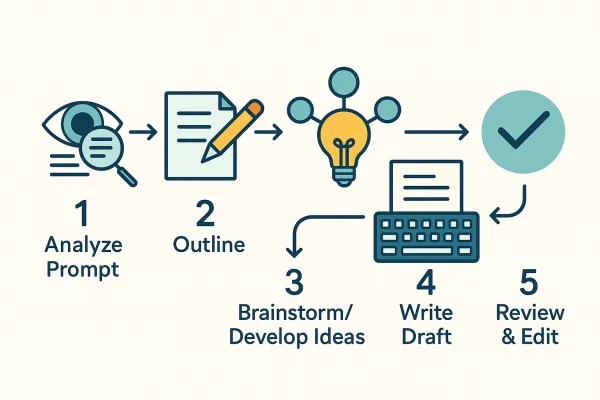
To write an effective Problem and Solution essay, follow this 5-step process:
Step 1: Analyze the prompt thoroughly (5 minutes)
This is the most critical step, determining whether you stay on track.
- Identify the question type and main requirements: Which of the three types mentioned above are you facing? What does the prompt require (only Problems/Causes and Solutions, or both Problems/Causes and Effects)?
- Analyze Keywords:
- Keywords: The broad topic of the essay (e.g.,
global warming,urbanization,the internet). - Micro Keywords: Help narrow down the specific scope (e.g.,
human face,sea level rise,young people). Avoid writing broadly about the general topic. - Instruction words: Identify the action verbs (
problems,solutions,causes,effects,measures).
- Keywords: The broad topic of the essay (e.g.,
Example: Prompt: “Global warming is one of the biggest threats humans face in the 21st Century, and sea levels continue to rise at alarming rates. What problems are associated with this, and what are some possible solutions?”
-
- Type: Problems – Solutions
- Keywords:
global warming - Micro Keywords:
humans,sea levels rise - Instruction words:
problems,solutions - Conclusion: The essay must focus on the problems humans face due to rising sea levels and solutions to fix them. Discussing the causes of global warming or the impact on animals would be considered off-topic.
Step 2: Create a detailed outline (5 – 7 minutes)
A clear outline helps organize your ideas and ensures coherence. The most common structure for a Problem and Solution essay is four paragraphs:
General structure:
- Paragraph 1: Introduction
- Sentence 1: Paraphrase the prompt.
- Sentence 2: State the essay’s purpose (e.g., “This essay will discuss the main problems associated with [issue] and propose some possible solutions.”). For Problem-Solution essays, you do not necessarily need a thesis statement expressing a personal opinion unless specifically requested.
- Paragraph 2: Body (Problems/Causes)
- Topic Sentence: State the first main problem/cause (or introduce the problems/causes to be discussed).
- Explanation/Expansion: Describe the specific problem/cause.
- Impact/Consequence: Clearly state the effect of that problem/cause.
- Example: Illustrate with a real-world or hypothetical example.
- Note: You can present 1-2 problems/causes in this paragraph; each should be fully developed.
- Paragraph 3: Body (Solutions)
- Topic Sentence: State the first main solution (or introduce the solutions to be discussed).
- Explanation: Describe how the solution works and why it is effective.
- Example/Result: Illustrate the effectiveness of the solution with an example or predicted positive outcome.
- Note: Solutions must directly address the problems/causes mentioned in the previous paragraph. Choose 1-2 solutions, each fully developed.
- Paragraph 4: Conclusion
- Sentence 1: Summarize the main problems/causes and solutions presented (using different wording).
- Sentence 2 (Optional): Provide a brief observation, prediction, or call to action. Never introduce new ideas in the conclusion.
Sample Template:
Problem(s) – Solution(s) type:
- Introduction: The proliferation of [topic/issue] has precipitated a myriad of concerns on a global scale. This essay will expound on the most pressing problems associated with this phenomenon and propose viable solutions to mitigate its impact.
- Body 1 (Problems): One fundamental problem arising from [topic] is [Problem 1]. This stems from [explanation]. Consequently, this exacerbates [negative effect]. A pertinent illustration is the case of [real-world example]. Another critical issue is [Problem 2]. This is evidenced by [explanation]. As a result, this intensifies [negative consequence].
- Body 2 (Solutions): One viable measure to address these issues is [Solution 1 for Problem 1]. By implementing this strategy, [explanation of how it tackles Problem 1]. A case in point is the initiative undertaken by [organization/government], which resulted in [positive outcome]. An equally effective approach would be [Solution 2 for Problem 2]. This solution is instrumental in [explanation of its effectiveness for Problem 2]. Thus, this serves as a long-term remedy to [Problem 2].
- Conclusion: In summary, the significant challenges posed by [topic], such as [Problem 1] and [Problem 2], require immediate attention. To mitigate these issues, proactive measures such as [Solution 1] and [Solution 2] should be implemented. Ultimately, a concerted effort from individuals and policymakers is imperative to alleviate the ramifications of this issue.
Important note on outlining: Quality over quantity! It is better to develop one problem/solution deeply than to list 3-4 generic points without clear explanation or illustration.
Step 3: Develop logical ideas with Linearthinking (10 – 12 minutes)

This step turns raw ideas into persuasive arguments. The Linearthinking method helps clarify and develop ideas logically.
- Specify the question: If the topic is too broad, make it specific by looking at different aspects (economic, social, environmental, individual, government, etc.). This helps you find more specific problems/causes and solutions.
Example: The prompt “Problems young people face in cities” can be specified as “economic problems” (high cost of living) and “social problems” (lack of green space, competitive pressure).
- Develop ideas logically: Use the following tools to expand ideas and create a chain of reasoning:
| Tool | Purpose | Formula/Connectors |
| Reason | Clarify the origin/reason for an argument | ...because/since/as +S+V, This is because + S+V, ...due to/thanks to/owing to + N, This stems from + N |
| Fact | Clarify the problem/solution with facts | In fact, + S+V, As a matter of fact, + S+V |
| Result | Prove the argument by showing results | As a result/Therefore/Hence, + S+V, As a consequence, + S+V, Eventually, + S+V, This results in/leads to + N, which results in/leads to + N |
| Comparison | Clarify through comparison | While + S+V..., Compared to + N, + S+V |
| Hypothesis | Highlight the importance of an idea | If + S+V..., Unless + S+V..., With/Without + N, S will... |
| Example | Prove the argument with specific examples | For example/instance, + S+V, A clear illustration is..., Take X for example... |
Ensure the solution matches the problem/cause: This is a fatal error many make. Every solution you provide must directly address a problem or cause you have mentioned. Think of it as “diagnosing” and “prescribing medication.”
Step 4: Write the complete essay (15 – 18 minutes)
Once you have a clear outline and ideas, writing becomes much easier. Focus on:
- Using diverse vocabulary and structures: Combine academic vocabulary (from the tables above) and complex grammatical structures (compound sentences, complex sentences, relative clauses, inversion) naturally.
- Cohesion & Coherence:
- Use appropriate linking words/phrases (e.g.,
Firstly, Secondly, In addition, Moreover, Furthermore, However, Therefore, As a result, Consequently, In conclusion). - Use pronouns and synonyms to avoid repetition.
- Ensure a “flow” at the end of each point: After explaining and providing an example, the final sentence of a small point should reaffirm or briefly summarize that problem/solution, creating a tight connection to the next point.
- Use appropriate linking words/phrases (e.g.,
Step 5: Review and edit (2 – 3 minutes)
Never skip this step! Spend the final minutes reviewing your entire essay.
- Task Achievement: Have you answered all parts of the prompt correctly and fully?
- Cohesion and Coherence: Are the ideas coherent and logically linked? Are linking words used appropriately?
- Lexical Resource: Is the vocabulary diverse, accurate, and contextually appropriate? Are there any spelling errors?
- Grammatical Range and Accuracy: Is the grammar diverse (simple, compound, complex sentences) and accurate? Are there errors in tense, subject-verb agreement, or punctuation?
III. Common mistakes and how to fix them
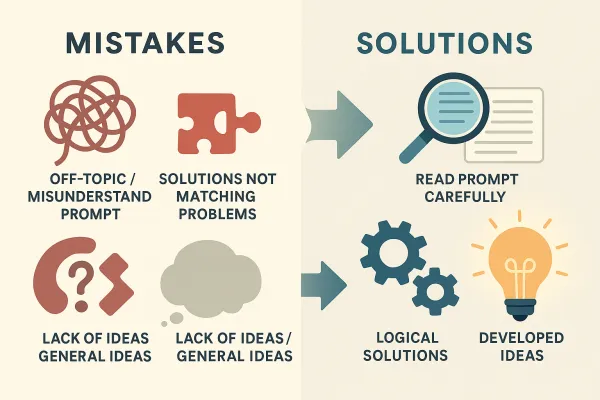
To avoid losing points, be aware of these common pitfalls:
- Going off-topic / Misidentifying the question type:
- Reason: Candidates read the prompt carelessly and fail to distinguish between
problems,causes, andeffects. - Fix: Spend enough time on Step 1. Underline
Keywords,Micro Keywords, andInstruction wordsand ask yourself, “What does the prompt really want me to write about?”
- Reason: Candidates read the prompt carelessly and fail to distinguish between
- Lack of ideas / Generic ideas:
- Reason: Candidates lack background knowledge on the topic and don’t know how to develop ideas.
- Fix: Apply the Linearthinking method (Specify the question, Develop ideas logically). Turn general ideas into specific ones by looking at related aspects. Practice reading news and articles on social issues to build knowledge.
- Solutions don’t match the problem / Not feasible:
- Reason: Candidates don’t understand the problem deeply; solutions don’t address the root cause.
- Fix: Always ask yourself, “Which specific problem does this solution address?” Solutions must be practical and applicable, not overly theoretical or vague. For example, if the problem is traffic congestion due to too many private vehicles, the solution should be encouraging public transport, developing infrastructure, or urban planning, not “people should walk more” (too generic and hard to implement on a large scale).
- Listing without explaining/developing:
- Reason: Candidates try to include too many ideas without enough time or ability to expand on them.
- Fix: Choose 1-2 problems and 1-2 solutions, but develop them fully with reasons, explanations, examples, and impacts. Emphasize WHY (why the problem happens, why the solution is effective) and HOW (how the problem impacts, how the solution works).
IV. Sample essay and detailed analysis
Let’s apply these strategies to a specific prompt:
Prompt: “Major cities in the world are growing fast, as well as their problems. What are the problems that young people living in those cities are facing? Suggest some solutions.”
Analysis:
- Type: Problems – Solutions (focus on young people).
- Keywords:
Major cities,growing fast,problems. - Micro Keywords:
young people. - Instruction words:
problems,suggest some solutions.
Outline (Using Linearthinking):
- Problems (for young people in cities):
- Problem 1 (Economic): High cost of living (housing, food, transport).
- Explanation: Supply cannot meet demand; prices rise faster than income.
- Consequence: Financial hardship, life pressure, reduced quality of life.
- Example: Rent in major cities like New York, London, or Tokyo is very high, consuming most of a young person’s income.
- Problem 2 (Social/Health): Competitive pressure and lack of green space.
- Explanation: Intense work/study environment, few opportunities for relaxation, lack of work-life balance.
- Consequence: Stress, anxiety, mental health issues, poor air quality, lack of physical activity.
- Problem 1 (Economic): High cost of living (housing, food, transport).
- Solutions (for the above problems):
- Solution 1 (for cost of living): Government intervention in the housing market and support policies.
- Explanation: Build social housing, control rent, provide subsidies for young people.
- Effectiveness: Reduce financial burden, help young people stabilize their lives.
- Solution 2 (for pressure and green space): Invest in social welfare and develop green spaces.
- Explanation: Provide mental health counseling, build more parks/playgrounds, encourage community activities.
- Effectiveness: Improve mental health, create a balanced and healthy living environment.
- Solution 1 (for cost of living): Government intervention in the housing market and support policies.
Sample Essay:
In recent decades, the rapid expansion of major global cities has brought about numerous challenges, particularly for their young inhabitants. This essay will delineate some of the most pressing problems faced by young people in these burgeoning urban centers and propose viable solutions to ameliorate these issues.
One of the foremost problems encountered by the youth in metropolitan areas is the exorbitant cost of living. Due to an imbalance between supply and demand, essential expenses such as housing, food, and transportation far outpace the average income of young professionals and students. This inevitably leads to significant financial strain and a diminished quality of life. For instance, in cities like London or New York, a substantial portion of a young person’s monthly earnings is often consumed by rent, leaving little for savings or other necessities.
Compounding these financial pressures is the intense competitive environment and a dearth of green spaces, which significantly impact mental and physical well-being. The relentless pace of urban life, coupled with fierce competition in academic and professional fields, can induce chronic stress and anxiety among young people. Moreover, the scarcity of parks and recreational areas limits opportunities for physical activity and relaxation, contributing to a sedentary lifestyle and poor air quality.
Fortunately, several measures can be adopted to address these critical problems. To alleviate the high cost of living, governments should intervene in the housing market by investing in affordable housing projects and implementing rent control policies. Furthermore, financial subsidies and educational programs on personal finance could empower young individuals to manage their budgets more effectively. For example, some European governments have successfully launched initiatives to provide low-interest loans for first-time homebuyers or young entrepreneurs.
To counter the societal pressures and lack of green areas, urban planners should prioritize the creation and maintenance of public parks and recreational facilities. Concurrently, robust mental health support services, such as free counseling and stress management workshops, should be readily accessible to young people. Encouraging community-building activities and promoting a healthier work-life balance through policy changes could also foster a more supportive and less stressful urban environment.
In conclusion, while fast-growing major cities present young people with considerable challenges like high living costs and overwhelming pressures, these issues are not insurmountable. Through concerted efforts from municipal authorities to regulate living expenses and invest in green infrastructure and welfare services, the quality of life for urban youth can be substantially enhanced.
We hope this detailed article from ECE Language Center provides you with a comprehensive perspective and effective strategies to conquer the Problem and Solution type in IELTS Writing Task 2. Good luck!





 Khai giảng Khóa học Hè cực HOT.
Chưa có bình luận nào!