
Tóm Tắt Nội Dung Bài Viết
Among the vast sea of IELTS preparation materials, “Improve Your IELTS Reading Skills” by Sam McCarter has long been a standout title that many learners turn to. But is this book truly the “golden key” to mastering the Reading section? This ECE article goes beyond a standard review. We’ve provided a detailed “dissection,” analyzing the pros and cons, and outlined a 4-stage roadmap to help you leverage this book intelligently and effectively, turning it into a powerful tool on your journey to your dream Reading band score.
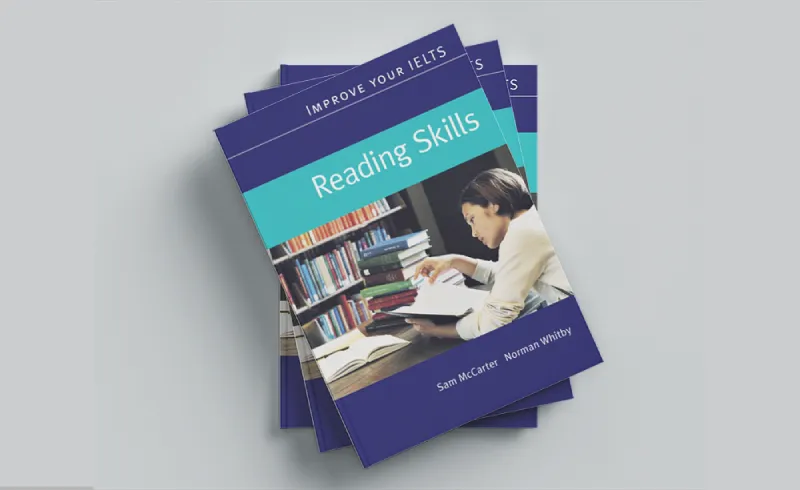
Part 1: Overview of Improve Your IELTS Reading Skills
- General Information:
- Book Title: Improve Your IELTS Reading Skills
- Authors: Sam McCarter & Norman Whitby
- Publisher: MacMillan
- Target Audience: Best suited for learners at an IELTS band 4.5 – 6.0, aiming for 6.5 – 7.5+.
- The book consists of 10 units revolving around the 10 most common academic topics in the IELTS exam, such as: Change and consequences, Education, Nature, Health, etc.
This approach helps you not only hone your skills but also build topic-specific vocabulary in a natural and systematic way.
- Each unit follows a consistent, logical learning flow:
- Reading Skills: Introduces and provides mini-exercises focusing on 1-2 specific reading skills (e.g., Scanning, Skimming) and 1-2 corresponding question types (e.g., Sentence completion, True/False/Not Given).
- Technique Box: Interspersed throughout the exercises are small “Technique” boxes, offering quick tips and notes on how to handle specific question types.
- Exam Practice: At the end of each unit is a full-length reading passage in the actual exam format, with questions focusing on the skills you just learned in that unit.
Part 2: Objective Review of Pros and Cons
This section is crucial for deciding whether this book is the right fit for you.
Key Strengths
- Structured Learning Path: The book guides learners from basic, isolated skills to applying them in a full exam setting. This prevents beginners from feeling overwhelmed.
- Contextual Vocabulary Learning: Learning through topic-based reading passages makes vocabulary much easier to remember and use compared to dry word lists.
- Focused Practice: The “Exam Practice” section at the end of each unit allows you to immediately reinforce what you’ve just learned, creating an effective study-practice loop.
- Comprehensive Coverage: The book covers all major IELTS Reading question types, ensuring you don’t miss any essential skills.
Points to Consider (Weaknesses)
- The “Self-Study Trap”: There are no explanations for the answers. This is the book’s biggest and most critical flaw. It only provides an Answer Key without explaining why an answer is correct or why others are wrong. For self-learners, this makes it difficult to get to the root of your mistakes.
- Techniques “Open Doors” but don’t “Lead the Way”: The “Technique” boxes are very concise and merely suggestive. They do not provide a detailed, step-by-step process for complex question types.
- Language Barrier: The book is written 100% in English. This can be challenging for students at the 4.5 – 5.0 band level, especially when reading the technical instructions.
Download the book here
Part 3: 4 Strategies for Using the Book Effectively
Knowing the limitations above, we can overcome them with a smart study strategy. Don’t just work from page one to the end; apply these 4 learning strategies:
Skill Building – “Accuracy First, Speed Later”
- Action: Focus on the exercises in the Reading Skills section of each unit.
- Goal: At this stage, do not worry about time. Your only goal is to get the answers right and clearly understand how to apply the skills (skimming, scanning, etc.). Use a dictionary and re-read as many times as needed to understand the logic behind the answers.
Practice Under Exam-Like Time Pressure
- Action: Move on to the Exam Practice section at the end of each unit.
- Goal: Now is the time to apply time pressure. Instead of 20 minutes, try to finish the passage in 18 minutes. This helps you get used to the pressure and improves your processing speed.
Analyze & Bridge Gaps (The Most Important Strategy)
This step addresses the book’s biggest weakness (lack of answer explanations). You must create your own “explanations.”
- Action: Use an “Error Log.” After each Exam Practice, record your incorrect answers in a table like this:
- Goal: This forces you to think deeply about your mistakes, ensuring you actually learn from them and don’t repeat them.
Expand & Systematize Vocabulary
- Action: After finishing a unit, go back to the reading passage and underline useful vocabulary, especially collocations.
- Goal: Systematize them using methods like Mind Maps/Word Webs. For example, with the topic “Health,” you can draw a network with branches for “Diseases,” “Treatments,” “Lifestyles,” and “Nutrition,” filling in the vocabulary you’ve learned.
Part 4: Final Advice & Conclusion
- This book is an excellent choice for:
- Students at band 4.5 – 6.0 who need a clearly structured study path.
- Learners who need a variety of practice materials closely aligned with real exam topics.
- Students working with a teacher/tutor (who can explain answers and errors for you).
- You should consider other options if:
- You are a complete beginner or below band 4.5.
- You are a 100% self-learner who requires extremely detailed answer explanations.
- You need an in-depth strategy guide rather than a practice workbook.
- Final Conclusion:
“Improve Your IELTS Reading Skills” is a very good workbook, but it is not a perfect self-study guide. Its greatest value lies in its exercise system and topic-based structure.
To optimize your results, combine it with an analytical tool like an “Error Log.” By doing so, you will overcome the book’s biggest weakness, and it will become a powerful companion on your journey to conquering IELTS Reading.





 Khai giảng Khóa học Hè cực HOT.
Chưa có bình luận nào!