
Tóm Tắt Nội Dung Bài Viết
Multiple Choice questions are among the most common yet challenging tasks in the IELTS Reading test. In this article, the ECE language center provides a comprehensive overview of the format, effective test-taking strategies, essential tips, and a practice exercise with detailed answer analysis to help you confidently “conquer” this question type.
1. Understanding the IELTS Reading Multiple Choice Format
In a Multiple Choice task, you are required to read a passage and answer questions based on it. Each question consists of an incomplete statement or a question followed by either four options (A, B, C, D) or three options (A, B, C). Your task is to select the BEST answer based on the information provided in the text.
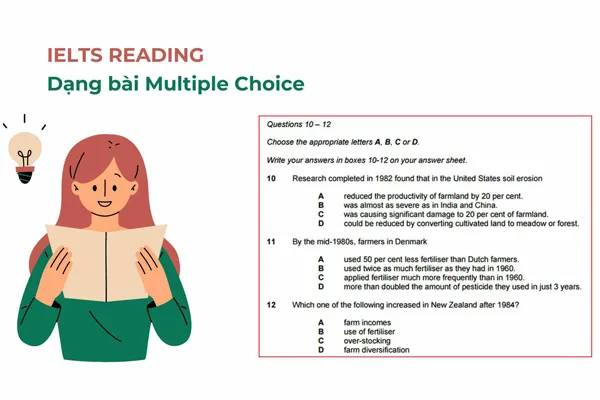
There are two main types of Multiple Choice questions:
- Select ONE correct answer: This is the most common format. Questions may begin with “According to the passage…”, “What is the main idea of…?”, or require you to complete an unfinished sentence.
- Select MULTIPLE correct answers: This is less common. You will be asked to choose two or three correct answers from a list. These questions usually take the form: “Which TWO/THREE of the following statements are true…?”
2. Strategies for IELTS Reading Multiple Choice
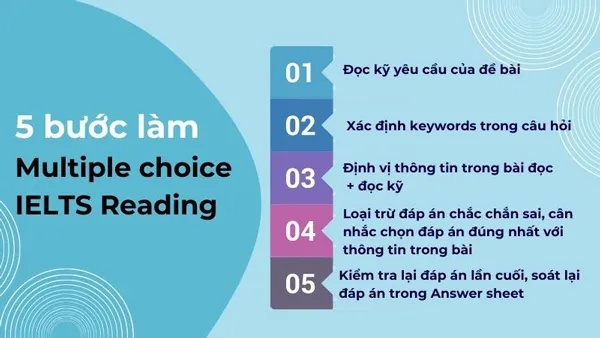
To achieve a high score in Multiple Choice, you need a clear and effective strategy. Below are the steps and techniques you can apply:
Step 1: Read the question and options carefully
- Identify the question type: Is it a single-choice or multiple-choice question? Does it ask for detailed information, the main idea, or the author’s purpose?
- Underline keywords: In both the question and the options, underline key terms that will help you locate information in the passage. Keywords are typically nouns, verbs, adjectives, or phrases that carry the core meaning.
- Watch for negative words: Words like “NOT”, “EXCEPT”, or “LEAST” can completely change the meaning of a question.
- Differentiate the options: Options are often designed to be confusing. Identify the differences between them to make elimination easier.
Step 2: Skimming and Scanning
- Skimming: Read the passage quickly to grasp the main idea and structure. Do not try to understand every single detail.
- Scanning: Based on your underlined keywords, “scan” the passage to find the specific section containing the relevant information.
Step 3: Read the relevant section closely
- Once you have located the likely spot for the answer, read that section (usually 1-2 sentences) carefully.
- Look for paraphrasing: Information in the questions and options is rarely phrased exactly the same way as in the text. Look for synonyms, antonyms, or equivalent expressions.
- Do not infer: Your answer must be based on INFORMATION IN THE TEXT. Do not speculate, add your own ideas, or rely on personal knowledge.
Step 4: Eliminate wrong answers and select the best one
- Elimination: Compare each option with the information in the passage. Eliminate answers that are clearly wrong (not mentioned, contradictory, or irrelevant).
- Choose the “best” answer: Sometimes, two options may seem correct. Choose the one that is the most comprehensive and accurate based on the text.
- If unsure, make an educated guess: Never leave a question blank. If you have eliminated some options, choose the one you think is most likely to be correct.
Step 5: Review your answers
3. Important tips for Multiple Choice questions
- Time management: Aim for about 1 minute per question. If you cannot find the answer within that time, move on and come back later if you have time.
- Don’t get stuck: If you are struggling with a specific question, mark it and return to it later.
- Read the whole passage: Don’t just read one part. Sometimes, information relevant to the question may be spread across different sections.
- Watch out for “trap” words:
- Absolute words: “always”, “never”, “only”, “all”, “none” are often signs of an incorrect answer, as information in the text is usually relative.
- Extreme words: “most”, “best”, “worst” should also be treated with caution.
- Similar words: Options may use words that look similar but carry different meanings.
- Pay attention to “not” or “except” questions: Typically, the correct answers for these types of questions will be information NOT mentioned in the text, or information that is FALSE.
Explore how to tackle other IELTS Reading question types:
- Identifying Information IELTS Reading
- Short Answer Questions IELTS Reading
- Matching Information IELTS Reading
4. Practice Exercise with Answers and Analysis
Passage:
The history of coffee is rich and fascinating. While the exact origins are shrouded in mystery, legend has it that coffee was first discovered in Ethiopia by a goat herder named Kaldi. He noticed that his goats became unusually energetic after eating berries from a particular tree. Intrigued, Kaldi tried the berries himself and experienced a similar effect. He shared his discovery with the local monastery, and the monks began experimenting with the berries, eventually creating a beverage that helped them stay awake during long hours of prayer.
From Ethiopia, coffee spread to the Arabian Peninsula, where it became a popular drink in the 15th century. Coffee houses, known as “qahveh khaneh,” sprang up in cities like Mecca and Cairo, becoming centers of social and intellectual life. Coffee cultivation and trade flourished, with Yemen becoming a major center for coffee production.
By the 17th century, coffee had made its way to Europe, where it initially faced opposition from some religious and political figures who viewed it as a “bitter invention of Satan.” However, coffee houses quickly became popular meeting places for artists, writers, and intellectuals, fueling the Age of Enlightenment. Coffee’s popularity continued to grow, and it eventually became one of the most widely consumed beverages in the world.
Today, coffee is a global commodity, grown in over 50 countries around the world. Different regions produce different varieties of coffee, each with its own unique flavor profile. From the bold and earthy Sumatran coffee to the bright and citrusy Ethiopian Yirgacheffe, there’s a coffee to suit every taste.
Questions:
-
According to the legend, how was coffee discovered? A. By a farmer who was looking for new crops. B. By a goat herder who observed his goats’ behavior. C. By monks who were searching for a way to stay awake. D. By traders who brought it from the Arabian Peninsula.
-
What was the initial reaction to coffee in Europe? A. It was immediately embraced by everyone. B. It was considered a healthy and beneficial drink. C. It faced some resistance from religious and political figures. D. It was only consumed by the wealthy elite.
-
Which of the following is NOT mentioned as a place where coffee became popular? A. Mecca B. Cairo C. Yemen D. Rome
-
Which TWO of the following statements about coffee are true, according to the passage? A. Coffee is only grown in Africa. B. Coffee was first discovered in Europe. C. Different regions produce coffee with different flavors. D. Coffee houses were important social centers. E. Kaldi consumed coffee to work long hours.
Answers and Explanations:
-
Answer: B
- Analysis: The question asks how coffee was discovered according to legend. Paragraph 1 states: “legend has it that coffee was first discovered in Ethiopia by a goat herder named Kaldi. He noticed that his goats became unusually energetic after eating berries from a particular tree.”
- Elimination:
- A is incorrect; it was not a farmer looking for new crops.
- C is incorrect; the monks only experimented after Kaldi’s discovery.
- D is incorrect; traders only brought coffee from the Arabian Peninsula, which was not the place of discovery.
-
Answer: C
- Analysis: The question asks about the initial reaction to coffee in Europe. Paragraph 3 states: “By the 17th century, coffee had made its way to Europe, where it initially faced opposition from some religious and political figures…”
- Elimination:
- A is incorrect; there was opposition.
- B is incorrect; it was not immediately considered a healthy drink.
- D is incorrect; there is no information stating it was only for the wealthy elite.
-
Answer: D
- Analysis: This is a NOT/EXCEPT question. We need to find the location NOT mentioned as a place where coffee became popular.
- A, B, and C are all mentioned in paragraph 2.
- D (Rome) is not mentioned.
- Note: In IELTS Reading, the correct answers for this type of question are typically information not found in the text.
- Analysis: This is a NOT/EXCEPT question. We need to find the location NOT mentioned as a place where coffee became popular.
-
Answer: C and D
- Analysis: This is a “select two” question. We need to find two pieces of information that are mentioned and true according to the passage.
- A is incorrect. Paragraph 4 states it is “grown in over 50 countries around the world,” not just Africa.
- B is incorrect. Paragraph 1 indicates it was first discovered in Ethiopia.
- C is correct. Paragraph 4: “Different regions produce different varieties of coffee, each with its own unique flavor profile.”
- D is correct. Paragraphs 2 and 3 mention: “… coffee houses … becoming centers of social and intellectual life,” and “…coffee houses quickly became popular meeting places for artists, writers, and intellectuals…”
- E is incorrect. Paragraph 1 says: “Kaldi tried the berries himself and experienced a similar effect,” meaning he also felt energetic, not that he consumed it to work long hours.
- Analysis: This is a “select two” question. We need to find two pieces of information that are mentioned and true according to the passage.
This article has provided a comprehensive overview of the Multiple Choice question type in IELTS Reading, including the format, test-taking strategies, essential tips, and a practice exercise with detailed analysis. Practice regularly to become familiar with this question type and improve your skills. Good luck!





 Khai giảng Khóa học Hè cực HOT.
Chưa có bình luận nào!