
Tóm Tắt Nội Dung Bài Viết
How long does it take to reach your target IELTS score? The answer isn’t simple; it depends on many factors, such as your current proficiency, your target score, and your study methods. This article will provide you with an overview and some helpful suggestions.
Assessing English proficiency on the 0 – 9.0 IELTS scale
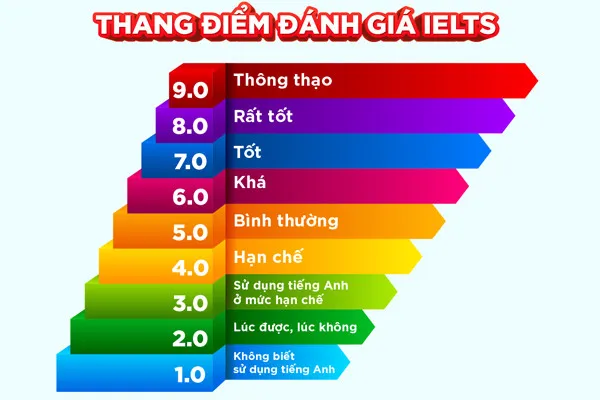
To give you a clearer picture of each IELTS band and the corresponding English proficiency, ECE has broken down and detailed each level from 0 to 9.0 as follows:
| IELTS Band |
English Proficiency
|
| 0 – 1.0 |
No ability to use English.
|
| 2.0 |
Very poor English usage; unable to communicate.
|
| 3.0 |
Can use a few simple words and phrases in familiar situations, but communication is extremely limited.
|
| 4.0 | Can use English in familiar situations but struggles with more detailed communication. Often uses simple sentence structures, which can lead to misunderstandings. |
| 5.0 | Can understand and use English in familiar contexts but struggles to express complex ideas. Writing and speaking skills still contain many errors. |
| 6.0 | Can understand most complex conversations and communicate with reasonable confidence, though errors in grammar and vocabulary occur in unfamiliar situations. |
| 7.0 | Communicates effectively in a variety of situations and can discuss abstract topics. Makes very few grammatical or vocabulary errors, though may not be fully proficient in highly complex topics. |
| 8.0 | Communicates fluently and accurately, with only occasional difficulties in highly specialized or complex topics. Listening, speaking, reading, and writing skills are all very strong. |
| 9.0 |
Communicates like a native speaker; understands and expresses ideas completely naturally and accurately in all situations. No significant errors in grammar, vocabulary, or pronunciation.
|
In Vietnam, the three target bands most students aim for when studying for the IELTS are 6.5, 7.0, and 8.0. Below is a detailed assessment of English proficiency across the four skills—listening, speaking, reading, and writing—for these three levels:
Band 6.5: Competent English User
- Listening: Can understand the main ideas of talks in many familiar contexts and follow conversations. However, may miss information in longer talks or when accents vary or the pace is too fast.
- Speaking: Communicates relatively fluently on familiar topics, but still makes grammatical and pronunciation errors; may pause to search for words when discussing difficult topics.
- Reading: Can understand medium to complex texts, including articles and academic materials. However, may struggle with specialized vocabulary and complex passages.
- Writing: Can write coherent and well-structured essays on familiar topics, but errors in grammar and unnatural phrasing persist. Ability to use vocabulary and link ideas is still limited.
Band 7.0: Good English User
- Listening: Understands most listening materials across various topics, with the ability to grasp detailed information, even in complex contexts. Ability to understand English with different accents and speeds is significantly improved.
- Speaking: Can speak coherently and fluently on a wide range of topics. Rarely needs to pause to search for words, though minor grammatical or pronunciation errors may still occur. Expresses ideas clearly and can argue points in complex conversations.
- Reading: Understands most texts, including academic and technical ones. Good grasp of complex vocabulary and sentence structures, though occasionally needs to re-read to fully grasp the meaning of a passage.
- Writing: Can write coherent essays with clear structure and use language flexibly, though minor vocabulary and grammatical errors may still appear in complex writing.
Band 8.0: Very Good English User
- Listening: Understands listening materials very well, even those spoken quickly or containing specialized vocabulary. Can follow and grasp detailed information in all situations.
- Speaking: Speaks very fluently and naturally. Expresses ideas coherently, with almost no errors in grammar, vocabulary, or pronunciation. Capable of debating complex topics without interruption.
- Reading: Understands complex and in-depth texts with ease, including academic or professional documents. Clearly understands both main ideas and fine details in the text.
- Writing: Can write complex, coherent essays with logical structure, using language with nuance and precision. Almost no grammatical or vocabulary errors, and knows how to create clear links between ideas.
Overall, English proficiency from band 6.5 to 8.0 shows a marked improvement in fluency, accuracy, and the ability to deeply understand complex listening and reading materials, as well as express ideas naturally in both writing and speaking.
How long does it take to learn IELTS? Detailed timeline to reach bands 6.5, 7.0, and 8.0

Learning IELTS is a long-term process that requires perseverance and effort, especially for those who have lost their English foundation and must start from scratch. ECE will help you build a detailed study roadmap, broken down into stages corresponding to each student’s level, to help you reach your goal easily.
Stage 1: From 0 – 3.0 IELTS (3 months with 48 study hours)
Listening Skills:
– Build foundational vocabulary from thematic listening exercises.
– Practice basic listening comprehension tasks at a moderate pace, gradually increasing speed.
Speaking Skills:
– Apply vocabulary learned in listening exercises to speaking practice.
– Apply grammar knowledge from Grammar-Writing sessions to speaking practice.
– Intensive pronunciation training, specifically correcting sounds heavily influenced by Vietnamese.
Reading Skills:
– Build foundational vocabulary from simple reading passages.
– Develop reading comprehension skills and logical thinking through open-ended questions.
Writing Skills:

– Grammar: Review basic sentence components, master basic verb tenses, and apply them to Listening, Reading, and Speaking exercises.
– Learn how to form complete simple sentences.
– Practice basic paraphrasing.
This is the study roadmap ECE has developed for learners with no English foundation to reach band 3.0 after 3 months of study at the center. You can view information about ECE’s IFA course here.
Stage 2: From 3.0 – 4.0 IELTS (9 weeks with 45 study hours)
Listening Skills:
– Build foundational vocabulary from thematic listening exercises. Listening passages are longer and more complex than in IFA but still manageable.
– Practice basic listening comprehension tasks at a faster pace than the IFA course.
Speaking Skills:
– Apply vocabulary learned in listening exercises to speaking practice.
– Apply grammar knowledge from Grammar-Writing sessions to speaking practice.
– Intensive pronunciation training, specifically correcting sounds heavily influenced by Vietnamese.
Reading Skills:
– Build foundational vocabulary from simple reading passages that are longer but manageable for IFB. Develop reading comprehension skills and logical thinking through open-ended questions.
Writing Skills:
– Grammar: Learn how to form compound sentences with increasing complexity.
– Learn to distinguish between different types of compound sentences and their purposes.
– Practice basic paraphrasing.
With the IFB course at ECE, you will reach band 4.0 IELTS after 45 hours of study over 9 weeks. You can view detailed information about the course here.
Stage 3: From 4.0 – 5.0 IELTS (10 weeks with 60 study hours)
Listening Skills:
– Expand vocabulary from listening passages.
– Practice through dictation.
– Paraphrasing practice.
– Get familiar with IELTS Listening question types (beginner level content).
Speaking Skills:
– Expand vocabulary across 8 basic topics.
– Intensive pronunciation training through shadowing practice.
– Get familiar with the Speaking test format and understand its purpose.
Reading Skills:
– Expand vocabulary from reading passages.
– Hone skimming and scanning skills through simple reading passages.
– Paraphrasing practice.
– Get familiar with IELTS Reading question types (beginner level content).
Writing Skills:
– Grammar: Review compound sentences learned previously.
– Paragraphs: Get familiar with different types of paragraphs and language, applying learned grammar knowledge to paragraph writing.
– Get familiar with Writing Task 1: structure and language for statistics.
This is the study roadmap ECE has developed for students at a 4.0 IELTS level to reach 5.0. You can view information about ECE’s IELTS Basic course here.
Stage 4: From 5.0 – 6.0 IELTS (10 weeks with 60 study hours)
Listening Skills:
– Enhance vocabulary from long and academic listening passages.
– Intensive paraphrasing practice.
– Intensive practice of IELTS Listening question types.
Speaking Skills:
– Expand vocabulary across 8 advanced social topics.
– Intensive pronunciation training through shadowing practice.
– Intensive practice for Speaking Parts 1, 2, and 3.
Reading Skills:
– Enhance vocabulary from difficult reading passages.
– Intensive skimming and scanning practice with longer, more difficult texts.
– Intensive paraphrasing practice.
– Intensive practice of IELTS Reading question types (intermediate level content).
Writing Skills:
– Grammar: Review compound sentences learned previously.
– Essays: Learn how to build a complete essay; understand the purpose of each section; learn how to form arguments and use different types of language.
– Writing Task 1: all types.
With 60 hours of study over 10 weeks, the IELTS Inter course at ECE will help you reach a 6.0 IELTS level. You can view detailed information about this course here.
Stage 5: From 6.0 – 6.5 IELTS (10 weeks with 60 study hours)

Listening Skills:
– Enhance vocabulary from long and academic listening passages.
– Intensive paraphrasing practice.
– Intensive practice of IELTS Listening question types (intermediate level content) under timed conditions.
Speaking Skills:
– Expand vocabulary across 8 advanced social topics.
– Intensive pronunciation training through shadowing practice.
– Intensive practice for Speaking Parts 1, 2, and 3.
Reading Skills:
– Enhance vocabulary from difficult reading passages.
– Intensive skimming and scanning practice with longer, more difficult texts.
– Intensive paraphrasing practice.
– Intensive practice of IELTS Reading question types (advanced level content) under timed conditions.
Writing Skills:
– Intensive practice in logical thinking to form persuasive arguments.
– Expand academic vocabulary for essays.
– Writing Task 1: understand task requirements and apply all learned knowledge.
– Practice writing under timed conditions.
With 60 hours of study over 10 weeks, the IELTS Hi-Inter course at ECE will help you reach a 6.5 IELTS level. You can view detailed information about this course here.
Stage 6: From 6.5 – 7.5+ (10 to 16 weeks)

Below is a detailed roadmap to raise your band from 6.5 to 7.5+ across all four skills: Listening, Reading, Writing, and Speaking. The roadmap lasts approximately 10 weeks, depending on your time and perseverance.
1. Listening Skills
– Goal: Understand fast-paced talks with complex vocabulary and topics, and get familiar with various accents and pronunciations.
– Practice time: 1 hour per day, 5-6 days/week.
Weeks 1 – 4:
Skill Analysis: Re-listen to difficult parts of band 6.5 IELTS Listening tests and identify reasons for errors (speed, vocabulary, accent).
Practice Resources:
– English podcasts (BBC, TED Talks, The Guardian).
– Watch international news channels (BBC News, CNN) to practice British and American accents.
Techniques:
– Listen and take notes on keywords.
– Listen to small segments and pause to identify difficult vocabulary and structures.
Weeks 5 – 8:
– Practice Tests: Practice IELTS Listening tests weekly, with detailed analysis after completion.
– Increase difficulty: Listen to talks with various accents (Australian, Canadian, Irish).
– Test Strategy: Practice time management and answering quickly.
Weeks 9 – 12:
– Intensive Paraphrasing: Focus on how to rephrase information to deal with paraphrased questions.
– Take full Listening practice tests weekly and aim for a 7.5+ score before the exam.
2. Reading Skills
– Goal: Quickly grasp and understand complex information and academic vocabulary.
– Practice time: 1 hour per day, 5-6 days/week.
Weeks 1 – 4:
– Expand vocabulary: Focus on academic vocabulary through IELTS vocabulary books (Cambridge, Collins).
– Skimming and Scanning Strategy: Practice skimming to find information quickly.
– Reading Resources: Academic articles, newspapers (The Economist, National Geographic, The Guardian).
Weeks 5 – 8:
– Practice Tests: Practice Reading tests weekly. Pay attention to checking time and analyzing errors.
– Improve reading speed: Use a stopwatch to push your speed.
Weeks 9 – 12:
– Focus on True/False/Not Given & Matching Headings: Intensive practice on the most difficult IELTS Reading question types.
– Take full Reading practice tests: Aim for 33 – 35 correct answers.
3. Writing Skills
– Goal: Reach at least band 7 in Writing with precise language and a tightly structured essay.
– Practice time: 1.5 hours per day, 5-6 days/week.
Weeks 1 – 4:
– Analyze current writing: Compare your writing with band 7.5+ sample essays.
– Practice Task 2 first: Focus on building clear ideas for argument essays (advantages, disadvantages, opinion essays).
Vocabulary and grammar: Learn academic phrases and complex grammar (linking words, conditional sentences).
Weeks 5 – 8:
– Practice Task 1: Focus on how to describe charts and trends (within 150 words).
– Feedback from teachers or peers: Receive regular feedback and make corrections.
– Practice under timed conditions: Practice writing both Task 1 and Task 2 in 60 minutes.
Weeks 9 – 12:
– Focus on coherence and cohesion: Use techniques to connect sentences and paragraphs.
– Practice Writing tests weekly: Try to improve from small errors and maintain proper writing time.
4. Speaking Skills
– Goal: Develop fluent, logical, and natural speaking ability with clear pronunciation.
– Practice time: 30 minutes – 1 hour per day, 5-6 days/week.
Weeks 1 – 4:
– Analyze band 6.5 Speaking: Review weaknesses in pronunciation, fluency, and vocabulary.
– Practice Topic Cards: Choose common topics in IELTS Speaking Part 2 to practice extended speaking skills.
– Practice Resources: Use speaking practice apps (Cambly, ELSA Speak) or find speaking partners through IELTS study groups.
Weeks 5 – 8:
– Focus on Part 3: Discuss and analyze questions that require giving opinions and debating.
– Vocabulary and phrases: Learn idioms and collocations to make answers sound more natural.
Weeks 9 – 12:
– Practice Speaking tests: Perform mock tests with teachers or friends to improve.
– Pronunciation and intonation: Focus on improving intonation to make your speech natural and easy to understand.
In summary, to reach your 7.5+ IELTS goal, you need to pay attention to the following key factors:
- Track your progress: Take comprehensive mock tests every two weeks to track your score and improve weaknesses.
- Correct based on feedback: Receive feedback from teachers or reliable assessment sources for continuous improvement.
- Increase study time: Intensify your practice in the final 2-3 weeks before the exam by taking tests continuously.
These are the detailed insights from the ECE language center to help you determine the time needed to reach your IELTS goals of 5.0, 6.0, 6.5, and 7.5+. We wish you success on your journey to conquering the IELTS!





 Khai giảng Khóa học Hè cực HOT.
Chưa có bình luận nào!