
Tóm Tắt Nội Dung Bài Viết
“High-Scoring IELTS Writing Model Answers” is a popular reference book for many IELTS candidates. While it provides a wealth of high-quality sample essays, it requires a strategic approach to ensure learners don’t fall into the trap of rote memorization.
In this article, ECE English provides a detailed review of the book based on five criteria: general overview, target audience, content breakdown, pros and cons, and an effective study workflow.
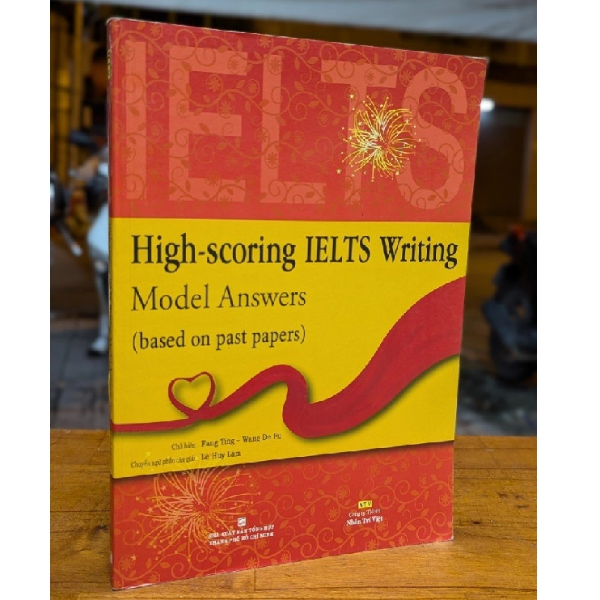
Overview of High-Scoring IELTS Writing Model Answers
First, here are the essential details you need to know about the book:
- Full Title: High-scoring IELTS Writing Model Answers (based on past papers)
- Authors: Fang Ting & Wang De Fu
- Publisher (in Vietnam): General Publishing House of Ho Chi Minh City & Nhan Tri Viet Co., Ltd.
- Main Content: The book features 79 sample essays selected from actual exam papers for both IELTS Academic and General Training, complete with vocabulary and grammatical structure analysis.
Target Audience Analysis
Determining whether this book is right for your current level is crucial for efficient study. “High-Scoring IELTS Writing” is designed for specific groups of learners.
❌ This book is NOT suitable for:
- Beginners (Band scores below 5.0): If you haven’t mastered basic sentence structures, tenses, or paragraph writing, this book may be overwhelming. Attempting to digest 7.5+ band samples filled with advanced vocabulary and complex structures can be counterproductive.
- Learners needing brainstorming techniques: This book provides finished products (sample essays) rather than teaching you the process of “how to generate ideas” for a brand-new prompt.
✅ This book IS suitable for:
- Learners at the 5.0 – 6.0 level: This is the ideal group. You likely have a solid grasp of grammar and essay structure, but your writing may still be simple, lacking academic vocabulary and sharp arguments. This book serves as an excellent tool to upgrade your language.
- Learners “stuck” at Band 6.5: You write accurately and meet the requirements, but you’re struggling to break through to a 7.0+. This book will highlight the nuances in collocations, complex grammar, and idea development used in higher-band essays.
Detailed Content Review
The 250-page book is divided into three clear sections, covering all common Writing task types:
Part 1: Argumentative Essays (IELTS Writing Task 2)
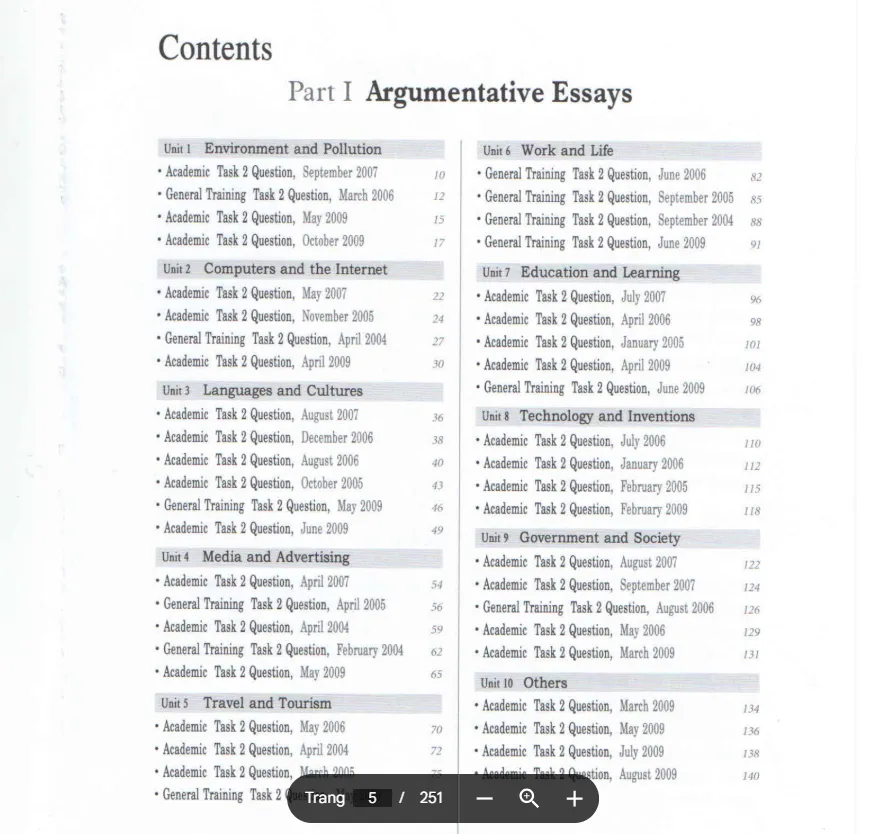
This is the core section, providing sample essays for 10 of the most common topics (each topic includes both Academic and General prompts):
- Unit 1: Environment and Pollution
- Unit 2: Computers and the Internet
- Unit 3: Languages and Cultures
- Unit 4: Media and Advertising
- Unit 5: Travel and Tourism
- Unit 6: Work and Life
- Unit 7: Education and Learning
- Unit 8: Technology and Inventions
- Unit 9: Government and Society
- Unit 10: Others
Part 2: Chart Essays (IELTS Writing Task 1 – Academic)
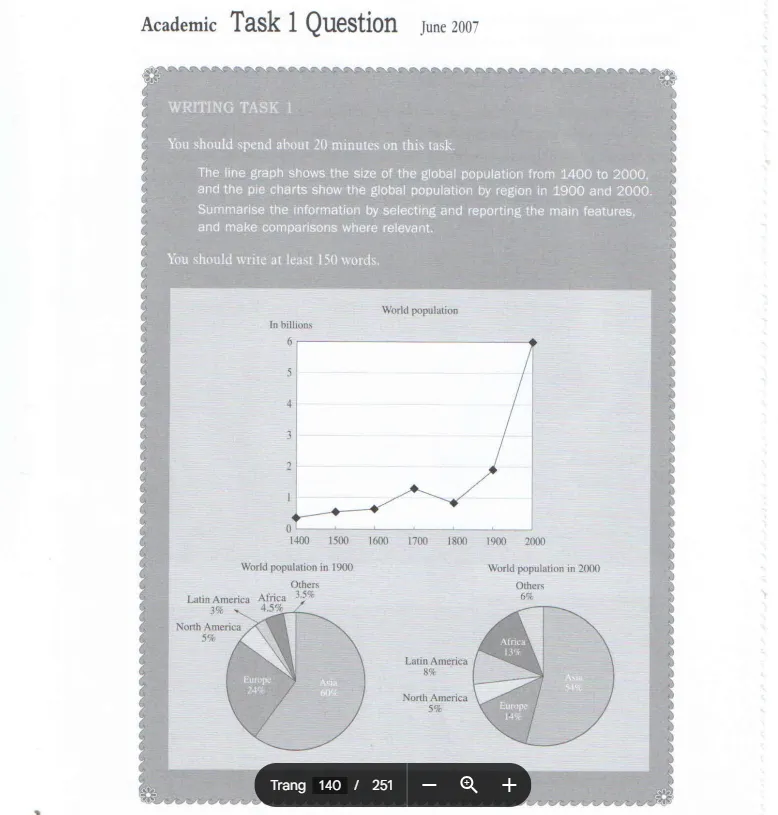
This section includes 5 units covering all Academic Task 1 chart types:
- Unit 1: Line Chart
- Unit 2: Bar Chart
- Unit 3: Pie Chart
- Unit 4: Table
- Unit 5: Diagram (Process)
Part 3: Letters (IELTS Writing Task 1 – General Training)
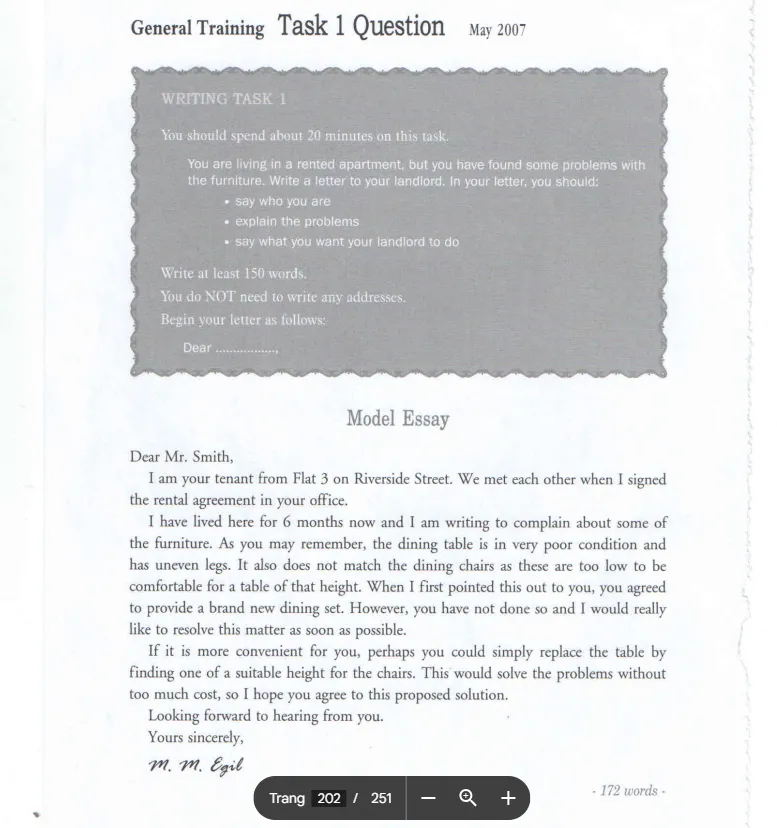
Dedicated to General Training candidates, this section covers 3 units for the main letter types:
- Unit 1: Letter of Complaint / Suggestion
- Unit 2: Letter of friendship
- Unit 3: Letter of application / invitation / thanks / enquiry
Key highlights: The book’s value lies not just in the samples, but in the two sections following each essay:
- Key Vocabulary: Lists useful vocabulary with Vietnamese translations (by translator Le Huy Lam), helping you grasp the exact meaning and context.
- Practical Sentence Patterns: This is arguably the most valuable part. The book selects 1-2 high-impact grammatical structures from the essay (e.g., “take… measures to…”, “There is no denying the fact that…”) and provides a thorough explanation of how to use them. This is where the book offers truly practical instruction.
Pros and Cons of High-Scoring IELTS Writing Model Answers
Pros
- Practical Grammar Analysis: The “Practical Sentence Patterns” section is a standout feature, teaching you how to use advanced grammar in context rather than just learning dry theory.
- Bilingual Support: The “Key Vocabulary” section is translated and explained in Vietnamese, saving learners time and deepening their understanding.
- Comprehensive Coverage: With 79 sample essays, the book covers a wide range of task types and topics for both Academic and General Training.
- Accessible Language: As stated in the book (page 3), the samples use “simple language and familiar structures” while still meeting high-band standards. This makes it very approachable for 5.0 – 6.0 level learners.
Cons
- Dated Content: This is a significant drawback. Although the book claims to be “based on past papers,” the Appendix (page 243) shows these prompts are primarily from 2007-2009. While general topics like Education or the Environment remain relevant, specific prompts may not reflect the latest exam trends.
- Risk of Rote Memorization: This is a major risk with any sample essay book. If you simply read and copy, you will develop a rigid, formulaic writing style that examiners often penalize.
- No Brainstorming Instruction: The book does not teach you how to generate ideas for completely new prompts.
How to Study Effectively (5-Step Process)
To maximize the book’s effectiveness and avoid rote memorization, do not read the sample essays immediately. Follow this 5-step practical workflow:
Step 1: Brainstorm & Outline
Before looking at the sample, work on the prompt yourself. Choose a topic, set a 10-minute timer, and analyze the prompt, brainstorm ideas, and organize them into a detailed outline. This step is crucial as it helps you identify your own struggles (e.g., running out of ideas, difficulty organizing arguments) before being influenced by the author’s work.
Step 2: Analyze & Compare
Now, open the sample essay. Instead of reading word-for-word, compare their outline with yours. Ask yourself:
- What main arguments did they choose? Are they similar to yours?
- How did they organize their points? (e.g., Body 1 for support, Body 2 for opposition, or both supporting?)
- Analyze paragraph structure: How did they paraphrase the prompt and present the Thesis Statement? Does each body paragraph have a clear Topic Sentence? What Supporting Ideas did they use to defend their argument?
Step 3: Language Mining
Now, dive into the details. Read the sample carefully and use a highlighter to underline:
- Collocations: 5-7 useful phrases you wouldn’t have thought of yourself (e.g., “financial burden”, “environmental degradation”).
- Vocabulary: High-impact academic vocabulary.
- Grammar: Read the “Practical Sentence Patterns” section thoroughly. This is the most valuable part of the book, helping you understand how to use complex grammar (cleft sentences, inversions, clauses) naturally.
Step 4: Active Summarizing
Don’t just copy vocabulary. Create an active vocabulary list. For each useful phrase (from Step 3), write a new example sentence of your own. This helps transform the book’s vocabulary into your own. Note down the “Practical Sentence Patterns” in a separate grammar notebook for review.
Step 5: Rewrite in Your Own Words
This is the most important step. Close the book. Return to your outline (from Step 1). Now, write a complete essay for that prompt yourself.
- Goal: Try to use your own ideas, but incorporate the language tools (vocabulary, collocations, grammar structures) you just “mined” in Steps 3 and 4. By doing this, you are practicing how to use advanced language to express your own ideas, rather than copying someone else’s.
By following this method, you are actively absorbing knowledge and making it your own, rather than passively copying.
Conclusion
“High-Scoring IELTS Writing Model Answers” is a useful reference, especially for its grammar analysis and bilingual vocabulary support. While the prompts are dated, the topics and argumentative methods remain valuable. Do not use this book for copying; instead, treat it as a resource for analysis and learning. If used correctly with the 5-step process above, it will be an effective tool to help you improve your writing skills.





 Khai giảng Khóa học Hè cực HOT.
Chưa có bình luận nào!