


Tóm Tắt Nội Dung Bài Viết
Have you ever imagined yourself completing something by a specific point in the future? For example, by the end of this year, you will have finished an English course. Or, by this time next week, you will have arrived somewhere? To describe actions that will be completed before a specific time or another action in the future, we use a special grammatical tense: the Future Perfect Tense.
This tense helps you “look ahead” and define results or milestones. Mastering it not only makes your conversations about long-term plans clearer but also demonstrates sophistication and control over English grammar. It is an essential tool, especially when you need to plan, set goals, or predict future achievements.
What is the Future Perfect?
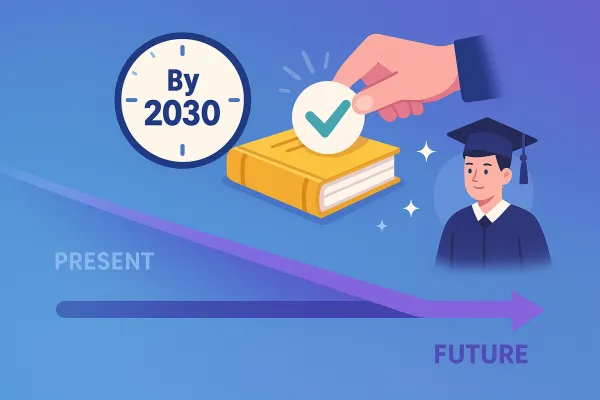
The Future Perfect tense is used to describe:
-
An action that will be completed before a specific time in the future: The action will finish before the mentioned time frame.
Example: By 2030, I will have graduated from university.
Example: She will have finished her report by noon tomorrow.
-
An action that will be completed before another action in the future: The action in the Future Perfect tense is the one that happens and finishes first.
Example: When you arrive, I will have prepared dinner.
Example: They will have cleaned the house before their parents get home.
Future Perfect Formulas
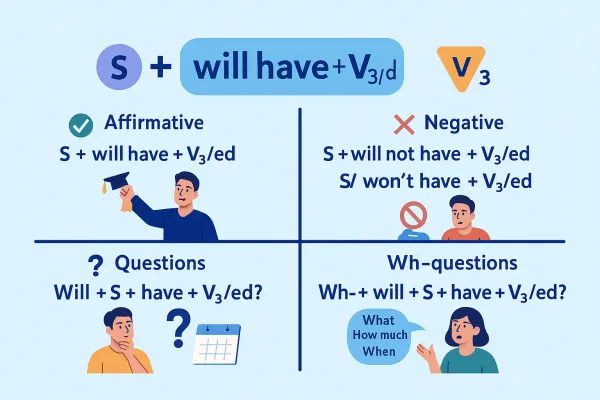
Mastering the formula helps you construct grammatically correct sentences, specifically by using the “will have + past participle (V3/ed)” structure correctly.
(Note: S: Subject, V3/ed: Past Participle, O: Object, A: Adverbial. Contraction: will not = won’t)
Key Point: The auxiliary “will have” does not change based on the subject (regardless of whether it is singular, plural, or first/second/third person). The main verb is always in the past participle form (V3/ed).
Detailed Usage of the Future Perfect
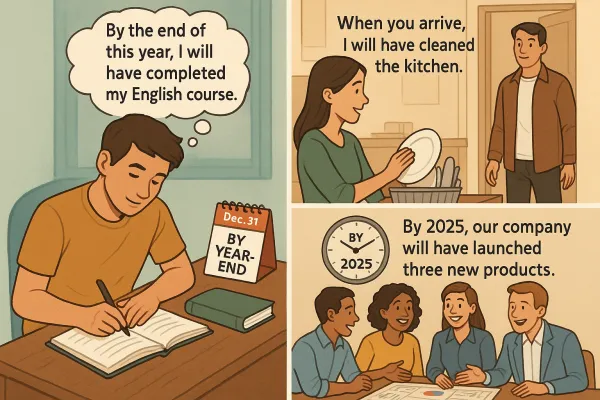
Understanding these usage scenarios helps you apply this tense flexibly and accurately, especially for setting future milestones.
Actions completed before a specific time in the future
This is the most important usage, emphasizing the result of an action achieved by a specific future point. It is often accompanied by time phrases containing “by” or “before” and a future time marker.
Example: By the end of this month, I will have paid off all my debts.
Example: By 2040, renewable energy sources will have become the primary power supply globally.
Application: Very useful when discussing long-term goals, plans, economic forecasts, or scientific projections.
Actions completed before another action in the future
The action in the Future Perfect tense is the one that happens and finishes first. The second action (occurring later) is usually expressed in the Present Simple (as it is a time clause for the future, so the future tense is not used).
It is often accompanied by time conjunctions such as: when, before, after, as soon as, until.
Example: When you wake up, I will have already left for work.
Example: After I have finished my studies, I will look for a job. (Note: Using the Present Perfect in time clauses is common).
Application: Helps sequence future events clearly.
Expressing the duration of an action up to a future point
When you want to emphasize the duration of an action leading up to a specific future point, the Future Perfect Continuous is typically used. However, the Future Perfect can also be used with certain verbs that do not describe a process or when emphasizing the result of the duration.
Example: By next month, I will have worked here for five years. (Emphasizing the result of the duration.)
Comparison: By next month, I will have been working here for five years. (Future Perfect Continuous, emphasizing the continuous process up to that point.)
Application: Common when talking about work experience, time spent living or studying, etc., up to a future milestone.
In Reported Speech
When the reporting verb is in the past, the Future Perfect in direct speech usually shifts back or changes structure to suit the context.
Example: He said, “I will have completed the project by Friday.” He said that he would have completed the project by Friday. (Will shifts to would.)
Identifying the Future Perfect
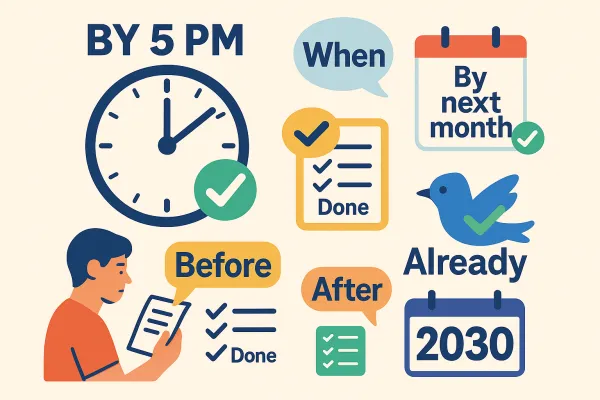
The Future Perfect tense is often accompanied by adverbs and time phrases that help define the future completion point.
Time phrases with “by”
- By + future time marker:
by 5 PM, by next week, by the end of the year, by 2030…
Example: I will have finished my homework by tomorrow morning.
- By then:
Example: He will have graduated by then.
Time conjunctions connecting two future actions: (Subordinate clauses usually use Present Simple or Present Perfect).
- Before:
Example: She will have gone to bed before you arrive.
- When:
Example: When you call, I will have cooked dinner.
- After: (Subordinate clause uses Present Perfect).
Example: After I have saved enough money, I will buy a car.
- As soon as: (Subordinate clause uses Present Simple or Present Perfect).
Example: As soon as the meeting ends, they will have discussed everything.
- Until / Till:
Example: I won’t have completed the report until Friday.
Implicit Context: Sometimes, the context of the sentence is enough to indicate that an action will be completed before something else in the future.
Example: Don’t worry about dinner. I will have taken care of it. (Implied: before you arrive or before mealtime.)
Rules for Conjugating the Future Perfect
Accurately conjugating the Future Perfect requires using the correct auxiliary “will have” and the past participle (V3/ed) of the main verb.
Using the past participle (V3/ed)
This is a key rule.
-
Regular Verbs: Add “-ed” to the base form. (The rules for adding -ed are the same as for the Past Simple).
- work worked
- finish finished
- clean cleaned
-
Irregular Verbs: Use the past participle (V3) form. This requires memorization from the irregular verb list.
- be been
- go gone
- do done
- see seen
- eat eaten
- write written
The auxiliary “will have” is invariable
- This is a convenient feature of the Future Perfect. The auxiliary phrase “will have” is always used, regardless of whether the subject is first, second, or third person, singular or plural.
- Example: I will have finished.
- Example: He will have finished.
- Example: They will have finished.
The Future Perfect in Specific Contexts
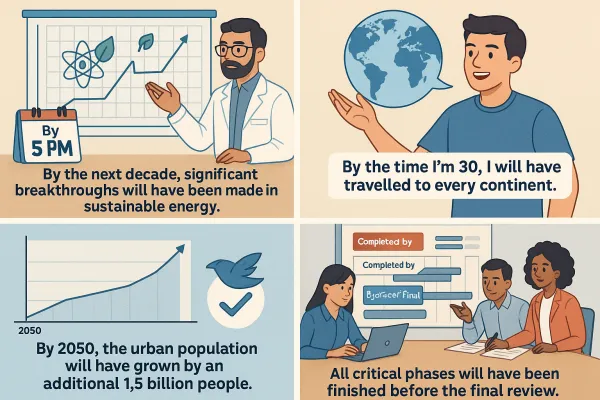
a. In General Academic Writing
The Future Perfect is essential when presenting predictions, goals, or expected outcomes of future research.
- Predicting future achievements or states:
Example: By the end of this century, significant progress will have been made in developing sustainable energy technologies.
- Stating completion goals for a project or study:
Example: This research project will have explored the full implications of the new policy by the time the final report is due.
b. In IELTS Writing Task 1 (Academic – Describing charts, maps, processes)
This tense is used when a chart has projected data for a specific future point, or to describe the completion stages of a project.
- Predicting trends or completion of events on a chart:
Example: By 2050, the global population will have reached approximately 10 billion, with a significant increase in urban areas.
- Describing changes to be completed on a map:
Example: By the time the new residential area is fully developed in 2030, all necessary infrastructure will have been constructed.
c. In IELTS Writing Task 1 (General Training – Letter writing)
The Future Perfect is useful when you need to clearly state that a task will be completed by a specific time or before another event.
- Stating a task you will have completed:
Example: By the time you receive this letter, I will have already left for my vacation.
Example: I will have completed all the necessary arrangements before the event begins.
d. In IELTS Writing Task 2 (Essay writing)
The Future Perfect adds depth to arguments by offering predictions about achievements, consequences, or the completed state of an issue in the future.
- Predicting what society will achieve or face in the future:
Example: If current trends continue, the internet will have fundamentally transformed education and communication by the middle of the century.
- Predicting the results of policies or actions:
Example: Should effective measures be taken, global warming will have been mitigated to a certain extent by 2070.
e. In IELTS Speaking Part 1 (Answering personal questions)
This tense is less common than the Future Simple but can be used when discussing personal goals you will have achieved.
Example:
Q: What do you hope to achieve by the end of this year? A: By the end of this year, I hope I will have improved my English skills significantly.
f. In IELTS Speaking Part 2 (Long Turn)
You can use the Future Perfect when describing a personal goal or a future event that you expect to complete before a certain milestone.
Example: (Describe a goal you want to achieve) One of my biggest goals is to run a marathon. By the time I’m 30, I will have completed at least one full marathon.
Example: (Describe a future event you are looking forward to) I’m really excited about my sister’s wedding next year. By the time the ceremony starts, I will have finished my speech, so I can relax and enjoy.
g. In IELTS Speaking Part 3 (In-depth discussion)
The Future Perfect helps discuss more complex predictions about the future, especially regarding achievements or challenges that will be resolved.
- Discussing achievements or issues that will be resolved in the future:
Example: Do you think by 2050, we will have found a cure for all major diseases?
- Predicting societal changes:
Example: I believe that in just a few decades, artificial intelligence will have revolutionized almost every aspect of our daily lives.
Upgrading your expression with the Future Perfect in IELTS
To make your writing and speaking more natural, flexible, and impressive, using a variety of structures and adverbs with the Future Perfect is essential.
a. Using synonyms for “by”:
- By the time / Before / Prior to:
Example: Prior to the next election, the government will have launched several key infrastructure projects.
- At the completion of / Upon completion of:
Example: Upon completion of the building, it will have become the tallest in the city.
b. Combining with other tenses accurately:
- Future Perfect + Present Simple (in time clauses):
Example: I will have cooked dinner when you arrive.
- Future Perfect + Future Perfect Continuous: (Future Perfect Continuous emphasizes duration up to a point, Future Perfect emphasizes the result/completion.)
Example: By 5 PM, I will have been studying for 6 hours, and I will have completed two chapters.
- Using “be going to have + V3/ed” (less common, but emphasizes the intention to complete):
Example: We are going to have completed the renovation by Christmas.
c. Using adverbs and structures to emphasize predictions/possibility:
- Likely / Probably / Certainly / Undoubtedly (with “will have”):
Example: By 2040, the global population will undoubtedly have exceeded 9 billion.
- It is expected/projected that… will have…:
Example: It is projected that by the end of this decade, renewable energy will have accounted for 50% of the world’s power supply.
d. Using the passive voice of the Future Perfect: will have been + V3/ed
Example: By next year, the new bridge will have been built.
Important notes for IELTS:
- Accuracy: Ensure you use the “will have + V3/ed” structure correctly. Distinguish it clearly from the Future Simple (will happen) and Future Perfect Continuous (will be happening up to a point).
- Range: Use the Future Perfect purposefully to describe completed actions in the future, especially when discussing goals, predictions, or results.
- Coherence and Cohesion: Use time conjunctions (“by”, “before”, “when”) accurately to link ideas and clarify the temporal relationship
Chia sẻ:

 Khai giảng Khóa học Hè cực HOT.
No comments yet!