
Tóm Tắt Nội Dung Bài Viết
Grammar is the “backbone” of any language and is especially crucial on your journey to conquering IELTS. Having mastered the fundamentals and understood the role of grammar in each skill set through our previous ECE article, it’s now time to dive deep into practice!
In this article, ECE brings you a collection of high-quality IELTS grammar exercises, designed to mirror the actual exam format. These exercises will help you reinforce your knowledge, identify common mistakes, and improve your ability to use grammar with precision and confidence. Let’s start training to build a solid grammatical foundation and reach your target IELTS score!
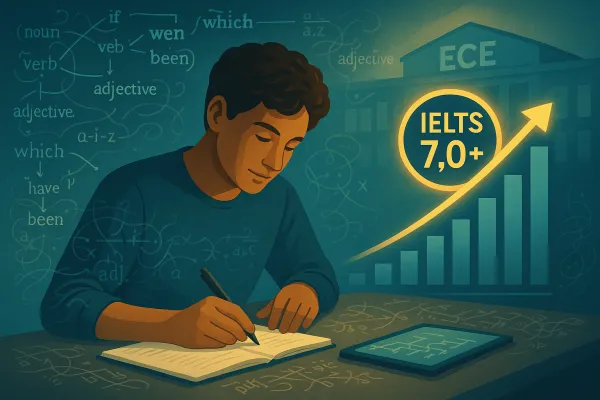
Type 1: Tenses – Building a Temporal Foundation
Description: This exercise tests your ability to use various English tenses accurately—a core requirement for both Writing and Speaking in the IELTS exam.
Exercise: Put the verbs in brackets into the most appropriate tense.
- By this time next year, Sarah (complete) her Master’s degree.
- I (not visit) my grandparents since last Christmas.
- Right now, the scientists (conduct) experiments in the lab.
- The company (expand) its market share steadily for the past two decades.
- Last night, as I (walk) home, it suddenly (start) to rain heavily.
- If the government (invest) more in public transport, traffic congestion (decrease) significantly.
- Water (freeze) at 0 degrees Celsius.
- He (work) on his thesis all day yesterday, so he was exhausted.
- By the time the rescue team (arrive), the fire (already spread) to the next building.
- I promise I (submit) the report before the deadline.
Type 2: Word Forms & Word Families – Expanding Vocabulary and Precision
Description: This exercise requires you to transform root words into the correct form (noun, verb, adjective, adverb) to complete sentences. This is an essential skill for achieving a high Lexical Resource score in Writing and Speaking, as well as improving Reading comprehension.
Exercise: Fill in the correct form of the word in brackets to complete each sentence.
- The rapid ____________ of technology has transformed our lives. (develop)
- She spoke ____________ and clearly, captivating the audience. (eloquence)
- His proposal was met with strong ____________ from the committee. (object)
- The company aims to provide ____________ solutions to its customers. (innovate)
- ____________, the weather cleared up just in time for the outdoor event. (fortune)
- The government is committed to ensuring the ____________ of its citizens. (secure)
- Despite facing numerous challenges, she maintained a positive ____________. (attitude)
- The economic downturn led to a significant ____________ in consumer spending. (reduce)
- The new policy received widespread ____________ from the public. (approve)
- His ability to connect with people makes him an incredibly ____________ leader. (influence)
Type 3: Passive Voice – Optimizing Academic Style
Description: This exercise tests your ability to convert and use the passive voice, a crucial structure for expressing ideas objectively and formally in IELTS Writing Task 1 and Task 2.
Exercise: Convert the following active sentences into the passive voice.
- The company will launch a new product next month.
- A renowned architect designed this iconic building.
- Students have to submit their assignments by Friday.
- The local authorities are building a new hospital in the city center.
- Someone stole my bicycle last night.
- They had already completed the research before the deadline.
- You must follow the safety regulations strictly.
- Scientists are conducting extensive experiments on the new vaccine.
- People believe that he is the most influential person in the industry.
- The government should have addressed this issue much earlier.
Type 4: Relative Clauses – Connecting Ideas Coherently
Description: Relative clauses help you provide additional information and create complex sentences, contributing to a higher Grammatical Range score in Writing and Speaking, while also improving reading comprehension.
Exercise: Combine the following pairs of sentences into one using a relative clause (add commas if necessary).
- The woman is my English teacher. She lives next door.
- I visited the city. I was born there.
- This is the book. I told you about it yesterday.
- My brother is a doctor. His car is parked outside.
- The new restaurant serves delicious food. It opened last week.
- I vividly remember the day. We first met on that day.
- The reason is unclear. He resigned for that reason.
- John, who is a brilliant student, received a scholarship. He studied at ECE. (Reduce the relative clause)
- The report was submitted this morning. It was written by the team. (Reduce the relative clause)
- The children were playing in the park. They seemed very happy.
Type 5: Conditional Sentences – Expressing Hypotheses and Cause-Effect
Description: Conditional sentences allow you to propose hypotheses, discuss potential outcomes, or talk about unreal situations, which is vital for IELTS Speaking Part 3 and Writing Task 2.
Exercise: Complete the following sentences by putting the verbs in brackets into the correct conditional structure.
- If the global temperature (continue) to rise, sea levels (increase) significantly.
- If I (know) about your problem, I (help) you immediately. (hypothetical past)
- What (you/do) if you (win) the lottery?
- Unless you (study) consistently, you (not achieve) your desired IELTS score.
- If he (be) a more experienced leader, he (handle) the crisis better. (hypothetical present)
- If you (heat) ice, it (melt).
- The project (not succeed) if the team (not cooperate) effectively.
- Had I (realize) the importance of the event, I (attend) it.
- If she (not be) so shy, she (make) more friends.
- I (buy) that house if I (have) enough money last year. (hypothetical past)
Type 6: Advanced & Mixed Exercises – Diverse Structures, Increased Difficulty
Description: This exercise tests your ability to use more complex grammatical structures such as inversion, hypothetical constructions (wish, if only), noun clauses, adverbial clauses, and reduced clauses, helping you demonstrate flexibility and high precision in the exam.
Exercise: Complete the following sentences as requested.
- Hardly ____________ (I / arrive) at the station when the train left. (Use inversion)
- ____________ (work) all day, he felt exhausted. (Reduce the adverbial clause)
- It is crucial that the new regulations ____________ (implement) immediately. (Use the subjunctive mood)
- I wonder ____________ he managed to finish the complex task on time. (Fill in the appropriate question word for the noun clause)
- The ancient temple, ____________ by tourists from all over the world, is a historical masterpiece. (Reduce the passive relative clause)
- The more he practiced, ____________ he played. (Use double comparatives)
- “I have never been to Japan.” “____________.” (Write a response showing negative agreement)
- I wish I ____________ (can / fly) like a bird. (Use the subjunctive with “wish” for the present)
- The new policy (discuss) thoroughly by the committee before its implementation. (Fill in the correct verb form, passive voice may be required)
- The company that ____________ (manufacture) these cars is known for its quality. (Reduce the relative clause)
Answer Key and Detailed Explanations
ECE provides not only the answers but also in-depth explanations of the underlying reasons, relevant grammar rules, and important notes so you can clearly understand the nature of your mistakes and how to apply the correct rules in similar situations. This is the key to not just “memorizing” but “truly mastering” grammar.
Answer Key & Explanation: Type 1 (Tenses)
- By this time next year, Sarah will have completed her Master’s degree.
- Explanation: “By this time next year” is a signal for the Future Perfect tense, describing an action that will be completed before a specific point in the future.
- I haven’t visited my grandparents since last Christmas.
- Explanation: “Since last Christmas” is a signal for the Present Perfect tense, describing an action that started in the past and continues to the present or has a result relevant to the present.
- Right now, the scientists are conducting experiments in the lab.
- Explanation: “Right now” is a signal for the Present Continuous tense, describing an action happening at the moment of speaking.
- The company has been expanding its market share steadily for the past two decades.
- Explanation: “For the past two decades” and “steadily” suggest the Present Perfect Continuous tense, emphasizing the continuous process of an action that started in the past and continues to the present.
- Last night, as I was walking home, it suddenly started to rain heavily.
- Explanation: “As I was walking” (Past Continuous) describes an action in progress at a point in the past, and “it suddenly started” (Past Simple) describes a sudden action that interrupted it.
- If the government invests more in public transport, traffic congestion will decrease significantly.
- Explanation: This is a First Conditional sentence, describing a condition that is possible in the present or future and its likely result.
- Water freezes at 0 degrees Celsius.
- Explanation: This is a scientific fact and a natural law, so the Present Simple tense is used.
- He had been working on his thesis all day yesterday, so he was exhausted.
- Explanation: “All day yesterday” and the result “was exhausted” indicate the Past Perfect Continuous tense, emphasizing the prolonged process of an action that ended in the past and led to a past result.
- By the time the rescue team arrived, the fire had already spread to the next building.
- Explanation: “By the time” and two past actions indicate the Past Perfect tense (“had spread”) for the action that happened before the Past Simple action (“arrived”).
- I promise I will submit the report before the deadline.
- Explanation: “I promise” is a signal for a promise, using the Future Simple tense.
Answer Key & Explanation: Type 2 (Word Forms)
- The rapid development of technology has transformed our lives.
- Explanation: After the adjective “rapid,” a noun is needed to form the noun phrase “rapid development.”
- She spoke eloquently and clearly, captivating the audience.
- Explanation: “Spoke” is a verb, so an adverb is needed to modify how she spoke. “Eloquently” is the adverb form of “eloquence.”
- His proposal was met with strong objection from the committee.
- Explanation: After the adjective “strong,” a noun is needed to form the noun phrase “strong objection.”
- The company aims to provide innovative solutions to its customers.
- Explanation: Before the noun “solutions,” an adjective is needed to modify it. “Innovative” is the adjective form of “innovate.”
- Fortunately, the weather cleared up just in time for the outdoor event.
- Explanation: The adverb “Fortunately” is placed at the beginning of the sentence to modify the entire sentence, expressing a fortunate event.
- The government is committed to ensuring the security of its citizens.
- Explanation: After the article “the” and before the preposition “of,” a noun is required. “Security” is the noun form of “secure.”
- Despite facing numerous challenges, she maintained a positive attitude.
- Explanation: After the adjective “positive,” a noun is required. “Attitude” is the correct noun.
- The economic downturn led to a significant reduction in consumer spending.
- Explanation: After the adjective “significant,” a noun is required. “Reduction” is the noun form of “reduce.”
- The new policy received widespread approval from the public.
- Explanation: After the adjective “widespread,” a noun is required. “Approval” is the noun form of “approve.”
- His ability to connect with people makes him an incredibly influential leader.
- Explanation: Before the noun “leader,” an adjective is required to modify it. “Influential” is the adjective form of “influence.”
Answer Key & Explanation: Type 3 (Passive Voice)
- A new product will be launched by the company next month.
- Explanation: The active sentence uses the Future Simple tense, so the passive voice is
will + be + V3/ed.
- Explanation: The active sentence uses the Future Simple tense, so the passive voice is
- This iconic building was designed by a renowned architect.
- Explanation: The active sentence uses the Past Simple tense, so the passive voice is
was/were + V3/ed.
- Explanation: The active sentence uses the Past Simple tense, so the passive voice is
- Their assignments have to be submitted by Friday.
- Explanation: The active sentence uses the modal verb “have to,” so the passive voice is
have to + be + V3/ed.
- Explanation: The active sentence uses the modal verb “have to,” so the passive voice is
- A new hospital is being built by the local authorities in the city center.
- Explanation: The active sentence uses the Present Continuous tense, so the passive voice is
am/is/are + being + V3/ed.
- Explanation: The active sentence uses the Present Continuous tense, so the passive voice is
- My bicycle was stolen last night.
- Explanation: The active sentence uses the Past Simple tense. The agent “Someone” does not need to be mentioned in the passive voice.
- The research had already been completed by them before the deadline.
- Explanation: The active sentence uses the Past Perfect tense, so the passive voice is
had + been + V3/ed.
- Explanation: The active sentence uses the Past Perfect tense, so the passive voice is
- The safety regulations must be followed strictly.
- Explanation: The active sentence uses the modal verb “must,” so the passive voice is
must + be + V3/ed.
- Explanation: The active sentence uses the modal verb “must,” so the passive voice is
- Extensive experiments on the new vaccine are being conducted by scientists.
- Explanation: The active sentence uses the Present Continuous tense, so the passive voice is
am/is/are + being + V3/ed.
- Explanation: The active sentence uses the Present Continuous tense, so the passive voice is
- He is believed to be the most influential person in the industry. / It is believed that he is the most influential person in the industry.
- Explanation: This is a passive construction with reporting verbs. There are two ways to convert it, as learned.
- This issue should have been addressed much earlier by the government.
- Explanation: The active sentence uses
should have + V3/ed, so the passive voice isshould have + been + V3/ed.
- Explanation: The active sentence uses
Answer Key & Explanation: Type 4 (Relative Clauses)
- The woman who/that lives next door is my English teacher. (Defining Relative Clause)
- Explanation: “Who” or “that” replaces the person (“The woman”) and acts as the subject in the relative clause.
- I visited the city where I was born. / I visited the city in which I was born.
- Explanation: “Where” replaces the place (“the city”).
- This is the book which/that I told you about yesterday.
- Explanation: “Which” or “that” replaces the object (“the book”) and acts as the object in the relative clause.
- My brother, whose car is parked outside, is a doctor. (Non-defining Relative Clause)
- Explanation: “Whose” indicates possession (“car of my brother”). Non-defining clauses are separated
Chia sẻ:
- Explanation: “Whose” indicates possession (“car of my brother”). Non-defining clauses are separated




 Khai giảng Khóa học Hè cực HOT.
Chưa có bình luận nào!