


Tóm Tắt Nội Dung Bài Viết
Vocabulary is the key to unlocking a high score in the IELTS exam. A rich vocabulary not only helps you understand questions and express your ideas, but it also clearly demonstrates your language proficiency and precision in communication. This article from ECE Language Center will guide you through the most effective vocabulary learning strategies, helping you not only memorize words for the long term but also use them flexibly across every section of the test.
The Importance of Vocabulary in the IELTS Exam
In the IELTS exam, vocabulary is a crucial factor that contributes significantly to achieving high scores across all skills, especially in Writing and Speaking. According to the IELTS assessment criteria, vocabulary accounts for 25% of the total score for both the Writing and Speaking sections, making the development of a diverse lexicon essential.
- Writing and Speaking Skills: Vocabulary plays a vital role in expressing ideas and building arguments. An essay or a Speaking response that uses a rich range of vocabulary, avoids repetition, and uses words in the correct context will be highly rated by examiners.
- Reading and Listening Skills: Although vocabulary is not directly graded here, learners still need a broad vocabulary to fully understand question content, synonyms, and academic terminology.
Therefore, building a solid vocabulary foundation will help you feel confident, allowing you to handle each section of the IELTS exam quickly and accurately.
Effective IELTS Vocabulary Learning Methods
Learning Vocabulary by Topic
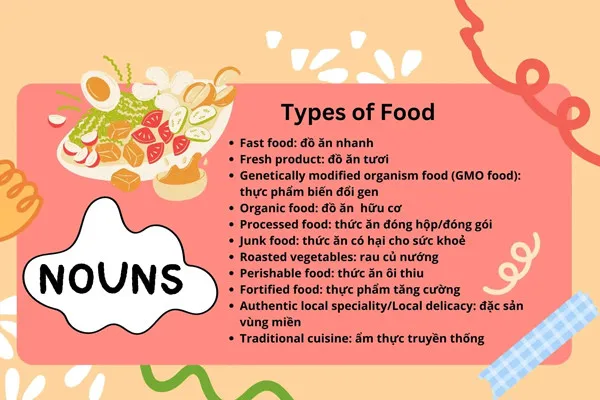
Learning words by topic helps you connect them within thematic groups, making them easier to memorize and improving your recall speed when you encounter similar topics in the exam.
How to do it: Choose familiar IELTS topics such as Environment, Technology, Health, Education, and Travel. Then, learn words related to each of these themes.
Specific example: When studying the topic of Food, you can divide vocabulary into smaller groups like “starter,” “main course,” and “dessert,” and learn food-related idioms like “a piece of cake.”
Check out: 5,000 IELTS Vocabulary Words by Topic
Learning Synonyms and Antonyms
Using synonyms and antonyms helps enrich your exam performance, minimizes word repetition, and improves your Lexical Resource score.
How to do it: Find synonyms or antonyms for words you already know and apply them to specific sentences or contexts.
Example: Instead of using the word “important” repeatedly, you can replace it with “crucial,” “essential,” or “vital.”
Learning Word Families
Learning word families helps you not only learn a single word but also understand how to transform it into different forms, allowing for flexible application in the exam.
How to do it: Choose a root word and find its variations, such as adjectives, nouns, verbs, and adverbs.
Example: With the root word “able,” you can learn “ability” (noun), “enable” (verb), and “disabled” (adjective).
Learning IELTS Vocabulary via Crosswords or Word Searches
Solving word puzzles is not only a way to relax but also helps you memorize new words in a lighthearted and engaging way.
How to do it: Participate in games like crosswords or word searches on websites such as Crossword Labs or The Word Search. These games can provide motivation and a fresh perspective on vocabulary study.
Learning Vocabulary via E-Flashcards
E-flashcards are an effective vocabulary tool that allows you to study anytime, anywhere, and easily review words you have already learned.
How to do it: Use apps like Quizlet to create your own flashcards or find existing vocabulary sets. Be sure to memorize the word, its definition, and an example of how to use it to improve your ability to recall words in specific contexts.
Reliable IELTS Vocabulary Resources
Books and Vocabulary Dictionaries

Choosing the right IELTS vocabulary book will help you build a solid foundation, thereby improving your ability to apply it to the exam.
For IELTS Beginners (Basic Level):
- English Vocabulary in Use (Pre-intermediate & Intermediate): This book is designed to help learners easily access vocabulary through practical topics like family, study, and travel. Each lesson provides vocabulary along with examples and exercises to aid deep retention.
- Cambridge Vocabulary for IELTS: This book focuses on topic-based vocabulary, accompanied by exercises to practice listening, reading, and writing skills. Vocabulary is introduced as keywords with specific contexts provided.
For Intermediate Level Learners:
- Check Your English Vocabulary for IELTS: This is a workbook that helps learners test and improve their vocabulary through a variety of exercises. It is suitable for learners at an Intermediate level or higher.
- English Collocations in Use (Intermediate): This book helps learners understand and use collocations (fixed phrases) that frequently appear in IELTS, making your responses sound more natural and fluent.
For Advanced Level Learners:
- English Vocabulary in Use (Advanced): This is an ideal book for learners who already have a strong vocabulary foundation, helping them further expand their academic and specialized lexicon.
- Get IELTS Band 9 Vocabulary Secrets: This book focuses on words and phrases that can impress examiners, along with instructions on how to use them effectively in the exam.
Reading Newspapers and Official English News Sources
Reading the news helps you not only get used to how words are used in real-world contexts but also keeps you updated on current affairs, diversifies topics, and builds an academic vocabulary foundation.
Popular News Sources:
- NY Times: This newspaper provides a wealth of academic vocabulary, helping you improve your reading comprehension, especially in political, social, and economic topics.
- The Guardian: With a diverse writing style, this newspaper covers many topics from education and the environment to culture, helping you expand your vocabulary and learn sophisticated ways of expression.
- BBC News: This is one of the most reliable sources, with clear and easy-to-understand articles. BBC offers articles on various fields, supporting vocabulary acquisition and deeper understanding.
How to use effectively:
- Read one article every day and record new words in a vocabulary notebook.
- Find synonyms and antonyms for new words in the article, and use a dictionary to gain a deeper understanding of their meanings.
Youtube Channels and Podcasts for Vocabulary
Youtube channels and podcasts are not only entertaining but also excellent vocabulary learning tools, helping you get used to standard pronunciation and improve your listening skills.
Useful Youtube channels for vocabulary:
- IELTS Liz: A channel specialized in IELTS, providing many videos on vocabulary, collocations, pronunciation, and word usage.
- BBC Learning English: Offers videos on popular IELTS topics, helping you approach vocabulary through specific themes, accompanied by illustrative examples.
IELTS vocabulary podcasts to consider:
- Voice of America Learning English: This podcast helps you get used to standard pronunciation and learn vocabulary through daily news topics.
- RealLife Radio: This program helps you learn phrases, idioms, and natural word usage, which is very useful for the Speaking and Listening sections.
In addition to the methods above, you can refer to our article on 6 free IELTS vocabulary apps and websites.
Common IELTS Vocabulary Topics
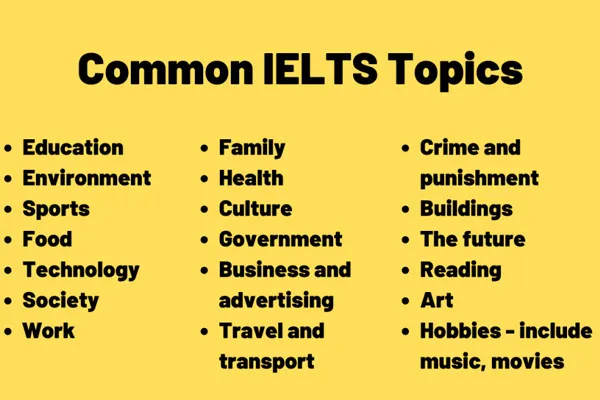
To achieve a high score in the IELTS exam, you not only need to understand vocabulary but also master the context in which words are used. Below are some common topics in the IELTS exam and how you can use vocabulary for each.
Education Topic
Key vocabulary: curriculum, pedagogy, academic achievement, literacy, vocational training, compulsory education.
Strategy: In the Speaking or Writing sections, you can discuss the education system in your country, the pros and cons of compulsory education, or the impact of vocational training on employability.
Examples:
“The pedagogical approach in my country has shifted from rote learning to a more interactive style.”
“The current curriculum places a strong emphasis on STEM subjects, but there is a growing interest in incorporating vocational training to prepare students for real-world careers.”
Health & Fitness Topic
Key vocabulary: physical well-being, mental health, obesity, sedentary lifestyle, balanced diet, public health.
Strategy: You can mention public health issues such as obesity, sedentary lifestyles, or the growing awareness of mental health. These phrases are particularly useful when writing essays about health or answering lifestyle questions in the Speaking section, for example:
“A sedentary lifestyle is becoming increasingly common due to modern conveniences, which has led to rising rates of obesity and other health issues.”
“Public awareness about the importance of mental health has improved, leading to better resources for individuals struggling with stress or depression.”
Environment Topic
Key vocabulary: pollution, conservation, renewable energy, deforestation, biodiversity, sustainable development.
Strategy: In Writing Task 2 or Speaking, you can mention urgent environmental issues like global warming, wildlife conservation, or the importance of renewable energy. These words not only help you express yourself clearly but also demonstrate your understanding of the topic:
“The expansion of renewable energy sources such as solar and wind power is essential to reducing our reliance on fossil fuels.”
“Protecting biodiversity is crucial for maintaining ecosystem balance and supporting sustainable development.”
Technology Topic
Key vocabulary: artificial intelligence, digital revolution, cybersecurity, innovation, automation, virtual reality.
Strategy: The technology topic often appears in both Speaking and Writing Task 2, especially when discussing the impact of technology on daily life or the economy. These words help you demonstrate linguistic sophistication and expand your ideas, for example:
“With the advent of artificial intelligence, tasks that were once considered impossible for machines are now automated, changing industries globally.”
“The digital revolution has transformed communication, enabling instant connectivity across vast distances.”
Travel Topic
Key vocabulary: itinerary, tourism industry, cultural exchange, wanderlust, hospitality, eco-tourism.
Strategy: In the Speaking section, when asked about personal interests or favorite travel destinations, this vocabulary will help you express your ideas more richly and accurately. You can also use these words to discuss the impact of tourism on the economy and culture:
“Eco-tourism is becoming increasingly popular as travelers seek to minimize their environmental impact while exploring new destinations.”
“The hospitality industry plays a vital role in supporting cultural exchange and promoting wanderlust among individuals.”
Tips for Maintaining Your IELTS Vocabulary Study

Maintaining your vocabulary study not only helps you remember words longer but also improves your ability to use them in the exam. Below are specific strategies to help you maintain and develop your vocabulary.
Build a Daily Habit of Learning New Words
Setting a specific time each day to study vocabulary makes it easier to maintain the habit and turn it into a part of your daily life.
How to do it:
- Learn words through context: Instead of just learning the meaning of a word, learn how to use it in a sentence or paragraph. For example, when learning the word “obesity,” you can memorize it by writing a sentence like, “Obesity has become a major public health issue in many developed countries.”
- Spaced Repetition Method: Use apps like Anki to review words periodically, which helps you remember vocabulary longer. Anki will automatically repeat words after a certain interval depending on how well you remember them.
Use Words in Your Own Sentences and Essays
Applying new words to your own writing or speech will increase your retention and help you understand how to use them in real-world contexts.
How to do it:
- Write short paragraphs: After learning new words, write a short paragraph (about 100-150 words) to practice using them in an appropriate context. For example, when learning “sustainable development,” you could write a paragraph about the necessity of sustainable development in the context of climate change.
- Practice speaking with new words: Create short stories or topics, then use the new words to talk about them. This method helps you feel more confident when answering Speaking questions in IELTS while simultaneously improving your pronunciation and expression.
Set Realistic and Specific Goals
Setting clear goals helps you maintain motivation and clearly see your progress.
Example of specific goals:
- Learn 5 – 10 new words every day and review old words weekly.
- Create one vocabulary topic per week; for example, this week study “Health & Fitness,” and next week move on to “Environment.”
- Self-testing: At the end of each week, test yourself by writing a paragraph or answering a Speaking question using the vocabulary learned that week. This helps you evaluate your retention and application of the words.
Use a Vocabulary Notebook or Note-taking App
Storing new words in a vocabulary notebook allows you to review them whenever you want and helps organize your vocabulary more scientifically.
How to do it:
- Traditional notebook: Use a notebook and categorize vocabulary by topic. Each word should be accompanied by its meaning, pronunciation, and an example sentence. Recording feelings or images related to the word can also help you remember it more easily.
- Note-taking apps: Use apps like Notion or Evernote to create vocabulary lists. These apps also allow you to insert images, record pronunciations, and organize vocabulary by difficulty level.
A rich vocabulary is the key to helping you confidently conquer the IELTS exam. Stay persistent in applying effective learning methods and utilize the right resources to get closer to your goal.
Check out: 1-on-1 IELTS Course at ECE Language Center





 Khai giảng Khóa học Hè cực HOT.
No comments yet!