
Tóm Tắt Nội Dung Bài Viết
In IELTS Reading tests, topics related to the environment and science appear frequently, and Coral Reefs are a classic example. This passage not only provides valuable knowledge about one of the most diverse ecosystems on Earth but also serves as a perfect “test” to evaluate a candidate’s reading comprehension and information processing skills.
With its complex structure and combination of various question types, mastering test-taking strategies is the key to conquering this passage. The following article by ECE will delve into each section, from a content overview to detailed guidance on solving the questions, helping you confidently “ace” this reading passage effectively.
READING PASSAGE
Coral Reefs
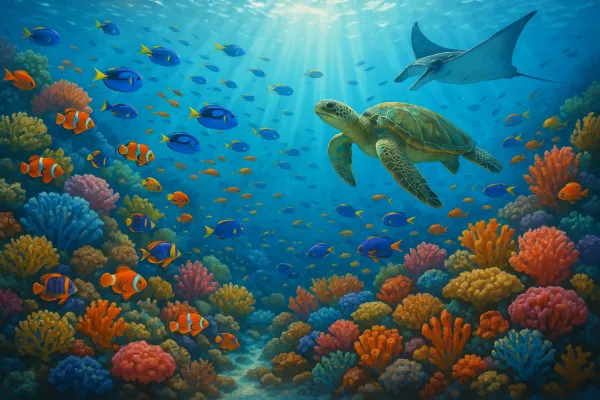
Coral reefs are underwater structures made from calcium carbonate secreted by corals. Coral reefs are colonies of tiny living animals found in marine waters that contain few nutrients. Most coral reefs are built from stony corals, which in turn consist of polyps that cluster in groups.
A. Coral reefs are estimated to cover 284,300 km2, just under 0.1% of the oceans‘ surface area, about half the area of France. The Indo-Pacific region accounts for 91.9% of this total area. Southeast Asia accounts for 32.3% of that figure, while the Pacific including Australia accounts for 40.8%. Atlantic and Caribbean coral reefs account for 7.6%. Yet often called “rainforests of the sea”, coral reefs form some of the most diverse ecosystems on Earth. They provide a home for 25% of all marine species, including fish, mollusks, worms, crustaceans, echinoderms, sponges, tunicates, and other cnidarians. Paradoxically, coral reefs flourish even though they are surrounded by ocean waters that provide few nutrients. They are most commonly found at shallow depths in tropical waters, but deep-water and cold-water corals also exist on smaller scales in other areas. Although corals exist in both temperate and tropical waters, shallow-water reefs form only in a zone extending from 30°N to 30°S of the equator. Deep-water coral can exist at greater depths and colder temperatures at much higher latitudes, as far north as Norway. Coral reefs are rare along the American and African west coasts. This is due primarily to upwelling and strong cold coastal currents that reduce water temperatures in these areas (respectively the Peru, Benguela, and Canary streams). Corals are seldom found along the coastline of South Asia from the eastern tip of India (Madras) to the Bangladesh and Myanmar borders. They are also rare along the coast around northeastern South America and Bangladesh due to the freshwater released from the Amazon and Ganges Rivers, respectively.
B. Coral reefs deliver ecosystem services to tourism, fisheries, and coastline protection. The global economic value of coral reefs has been estimated at as much as US$375 billion per year. Coral reefs protect shorelines by absorbing wave energy, and many small islands would not exist without their reef to protect them.
C. The value of reefs in biodiverse regions can be even higher. In parts of Indonesia and the Caribbean where tourism is the main use, reefs are estimated to be worth US$1 million per square kilometer, based on the cost of maintaining sandy beaches and the value of attracting snorkelers and scuba divers. Meanwhile, a recent study of the Great Barrier Reef in Australia found that the reef is worth more to the country as an intact ecosystem than an extractive reserve for fishing. Each year more than 1.8 million tourists visit the reef, spending an estimated AU$4.3 billion (Australian dollars) on reef-related industries from diving to boat rental to posh island resort stays. In the Caribbean, says UNEP, the net annual benefits from diver tourism were US$2 billion in 2000 with US$625 million spent directly on diving on reefs. Further, reef tourism is an important source of employment, especially for some of the world‘s poorest people. UNEP says that of the estimated 30 million small-scale fishers in the developing world, most are dependent to a greater or lesser extent on coral reefs. In the Philippines, for example, more than one million small-scale fishers depend directly on coral reefs for their livelihoods. The report estimates that reef fisheries were worth between $15,000 and $150,000 per square kilometer a year, while fish caught for aquariums were worth $500 a kilogram against $6 for fish caught as food. The aquarium fish export industry supports around 50,000 people and generates some US$5.5 million a year in Sri Lanka alone.
D. Unfortunately, coral reefs are dying around the world. In particular, coral mining, agricultural and urban runoff, pollution (organic and inorganic), disease, and the digging of canals and access into islands and bays are localized threats to coral ecosystems. Broader threats are sea temperature rise, sea-level rise, and pH changes from ocean acidification, all associated with greenhouse gas emissions. Some current fishing practices are destructive and unsustainable. These include cyanide fishing, overfishing, and blast fishing. Although cyanide fishing supplies live reef fish for the tropical aquarium market, most fish caught using this method are sold in restaurants, primarily in Asia, where live fish are prized for their freshness. To catch fish with cyanide, fishers dive down to the reef and squirt cyanide in coral crevices and on the fast-moving fish, to stun the fish making them easy to catch. Overfishing is another leading cause for coral reef degradation. Often, too many fish are taken from one reef to sustain a population in that area. Poor fishing practices, such as banging on the reef with sticks (muro-ami), destroy coral formations that normally function as fish habitat. In some instances, people fish with explosives (blast fishing), which blast apart the surrounding coral.
E. Tourist resorts that empty their sewage directly into the water surrounding coral reefs contribute to coral reef degradation. Wastes kept in poorly maintained septic tanks can also leak into surrounding groundwater, eventually seeping out to the reefs. Careless boating, diving, snorkeling, and fishing can also damage coral reefs. Whenever people grab, kick, walk on, or stir up sediment in the reefs, they contribute to coral reef destruction. Corals are also harmed or killed when people drop anchors on them or when people collect coral.
F. To find answers for these problems, scientists and researchers study the various factors that impact reefs. The list includes the ocean‘s role as a carbon dioxide sink, atmospheric changes, ultraviolet light, ocean acidification, viruses, impacts of dust storms carrying agents to far-flung reefs, pollutants, algal blooms, and others. Reefs are threatened well beyond coastal areas. General estimates show approximately 10% of the world’s coral reefs are dead. About 60% of the world‘s reefs are at risk due to destructive, human-related activities. The threat to the health of reefs is particularly strong in Southeast Asia, where 80% of reefs are endangered.
G. In Australia, the Great Barrier Reef is protected by the Great Barrier Reef Marine Park Authority and is the subject of much legislation, including a biodiversity action plan. Inhabitants of Ahus Island, Manus Province, Papua New Guinea, have followed a generations-old practice of restricting fishing in six areas of their reef lagoon. Their cultural traditions allow line fishing, but not net or spearfishing. The result is both the biomass and individual fish sizes are significantly larger in these areas than in places where fishing is unrestricted.
Questions 1 – 6
The reading Passage has seven paragraphs A-G.
Which paragraph contains the following information?
Write the correct letter A-G, in boxes 1-6 on your answer sheet. NB You may use any letter more than once.
1. Geographical location of the world‘s coral reefs
2. How coral reefs benefit the local economy
3. Statistics on the economic significance of coral reefs
4. Listed reasons for the declining number of coral reefs
5. Physical impact on coral reefs by people
6. Unsustainable fishing methods applied in regions of the world
Questions 7-12
Do the following statements agree with the information given in Reading Passage? Write your answers in boxes 7-12 on your answer sheet.
TRUE if the statement is true
FALSE if the statement is false
NOT GIVEN if the information is not given in the passage
7. Coral reefs provide habitat to a variety of marine life.
8. Coral reefs are distributed around the ocean disproportionately.
9. Coral reefs are increasingly important for scientific purposes.
10. Coral reefs are widely traded and exported to other countries.
11. Reef tourism is of economic essence generally for some poor people.
12. As with other fishing businesses, coral fishery is not suitable for women and children.
Question 13
Choose the correct letter, A, B, C or D. Write your answer in box 13 on your answer sheet.
What is the main purpose of this passage?
A. To demonstrate how coral reefs grow in the ocean
B. To explain that coral reefs are widely used as a scientific project
C. To present the general benefits and the alarming situation of coral reefs
D. To show the vital efforts made to protect the coral reef in Australia
Analyzing the IELTS Reading Passage: Coral Reefs
The “Coral Reefs” passage is a classic example of an Academic Reading task in the IELTS exam. The passage provides a wealth of information about coral reefs, including definitions, geographical locations, economic importance, threats, and conservation efforts. Your main goal when tackling this passage is to locate information quickly and accurately.
1. Overview of each paragraph
To grasp the main ideas, you should skim through each paragraph:
- Paragraph A: Introduces the definition of coral reefs, geographical distribution (Indo-Pacific, Southeast Asia, Atlantic, etc.), and their role as diverse ecosystems.
- Paragraph B: Mentions the economic value of coral reefs for tourism, fisheries, and coastline protection.
- Paragraph C: Analyzes the economic value in specific regions like Indonesia, the Caribbean, and the Great Barrier Reef in Australia, emphasizing benefits from diving tourism and fisheries.
- Paragraph D: Lists threats to coral reefs, including localized factors (coral mining, pollution) and broader factors (climate change, ocean acidification), as well as unsustainable fishing practices.
- Paragraph E: Outlines human behaviors that directly harm coral reefs, such as sewage discharge, anchoring, and careless diving activities.
- Paragraph F: Mentions scientific research on factors impacting reefs and provides statistics on the global status of coral reefs.
- Paragraph G: Introduces conservation and protection measures for coral reefs, with specific examples in Australia and Papua New Guinea.
2. Detailed solution guide
Task Type: Matching Information
This task requires you to find the paragraph containing specific information. The tip is to identify keywords in the question and scan the passage to find the corresponding paragraph.
- Question 1: Geographical location of the world‘s coral reefs
Answer: A.
Explanation: The question asks for geographical location. In paragraph A, the sentence “The Indo-Pacific region accounts for 91.9% of this total area. Southeast Asia accounts for 32.3%…” provides specific figures and geographical regions.
- Question 2: How coral reefs benefit the local economy
Answer: C.
Explanation: The question focuses on economic benefits at a local level. Paragraph C provides specific examples such as “In parts of Indonesia and the Caribbean where tourism is the main use, reefs are estimated to be worth US$1 million per square kilometer…” and “In the Philippines, for example, more than one million small-scale fishers depend directly on coral reefs for their livelihoods.”
- Question 3: Statistics on the economic significance of coral reefs
Answer: B.
Explanation: The question asks for statistics regarding economic importance. Paragraph B is the only one that provides a general figure: “The global economic value of coral reefs has been estimated at as much as US$375 billion per year.”
- Question 4: Listed reasons for the declining number of coral reefs
Answer: D.
Explanation: The question asks for reasons for the decline of coral reefs. Paragraph D lists a series of threats: “coral mining, agricultural and urban runoff, pollution (organic and inorganic), disease…” and “sea temperature rise, sea-level rise and pH changes from ocean acidification…”.
- Question 5: Physical impact on coral reefs by people
Answer: E.
Explanation: The question refers to physical actions by humans. Paragraph E directly mentions these actions: “Whenever people grab, kick, walk on, or stir up sediment in the reefs, they contribute to coral reef destruction.”
- Question 6: Unsustainable fishing methods applied in regions of the world
Answer: D.
Explanation: The question refers to unsustainable fishing methods. Paragraph D specifically lists these methods: “cyanide fishing, overfishing and blast fishing” and explains how they are used.
Task Type: True/False/Not Given
This task requires you to determine if the information in the question matches, contradicts, or is not mentioned in the passage.
- Question 7: Coral reefs provide habitat to a variety of marine life.
Answer: TRUE.
Explanation: Paragraph A states clearly: “They provide a home for 25% of all marine species, including fish, mollusks, worms, crustaceans, echinoderms, sponges, tunicates and other cnidarians.” This information matches perfectly.
- Question 8: Coral reefs are distributed around the ocean disproportionately.
Answer: TRUE.
Explanation: Paragraph A provides figures showing uneven distribution: “The Indo-Pacific region accounts for 91.9%… Atlantic and Caribbean coral reefs account for 7.6%.” The significant difference in percentages indicates a disproportionate distribution.
- Question 9: Coral reefs are increasingly important for scientific purposes.
Answer: NOT GIVEN.
Explanation: Paragraph F mentions that scientists “study the various factors that impact reefs,” but it does not state that their importance for scientific purposes is increasing.
- Question 10: Coral reefs are widely traded and exported to other countries.
Answer: NOT GIVEN.
Explanation: The passage mentions the “aquarium fish export industry,” but it does not mention that coral reefs themselves are exported or traded between countries.
- Question 11: Reef tourism is of economic essence generally for some poor people.
Answer: TRUE.
Explanation: Paragraph C states: “reef tourism is an important source of employment, especially for some of the world‘s poorest people.”
- Question 12: As with other fishing businesses, coral fishery is not suitable for women and children.
Answer: NOT GIVEN.
Explanation: The passage only mentions that “30 million small-scale fishers in the developing world” depend on coral reefs. There is no information regarding whether coral fishery is suitable for women and children.
Task Type: Multiple Choice
- Question 13: What is the main purpose of this passage?
- Answer: C.
- Explanation:
A. Incorrect. The passage mentions how coral reefs grow, but this is not the main purpose.
B. Incorrect. Scientific purposes are only a small part of paragraph F.
C. Correct. The passage begins by introducing the definition and general benefits of coral reefs in paragraphs B and C. Then, paragraphs D and E focus on their alarming situation due to various threats.
D. Incorrect. Conservation efforts are only briefly mentioned in paragraph G, not the main purpose of the entire passage.
Tips and effective strategies
- Skimming: Spend 2-3 minutes reading the entire passage quickly to grasp the main idea of each paragraph. This helps you answer Matching Information and Multiple Choice questions.
- Scanning: When looking for keywords, scan the passage quickly. Do not read every word.
- Synonyms: Sometimes keywords in the question will be replaced by synonyms in the passage. For example, “geographical location” in question 1 corresponds to the list of geographical regions in the passage.
- Distinguishing TRUE, FALSE, and NOT GIVEN:
- TRUE: Information in the question matches the passage perfectly.
- FALSE: Information in the question contradicts the passage.
- NOT GIVEN: Information is not mentioned in the passage.
- Matching Information: Note the instruction “You may use any letter more than once.” This means one paragraph can contain information for multiple questions.
The “Coral Reefs” passage is a classic example of the importance of mastering IELTS reading strategies. By combining skimming for main ideas, scanning for keywords, and carefully analyzing the questions, you can effectively handle a large amount of information in a short time. Hopefully, this detailed analysis by ECE English will help you not only perform well on this passage but also face similar academic reading passages with confidence in your upcoming IELTS exam.




 Khai giảng Khóa học Hè cực HOT.
Chưa có bình luận nào!