


Tóm Tắt Nội Dung Bài Viết
“Bovids” is a recurring topic in IELTS Reading exams, often challenging test-takers with its dense information and specialized vocabulary. This article provides a detailed breakdown of a typical “Bovids” passage, helping you understand the reading structure, how to locate information, and effective test-taking strategies. By mastering the facts about this diverse family of mammals, you will sharpen your skills and boost your performance in the IELTS Reading section.
Bovids
A
The family of mammals called bovids belongs to the Artiodactyl class, which also includes giraffes. Bovids are a highly diverse group consisting of 137 species, some of which are man’s most important domestic animals.
B
Bovids are well represented in most parts of Eurasia and Southeast Asian islands, but they are by far the most numerous and diverse in the latter. Some species of bovid are solitary, but others live in large groups with complex social structures. Although bovids have adapted to a wide range of habitats, from arctic tundra to deep tropical forest, the majority of species favour open grassland, scrub or desert. This diversity of habitat is also matched by great diversity in size and form: at one extreme is the royal antelope of West Africa, which stands a mere 25 cm at the shoulder; at the other, the massively built bison of North America and Europe, growing to a shoulder height of 2.2m.
C
Despite differences in size and appearance, bovids are united by the possession of certain common features. All species are ruminants, which means that they retain undigested food in their stomachs, and regurgitate it as necessary. Bovids are almost exclusively herbivorous.
D
Typically their teeth are highly modified for browsing and grazing: grass or foliage is cropped with the upper lip and lower incisors (the upper incisors are usually absent), and then ground down by the cheek teeth. As well as having cloven, or split, hooves, the males of all bovid species and the females of most carry horns. Bovid horns have bony cores covered in a sheath of horny material that is constantly renewed from within; they are unbranched and never shed. They vary in shape and size: the relatively simple horns of a large Indian buffalo may measure around 4 m from tip to tip along the outer curve, while the various gazelles have horns with a variety of elegant curves.
E
Five groups, or sub-families, may be distinguished: Bovinae, Antelope, Caprinae, Cephalophinae and Antilocapridae. The sub-family Bovinae comprises most of the larger bovids, including the African bongo, nilgai, eland, bison and cattle. Unlike most other bovids, they are all non-territorial. The ancestors of the various species of domestic cattle—banteng, gaur, yak and water buffalo—are generally rare and endangered in the wild, while the aurochs (the ancestor of the domestic cattle of Europe) is extinct.
F
The term ‘antelope’ is not a very precise zoological name; it is used to loosely describe a number of bovids that have followed different lines of development. Antelopes are typically long-legged, fast-running species, often with long horns that may be laid along the back when the animal is in full flight. There are two main sub-groups of antelope: Hippotraginae, which includes the oryx and the addax, and Antilopinae, which generally contains slighter and more graceful animals such as the gazelle and the springbok. Antelopes are mainly grassland species, but many have adapted to flooded grasslands: pukus, waterbucks and lechwes are all good at swimming, usually feeding in deep water, while the sitatunga has long, splayed hooves that enable it to walk freely on swampy ground.
G
The sub-family Caprinae includes the sheep and the goat, together with various relatives such as the goral and the tahr. Most are woolly or have long hair. Several species, such as wild goats, chamois and ibex, are agile cliff- and mountain-dwellers. Tolerance of extreme conditions is most marked in this group: Barbary and bighorn sheep have adapted to arid deserts, while Rocky Mountain sheep survive high up in mountains and musk oxen in arctic tundra.
H
The duiker of Africa belongs to the Cephalophinae sub-family. It is generally small and solitary, often living in thick forests. Although mainly feeding on grass and leaves, some duikers—unlike most other bovids—are believed to eat insects, feed on dead animal carcasses, and even kill small animals.
I
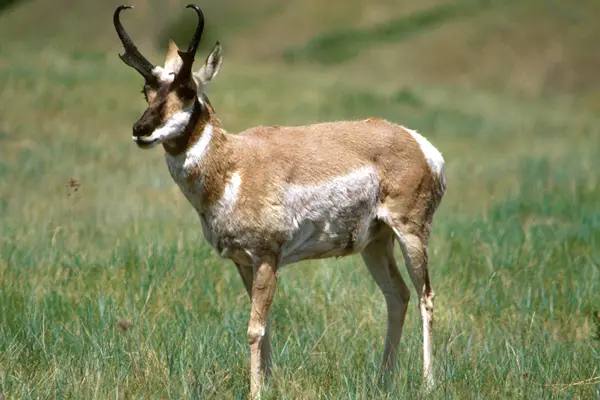
The pronghorn is the sole survivor of a New World sub-family of herbivorous ruminants, the Antilocapridae in North America. It is similar in appearance and habits to the Old World antelope. Although greatly reduced in numbers since the arrival of Europeans and the subsequent enclosure of grasslands, the pronghorn is still found in considerable numbers throughout North America, from Washington State to Mexico. When alarmed by the approach of wolves or other predators, hairs on the pronghorn’s rump stand erect, showing and emphasizing the white patch there. At this signal, the whole herd gallops off at a speed of over 60 km per hour.
Questions 1 – 3
Choose the correct letter, A, B, C or D.
Write your answers in boxes 1-3 on your answer sheet.
1. In which region is the biggest range of bovids to be found?
A. Africa
B. Eurasia
C. North America
D. South-east Asia
2. Most bovids have a preference for living in
A. isolation
B. small groups
C. tropical forest
D. wide open spaces
3. Which of the following features do all bovids have in common?
A. Their horns are short
B. They have upper incisors
C. They store food in the body
D. Their hooves are undivided
Questions 4 – 8
Look at the following characteristics (Questions 4-8) and the list of sub-families below.
Match each characteristic with the correct sub-family, A, B, C or D.
Write the correct letter, A, B, C or D, in boxes 4-8 on your answer sheet.
NB You may use any letter more than once
4. can endure very harsh environments
5. includes the ox and the cow
6. may supplement its diet with meat
7. can usually move at speed
8. does not defend a particular area of land
List of sub-families
A. Antelope
B. Bovinae
C. Caprinae
D. Cephalophinae
Questions 9 – 13
Answer the questions below.
Choose NO MORE THAN THREE WORDS from the passage for each answer.
Write your answers in boxes 9 – 13 on your answer sheet.
9. What is the smallest species of bovid called?
10. Which species of Bovinae has now died out?
11. What facilitates the movement of the sitatunga over wetland?
12. What sort of terrain do Barbary sheep live in?
13. What is the only living member of the Antilocapridae sub-family?
Reading Passage Overview
The “Bovids” passage provides a comprehensive look at this diverse family of mammals, covering the following aspects:
- Classification and general characteristics:
- The passage introduces the position of bovids within the Artiodactyla order, along with their species diversity and habitats.
- Common traits such as rumination, specialized teeth, cloven hooves, and horns (in males and most females) are described in detail.
- Sub-family classification:
- The passage divides bovids into five main sub-families: Bovinae, Antelope, Caprinae, Cephalophinae, and Antilocapridae, highlighting the distinct features of each group.
- Habitat and behavioral diversity:
- Bovids have adapted to various environments, from arctic tundra to tropical forests and deserts.
- Their behaviors are equally varied, ranging from solitary living to complex social structures within herds.
Detailed Question and Answer Analysis
Questions 1 – 3 (Multiple Choice):
Question 1: Answer D (South-east Asia) is correct, supported by the information in paragraph B: “they are by far the most numerous and diverse in the latter.”
Question 2: Answer D (wide open spaces) aligns with the information in paragraph B: “the majority of species favour open grassland, scrub or desert.”
Question 3: Answer C (They store food in the body) relates to the information: “All species are ruminants, which means that they retain undigested food in their stomachs, and regurgitate it as necessary.”
Questions 4 – 8 (Matching):
Question 4: Answer C (Caprinae) fits paragraph G, which describes this group’s ability to endure harsh conditions.
Question 5: Answer B (Bovinae) is confirmed by paragraph E, which lists oxen and cattle in this sub-family.
Question 6: Answer D (Cephalophinae) is supported by paragraph H, which mentions that duikers may eat insects and animal carcasses.
Question 7: Answer A (Antelope) is supported by paragraph F, which notes that antelopes are fast-running animals.
Question 8: Answer B (Bovinae) is confirmed by paragraph E, which states that Bovinae “are all non-territorial.”
Questions 9 – 13 (Short Answer):
Question 9: “royal antelope” is the correct answer, found in paragraph B.
Question 10: “the aurochs” is the correct answer, mentioned in paragraph E.
Question 11: “long, splayed hooves” is the correct answer, found in paragraph F.
Question 12: “arid deserts” is the correct answer, found in paragraph G.
Question 13: “pronghorn” is the correct answer, found in paragraph I.
Additional Context:
Importance of bovids to humans:
- Many bovid species have been domesticated, serving as vital sources of food, labor, and materials.
- They play a crucial role in natural ecosystems, influencing plant distribution and soil structure.
Threats to bovids:
- Habitat loss, overhunting, and climate change are the primary threats to many bovid species.
- Many species are currently threatened or endangered, necessitating conservation efforts.
Evolution of bovids:
- The bovid family has a long and complex evolutionary history, with many extinct lineages.
- Fossil and genetic research helps us better understand the evolutionary trajectory of this animal group.
We hope this detailed analysis has provided you with deeper insight into the “Bovids” topic and how to approach IELTS Reading tasks effectively. Mastering knowledge about different animal species and honing your reading comprehension skills will help you confidently tackle similar questions in the actual exam. Good luck on your journey to conquering the IELTS!
Explore more IELTS Reading passages compiled and curated by ECE:





 Khai giảng Khóa học Hè cực HOT.
No comments yet!