
Tóm Tắt Nội Dung Bài Viết
Freeze-drying is a vital food preservation technique, serving not only the aerospace industry but also finding numerous applications in medicine and daily life. The reading passage Astronaut ice cream, anyone? provides a detailed explanation of the science behind this process, as well as how it affects the weight and shelf life of products. Understanding the physical mechanisms of sublimation and the components of the machinery will help you accurately tackle “fill in the diagram” and summary completion tasks. We hope this translation and detailed breakdown from ECE English will effectively support your study process.
Reading Passage
ASTRONAUT ICE CREAM, ANYONE?
Freeze-drying is a technique that can help to provide food for astronauts. But it also has other applications nearer home. Freeze-drying is like suspended animation for food: you can store a freeze-dried meal for years, and then, when you’re finally ready to eat it, you can completely revitalise it with a little hot water. Even after several years, the original foodstuff will be virtually unchanged.
The technique basically involves completely removing the water from some material, such as food while leaving the rest of the material virtually intact. The main reason for doing this is either to preserve the food or to reduce its weight. Removing the water from food keeps it from spoiling, because the microorganisms such as bacteria that cause spoiling cannot survive without it. Similarly, the enzymes which occur naturally in food cannot cause ripening without water, so removing water from food will also stop the ripening process.
Freeze-drying significantly reduces the total weight of the food because most food is largely made up of water; for example, many fruits are more than 80% water. Removing this makes the food much lighter and therefore makes transportation less difficult. The military and camping-supply companies freeze-dry foods to make them easier for an individual to carry and NASA has also freeze-dried foods for the cramped quarters on board spacecraft.
The process is also used to preserve other sorts of material, such as pharmaceuticals. Chemists can greatly extend pharmaceutical shelf life by freeze-drying the material and storing it in a container free of oxygen and water. Similarly, research scientists may use freeze-drying to preserve biological samples for long periods of time. Even valuable manuscripts that had been water damaged have been saved by using this process.
Freeze-drying is different from simple drying because it is able to remove almost all the water from materials, whereas simple drying techniques can only remove 90-95%. This means that the damage caused by bacteria and enzymes can virtually be stopped rather than just slowed down. In addition, the composition and structure of the material is not significantly changed, so materials can be revitalised without compromising the quality of the original.
This is possible because in freeze-drying, solid water – ice – is converted directly into water vapour, missing out the liquid phase entirely. This is called sublimation, the shift from a solid directly into a gas. Just like evaporation, sublimation occurs when a molecule gains enough energy to break free from the molecules around it. Water will sublime from a solid (ice) to a gas (vapour) when the molecules have enough energy to break free but the conditions aren’t right for a liquid to form. These conditions are determined by heat and atmospheric pressure. When the temperature is above freezing point, so that ice can thaw, but the atmospheric pressure is too low for a liquid to form (below 0.06 atmospheres (ATM)) then it becomes a gas.
This is the principle on which a freeze-drying machine is based. The material to be preserved is placed in a freeze-drying chamber which is connected to a freezing coil and refrigerator compressor. When the chamber is sealed the compressor lowers the temperature inside it. The material is frozen solid, which separates the water from everything around it on a molecular level, even though the water is still present. Next, a vacuum pump forces air out of the chamber, lowering the atmospheric pressure below to 0.06 ATM. The heating units apply a small amount of heat to the shelves in the chamber, causing the ice to change phase. Since the pressure in the chamber is so low, the ice turns directly into water vapour, which leaves the freeze-drying chamber, and flows past the freezing coil. The water vapour condenses onto the freezing coil in the form of solid ice, in the same way that water condenses as frost on a cold day.
The process continues for many hours (even days) while the material gradually dries out. This time is necessary to avoid overheating, which might affect the structure of the material. Once it has dried sufficiently, it is sealed in a moisture-free package. As long as the package is secure, the material can sit on a shelf for years and years without degrading, until it is restored to its original form with a little hot water. If everything works correctly, the material will go through the entire process almost completely unscathed.
In fact, freeze-drying, as a general concept, is not new but has been around for centuries. The ancient Incas of Peru used mountain peaks along the Andes as natural food preservers. The extremely cold temperatures and low pressure at those high altitudes prevented food from spoiling in the same basic way as a modern freeze-drying machine and a freezer.
Questions
Questions 1-5 Complete the notes below. Choose NO MORE THAN THREE WORDS from the passage for each answer. Write your answers in boxes 1-5 on your answer sheet.
Uses of freeze-drying:
-
food preservation
-
easy 1 ___________ of food items
-
long-term storage of 2 ___________ and biological samples
-
preservation of precious 3 ___________
Freeze-drying:
-
is based on process of 4 ___________
-
is more efficient than 5 ___________
Questions 6-9 Label the diagram below. Choose NO MORE THAN TWO WORDS from the passage for each answer. Write your answers in boxes 6-9 on your answer sheet.
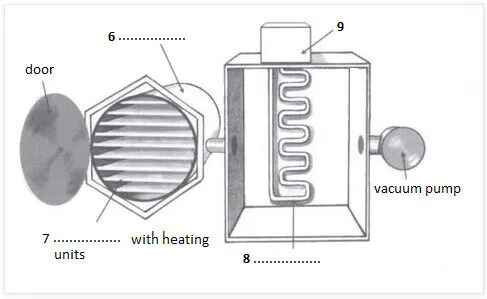
A simplified freeze-drying machine
-
6. ___________
-
7. ___________ with heating unit
-
8. ___________
-
9. ___________
(Note: Numbers 6, 7, 8, and 9 correspond to the labeled positions on the freeze-drying machine diagram in the reading passage.)
Questions 10-13 Complete the summary below. Choose NO MORE THAN THREE WORDS AND/OR A NUMBER from the passage for each answer. Write your answers in boxes 10-13 on your answer sheet.
Freeze-drying prevents food from going bad by stopping the activity of microorganisms or 10 ___________. Its advantages are that the food tastes and feels the same as the original because both the 11 ___________ and structure are preserved. The process is carried out slowly in order to ensure that 12 ___________ does not take place. The people of one ancient mountain civilisation were able to use this method of food preservation because the conditions needed were present at 13 ___________.
Full Translation of the Reading Passage
Freeze-drying is a technique that helps provide food for astronauts, but it also has other, more familiar applications. Freeze-drying is like putting food into suspended animation: you can store a freeze-dried meal for years, and when you are ready to eat it, you can completely revitalize it with just a little hot water. Even after several years, the original food will remain virtually unchanged.
This technique basically involves removing all water from a material, such as food, while leaving the rest of the material virtually intact. The main reason for doing this is to preserve the food or reduce its weight. Removing water from food prevents spoilage because microorganisms like bacteria, which cause decay, cannot survive without it. Similarly, enzymes that occur naturally in food cannot trigger the ripening process without water, so removing water also halts ripening.
Freeze-drying significantly reduces the total weight of food because most food is composed largely of water; for example, many fruits are over 80% water. Removing this water makes the food much lighter, thereby making transportation less difficult. The military and camping supply companies use freeze-drying to make food easier for individuals to carry, and NASA has also used it for the cramped quarters on board spacecraft.
This process is also used to preserve other types of materials, such as pharmaceuticals. Chemists can greatly extend the shelf life of pharmaceuticals by freeze-drying the material and storing it in an oxygen- and water-free container. Similarly, research scientists may use freeze-drying to preserve biological samples for long periods. Even valuable manuscripts damaged by water have been saved using this process.
Freeze-drying differs from simple drying because it can remove almost all water from materials, whereas simple drying techniques can only remove 90-95%. This means that the damage caused by bacteria and enzymes can be virtually stopped rather than just slowed down. Additionally, the composition and structure of the material are not significantly altered, so materials can be revitalized without compromising the quality of the original.
This is possible because, in freeze-drying, solid water (ice) is converted directly into water vapour, bypassing the liquid phase entirely. This is called sublimation—the shift from a solid directly into a gas. Just like evaporation, sublimation occurs when a molecule gains enough energy to break free from the molecules around it. Water will sublime from a solid (ice) to a gas (vapour) when the molecules have enough energy to break free, but conditions are not right for a liquid to form. These conditions are determined by heat and atmospheric pressure. When the temperature is above freezing, allowing ice to thaw, but the atmospheric pressure is too low for a liquid to form (below 0.06 ATM), it turns into a gas.
This is the principle on which a freeze-drying machine is based. The material to be preserved is placed in a freeze-drying chamber connected to a freezing coil and a refrigerator compressor. When the chamber is sealed, the compressor lowers the temperature inside. The material is frozen solid, which separates the water from everything around it at a molecular level. Next, a vacuum pump forces air out of the chamber, lowering the atmospheric pressure to below 0.06 ATM. Heating units apply a small amount of heat to the shelves in the chamber, causing the ice to change phase. Because the pressure in the chamber is so low, the ice turns directly into water vapour, which leaves the chamber and flows past the freezing coil. The water vapour then condenses onto the freezing coil as solid ice.
The process continues for many hours (even days) while the material gradually dries out. This time is necessary to avoid overheating, which could affect the structure of the material. Once sufficiently dry, it is sealed in moisture-free packaging. The material can sit on a shelf for years without degrading until it is restored to its original form with a little hot water. If everything works correctly, the material will go through the entire process almost completely unscathed.
In fact, the concept of freeze-drying is not new; it has existed for centuries. The ancient Incas of Peru used mountain peaks along the Andes as natural food preservers. The extremely cold temperatures and low pressure at those high altitudes prevented food from spoiling in the same basic way as a modern freeze-drying machine.
Key Academic Vocabulary
-
Revitalise (v): To restore something to a better condition or state of life.
-
Intact (adj): Complete and in the original state; not damaged.
-
Microorganisms (n): Microscopic organisms, such as bacteria.
-
Ripening (n): The process of becoming mature or ready to eat (for fruit).
-
Pharmaceuticals (n): Medicinal drugs.
-
Manuscripts (n): Documents or books written by hand.
-
Sublimation (n): The transition of a substance directly from solid to gas.
-
Atmospheric pressure (n): The pressure exerted by the weight of the atmosphere.
-
Condense (v): To change from a gas or vapour to a liquid or solid.
-
Degrading (v/adj): Deteriorating or breaking down.
-
Unscathed (adj): Without suffering any injury, damage, or harm.
-
High altitudes (n): Great heights above sea level.
Answer Key and Detailed Explanations
1. transportation
-
Location: Paragraph 3.
-
Explanation: The passage states that removing water makes food lighter and “makes transportation less difficult.”
2. pharmaceuticals
-
Location: Paragraph 4.
-
Explanation: The process is used to preserve “other sorts of material, such as pharmaceuticals.”
3. manuscripts
-
Location: Paragraph 4.
-
Explanation: Even “valuable manuscripts” have been saved using this process.
4. sublimation
-
Location: Paragraph 6.
-
Explanation: The process of converting directly from solid to gas is called “sublimation.”
5. simple drying
-
Location: Paragraph 5.
-
Explanation: “Freeze-drying is different from simple drying because it is able to remove almost all the water…” (implying it is more efficient).
6. (freeze-drying) chamber
-
Location: Paragraph 7.
-
Explanation: The material is placed in a “freeze-drying chamber.”
7. shelves
-
Location: Paragraph 7.
-
Explanation: The heating unit applies heat to the “shelves” in the chamber.
8. freezing coil
-
Location: Paragraph 7.
-
Explanation: Water vapour flows past and condenses on the “freezing coil.”
9. refrigerator compressor
-
Location: Paragraph 7.
-
Explanation: The chamber is connected to a freezing coil and a “refrigerator compressor.”
10. enzymes
-
Location: Paragraph 2.
-
Explanation: Removing water stops the activity of microorganisms or “enzymes.”
11. composition
-
Location: Paragraph 5.
-
Explanation: Both the “composition” and structure remain largely unchanged.
12. overheating
-
Location: Paragraph 8.
-
Explanation: The process is slow to avoid “overheating.”
13. high altitudes
-
Location: Paragraph 9.
-
Explanation: The Incas used natural conditions found at “high altitudes.”
Mastering this reading passage will help you become familiar with the presentation of physical and chemical data often found in IELTS Reading Passage 1. This article has systematized the entire freeze-drying process, helping you more easily identify traps related to pressure and temperature. Understanding this content will not only improve your academic vocabulary but also increase your speed in completing “fill-in-the-blank” tasks. We wish you persistence in your practice to achieve a breakthrough in your Reading band score.



 Khai giảng Khóa học Hè cực HOT.
Chưa có bình luận nào!