
Tóm Tắt Nội Dung Bài Viết
To learn English effectively and sustainably, having a well-structured roadmap is essential. This is especially true for middle school students.
Defining the right learning path helps solidify your English foundation and develops the four core academic skills—Listening, Speaking, Reading, and Writing—creating a solid base for future standardized tests like IELTS, TOEFL, and SAT. Join the ECE Language Center as we break down the details in this article!
A 9-Stage English Learning Roadmap for Middle School

| Stage & Duration | Entry Level | Exit Level | Target Audience | Detailed Roadmap |
| Stage 1 – 2.5 hours/week for 3 months | A1 – A2 | A2+ | – Advanced 5th graders
– 6th & 7th graders |
– Students focus on pronunciation, vocabulary, and grammar review to build a solid foundation.
– Students are introduced to short reading passages and mind-mapping to improve reading comprehension. – For writing, students review various types of correspondence, such as response, complaint, and proposal letters. – For speaking, students begin practicing complex and compound sentences, speaking on familiar topics for 1–2 minutes, and engaging in peer discussions. |
| Stage 2 – 2.5 hours/week for 3 months | Entry A2 (Solid A2, familiarizing with B1 exercises. Students can reach B1-) | B1- | 6th & 7th graders | – Students continue pronunciation work, focusing on difficult sounds, word stress, and linking sounds.
– Students are exposed to more academic vocabulary and complex topics compared to Stage 1. – Grammar at this stage focuses more on application for speaking and writing. – For writing, students begin introductory academic writing: writing paragraphs to express opinions, explain causes/effects, or discuss issues. – For speaking, students practice longer responses with more complex topics and vocabulary. |
| Stage 3 – 2.5 hours/week for 3 months | Entry B1- (Solid B1 in reading, listening, and grammar. Speaking/writing at B1-) | Exit B1 (Listening/Reading), B1- (Speaking/Writing) | 6th & 7th graders | – Students get accustomed to longer listening and reading passages with complex topics, though vocabulary remains accessible. Materials introduce complex sentence structures and cultural elements.
– Writing continues to focus on paragraph structure to refine academic style, preparing for essay writing in later stages. – Speaking requirements increase in duration, and presentation exercises are introduced. |
| Stage 4 – 2.5 hours/week for 3 months | Entry B1 (Listening/Reading), B1- (Speaking/Writing). (Students begin B1-B2 level materials. Speaking/writing progress toward B1) | Exit B1-B2 (Listening/Reading), B1 (Speaking/Writing) | 7th & 8th graders | – Grammar exercises focus on providing complex sentence structures for writing.
– Writing begins to cover essay formats and components. – Speaking continues with difficult, argumentative topics, with more frequent presentations in class and at home. – Reading and listening materials become longer with a significant increase in vocabulary and structure compared to Stage 3. Academic elements are emphasized through more challenging exercises. |
| Stage 5 – 2.5 hours/week for 3 months | Entry B2 (Listening/Reading), B1 (Speaking/Writing). (Reading/listening/grammar move toward B2; speaking/writing at late B1) | Exit mid-B2 (Listening/Reading), late B1 (Speaking/Writing) | 7th & 8th graders | – Students become accustomed to longer texts and audio, focusing on analytical comprehension rather than just literal meaning.
– Writing continues with essay practice, focusing on expanding vocabulary and structure through in-class brainstorming sessions and debates to generate ideas. – Speaking practice relates to learned reading/listening topics and begins transitioning into debate. |
| Stage 6 – 2.5 hours/week for 3 months | Entry B2 (Listening/Reading), late B1 (Speaking/Writing). (Solid B2 grammar/reading/listening. Speaking/writing transitioning from B1 to B2) | Exit solid B2 (Listening/Reading), early B2 (Speaking/Writing) | 7th & 8th graders | – At the B2 level, students are expected to work more independently with less teacher support, applying deep-reading and listening strategies.
– Speaking focuses on complex topics, requiring longer responses and a wider range of structures and vocabulary. – Writing continues with essay practice and introduces data description (charts/graphs). |
| Stage 7 – 2.5 hours/week for 3 months | Entry solid B2 (Listening/Reading), late B1 (Speaking/Writing). (Reading/listening/grammar moving toward late B2/early C1) | Exit solid B2/early C1 (Listening/Reading), mid-B2 (Speaking/Writing) | 8th & 9th graders | – Reading and listening difficulty increases. Students use materials from standardized tests to easily gauge their proficiency.
– Writing continues with advanced social topics and chart description. – Speaking increases focus on debate and impromptu speaking. Students learn to distinguish between spoken and written styles, incorporating cultural elements into their speech. |
| Stage 8 – 2.5 hours/week for 3 months | Entry early C1 (Listening/Reading), mid-B2 (Speaking/Writing). (Reading/listening/grammar moving toward C1; speaking/writing moving toward C1) | Exit mid-C1 (Listening/Reading), late B2/early C1 (Speaking/Writing) | 8th & 9th graders | – Students continue practicing with standardized test materials. Writing focuses more on chart description.
– Speaking practice focuses on expressing opinions and in-depth discussion, with answers structured logically, supported by arguments and real-world knowledge. |
| Stage 9 – 2.5 hours/week for 3 months | Entry mid-C1 (Listening/Reading), late B2/early C1 (Speaking/Writing). (Solid C1 grammar/reading/listening; mid-C1 speaking/writing) | Exit late C1 (Listening/Reading), mid-C1 (Speaking/Writing) | 8th & 9th graders | – Students practice all four skills, focusing on expanding vocabulary, sentence structure, and background knowledge for speaking and writing.
– Students can use English to present and discuss complex, highly academic issues. |
FAQ: Answers for Parents and Students
1. Who developed this learning roadmap?
ECE: This middle school roadmap (for grades 6, 7, 8, and 9) was developed by Ms. Doan Nuong, Director of the ECE Language Center. Ms. Nuong has 19 years of English teaching experience and is currently a lecturer at the University of Languages and International Studies (ULIS – VNU).
Ms. Nuong oversees the entire curriculum, working with colleagues including Ms. Ngoc Mai, Ms. Anh Duong, Mr. Phan, Ms. Thuy, and Ms. Thu Ha.
Our teachers are not only experienced English educators but also experts in middle school psychology, ensuring they can effectively support students and maintain open communication with parents to resolve any learning challenges.
2. Is 2.5 hours/week enough to ensure quality?
ECE: This roadmap is designed to complement and reinforce the school curriculum. Students have other academic and physical education commitments, so this duration is balanced to keep them engaged without causing burnout.
Furthermore, this roadmap is tailored for middle schoolers. It goes beyond grammar, teaching students to use grammar to understand sentence structures, nuances, and implied meanings in reading/listening materials covering biology, history, society, technology, law, and travel. This expands their vocabulary and knowledge, enabling them to speak, write, and argue logically about these topics.
3. What will middle school students achieve with this roadmap?
ECE: This 9-stage roadmap, developed by Ms. Doan Nuong, allows students to advance one CEFR level every three stages, verified by official exams or ECE proficiency tests. Academic English skills will help students achieve specific goals:
- High scores in standardized tests (IELTS, TOEFL Junior) to gain an advantage in school entrance exams or scholarship applications.
- The knowledge required to participate in school-level and higher Debate and Presentation competitions.
- The skills to participate in national English competitions like the Internet Olympiads of English (IOE) or the English Olympic (EO).
- Improved academic performance in English at school.
4. What are the A1 – A2 – B1 – B2 – C1 – C2 levels in the roadmap?
ECE: These levels correspond to the 6-level Common European Framework of Reference for Languages (CEFR), a widely used standard for assessing language proficiency across Listening, Speaking, Reading, and Writing. In Vietnam, the CEFR is also applied as a 6-level system to evaluate foreign language proficiency.
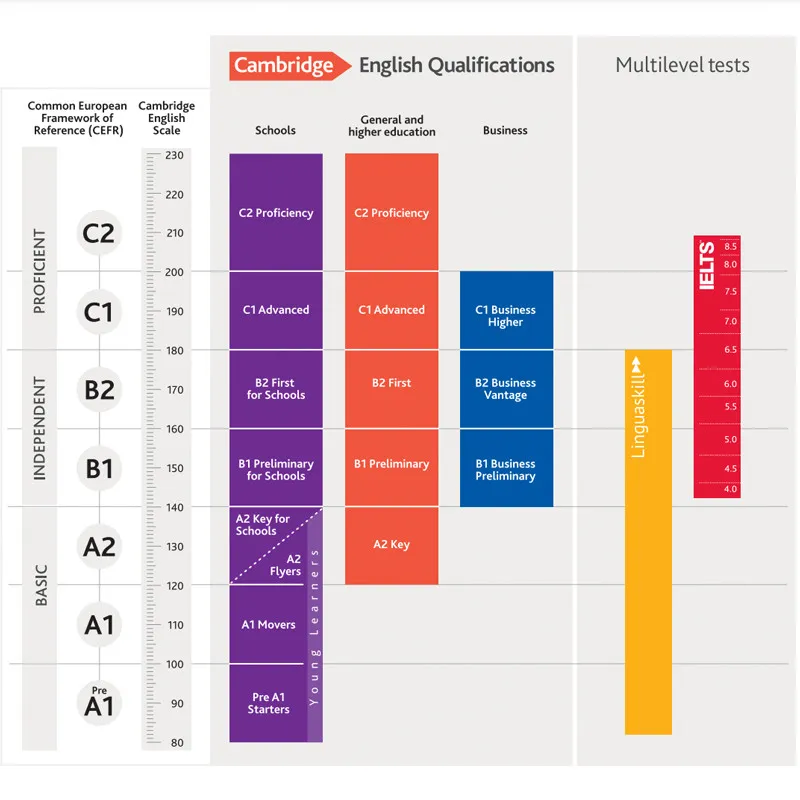
To accurately assess current proficiency, students will need to take a test covering all four skills: listening, speaking, reading, and writing. Teachers will grade the test and provide feedback to parents and students so they are fully aware of the student’s progress.
If you or your child are interested in this middle school English roadmap, please contact the ECE Language Center for consultation and support.
- Hotline: 0971217556 – 0982166634 – 0971.217.556
- Website: https://ece.edu.vn/
- Email: info@ece.edu.vn
- Address:
- Location 1: 43, Alley 91 Tran Duy Hung, Cau Giay, Hanoi.
- Location 2: 16N8B, Alley 7 Hoang Minh Giam, Thanh Xuan, Hanoi.
- Location 3: House CL11-A2, Alley 118 Nguyen Khanh Toan Street, Quan Hoa, Cau Giay (Behind Honda 120 Nguyen Khanh Toan).




 Khai giảng Khóa học Hè cực HOT.
Chưa có bình luận nào!