


Tóm Tắt Nội Dung Bài Viết
An IELTS 7.0 band score is always an attractive yet challenging goal for English learners. It not only demonstrates a solid command of the language but also opens countless doors for the future, from academics and career advancement to immigration. But is the journey to a 7.0 really that difficult? What are the benefits and challenges you will face?
In this article, ECE English provides an in-depth, comprehensive analysis of the IELTS 7.0 band score to give you the clearest and most practical perspective.
What is IELTS 7.0? B2 or C1?
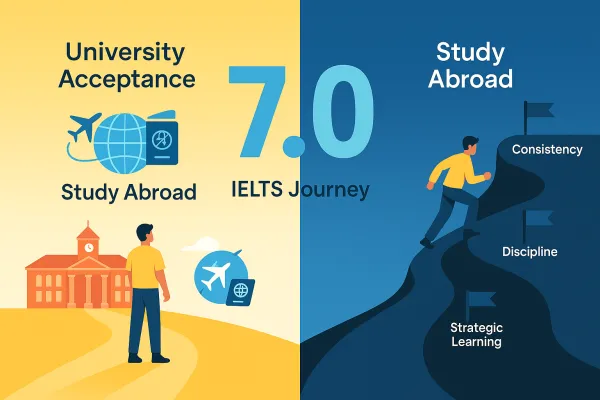
According to the Common European Framework of Reference for Languages (CEFR), IELTS 7.0 is equivalent to C1 level. This score reflects a high level of proficiency. Someone with a 7.0 can:
- Understand complex, detailed, and abstract texts on a wide range of topics, including specialized fields.
- Communicate fluently and naturally without significant difficulty in finding the right words.
- Use language flexibly and effectively for academic, social, and professional purposes.
- Produce clear, well-structured text and present viewpoints on complex subjects.
While considered highly proficient, a 7.0 scorer may still make occasional errors or struggle in unfamiliar situations. This is the key distinction between a 7.0 and an 8.0 or 9.0 band.
- Score Equivalencies:
- IELTS 7.0 ≈ C1 (CEFR)
- IELTS 7.0 ≈ TOEFL iBT 94 – 101
- IELTS 7.0 ≈ TOEIC 785 – 830
Is IELTS 7.0 hard to achieve?
Is getting an IELTS 7.0 difficult? The answer isn’t a simple “yes” or “no”—it depends on several factors: your English foundation, your learning capacity, and your commitment.
If you already have a solid foundation (5.0 – 6.0): Moving up to a 7.0 isn’t overly difficult, but it requires discipline and the right study strategy. At this stage, you need to focus on cultivating academic vocabulary, honing critical thinking, and specifically improving your Writing and Speaking skills—the two hardest areas to score high in.
If you are starting from scratch: The journey to a 7.0 will be a long and arduous process, potentially taking 1.5 to 2 years. You will need to rebuild your entire foundation, from pronunciation and grammar to basic vocabulary, before even getting familiar with the test format.
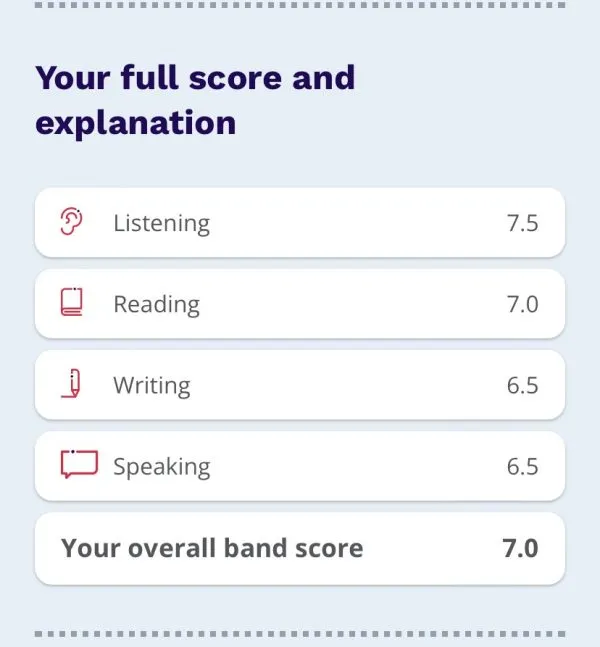
Strategy for the 4 skills: To achieve an Overall 7.0, you don’t necessarily need a 7.0 in every skill. Identifying your strengths and weaknesses will help you build an effective study strategy. Here are some common score combinations that Vietnamese candidates often achieve:
- Most common:
Listening 8.0, Reading 7.5, Writing 6.0, Speaking 6.5 - Strong in Listening/Reading:
Listening 8.5, Reading 7.5, Writing 6.0, Speaking 6.0 - Balanced:
Listening 7.5, Reading 7.5, Writing 6.5, Speaking 6.5 - Strong in Writing/Speaking (less common):
Listening 7.0, Reading 7.0, Writing 7.0, Speaking 6.0
Benefits of an IELTS 7.0 Overall Certificate
Holding an IELTS 7.0 certificate is a massive advantage that opens doors in many areas:
- High School Graduation Exemption: According to the Ministry of Education and Training, candidates with an IELTS score of 4.0 or higher are exempt from the English portion of the National High School Graduation Exam.
- University Admission: While there is no such thing as a blanket “university entrance exam exemption,” many top universities in Vietnam have policies for direct admission or combined admission using IELTS scores. For example, the Foreign Trade University offers direct admission to candidates with an IELTS of 6.5 or higher; Hanoi University of Science and Technology requires a minimum of 5.0 for score conversion. Therefore, a 7.0 is a significant advantage when applying to top-tier schools.
- University English Course Exemption: Most universities have English proficiency requirements for graduation. With an IELTS 7.0, you are often exempt from these courses and can receive a high grade (usually 9.0 or 10.0), which boosts your GPA.
- Scholarship Opportunities: An IELTS 7.0 is generally sufficient to apply to most of the world’s top universities and significantly increases your chances of securing scholarships in countries like the UK, Australia, the US, and Canada.
- Career Opportunities: Multinational corporations and large companies in Vietnam often require high English proficiency. With a 7.0, you can confidently apply for positions that require frequent communication in English.
Can you teach English with an IELTS 7.0?
The answer is yes, but you need to understand the specific requirements.
- At English centers: A 7.0 is generally considered sufficient to start a teaching career, especially for beginner to intermediate levels (bands 4.0 – 6.0). However, to be a great teacher, you need more than just an IELTS score; you need pedagogical skills, knowledge of psychology, and effective teaching methods.
- At international schools or specialized test prep centers: These positions typically require a band score of 7.5 or higher, along with teaching experience and international certifications like CELTA or TESOL.
The Roadmap to 7.0: Breaking through the 6.5 barrier
Reaching a 7.0 is often a psychological hurdle, as many people feel “stuck” at 6.5. Below is a study roadmap focused on crossing this threshold.
Phase 1: Preparation (Band 6.0 – 6.5)
- Goal: Consolidate existing knowledge and identify gaps and weaknesses.
- Study focus:
- Writing & Speaking: These are the two skills you need to invest in the most. Focus on learning how to paraphrase, using less common vocabulary, and employing more complex sentence structures. You can refer to 7.0+ sample essays to learn how to develop ideas logically.
- Reading & Listening: Practice with the Cambridge Practice Test for IELTS series (from book 10 onwards). After each test, thoroughly analyze your mistakes to determine the cause: was it vocabulary, a trick question, or a lack of focus?
- Resources: The Official Cambridge Guide to IELTS, books by Simon, and reputable websites like IELTS Liz, IELTS Simon, etc.
Phase 2: The Breakthrough (Band 6.5 – 7.0+)
- Goal: Refine reflexes and effective test-taking strategies.
- Study focus:
- Practice Tests: Simulate real exam conditions. Time yourself strictly to get used to the pressure.
- Writing and Speaking: Focus on developing ideas more deeply and logically. For Speaking, record your answers, then listen back and critique yourself.
- Reading and Listening: Practice with difficult test sets, focusing on questions that require synthesis and inference.
- Resources: Continue with the Cambridge Practice Test series and mock tests on the websites of official testing organizations (IDP, British Council).
Conclusion
An IELTS 7.0 is not an impossible goal. This score represents an excellent C1 level and is a golden ticket to many opportunities. However, the journey to achieving it requires determination, a clear roadmap, and above all, persistence. With the right strategy, you can absolutely reach this goal.




 Khai giảng Khóa học Hè cực HOT.
No comments yet!