

Tóm Tắt Nội Dung Bài Viết
As part of a child’s comprehensive language development path, the Cambridge English Qualifications (YLE) are widely chosen by parents as a benchmark of ability. As children approach Flyers—the highest level of the young learner certificates—many parents often ask: What is the IELTS equivalent of a Cambridge Flyers certificate?
Understanding the true nature of international testing scales helps parents accurately gauge their child’s actual proficiency, allowing them to build a systematic study roadmap and avoid unrealistic expectations.
What IELTS band is Cambridge Flyers roughly equivalent to?
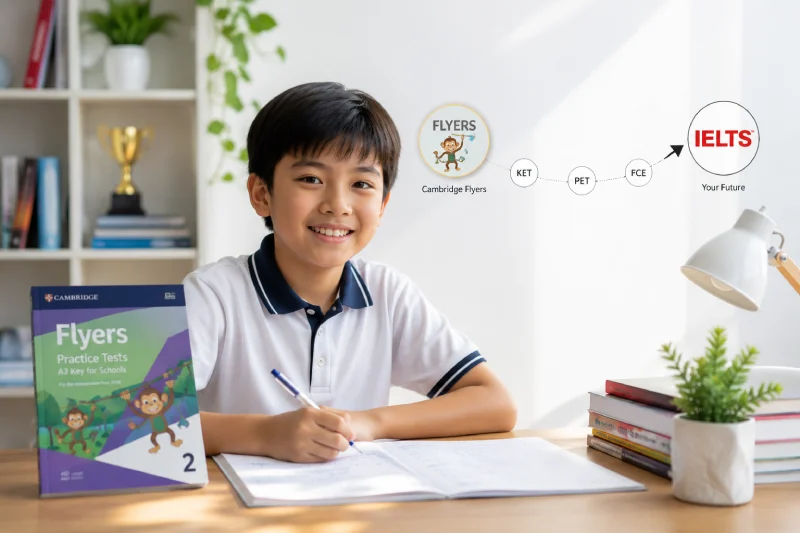
According to the Common European Framework of Reference for Languages (CEFR), the Cambridge Flyers certificate corresponds to level A2. When making a relative comparison to the IELTS scale via the CEFR framework, this proficiency level is roughly equivalent to an IELTS band 2.5 to 3.0.
It is important to note that this is merely a theoretical reference for language proficiency. At an A2 level, learners typically demonstrate the following specific abilities:
-
Can understand and respond simply in basic, familiar, everyday situations (such as asking for directions, describing objects, or talking about personal hobbies), though communication skills remain very limited.
-
Can understand and use common phrases and simple sentences about themselves, their family, and school.
-
Can read and understand notices, signs, or short paragraphs. Can write simple sentences or a short paragraph describing a situation or story based on pictures.
In Vietnam, the Flyers program is generally suited for primary and early middle school students (roughly 9 to 12 years old, corresponding to grades 4, 5, and 6). Based on practical averages from testing data, students typically need around 180 to 250 hours of structured study to accumulate enough knowledge for this level. However, this is not a mandatory requirement set by Cambridge and will vary depending on each child’s learning capacity and environment.
Why can’t Flyers and IELTS be directly converted?
Cambridge Assessment does not publish any direct conversion table between the YLE Flyers test and the Academic IELTS test. Although both sit on the CEFR scale, equating the two certificates is a major professional misconception due to the following core differences:
Differences in Target Audience and Age Psychology
-
Cambridge Flyers: Specifically designed for young learners. The test uses plenty of vivid imagery and colors to spark natural reflexes and confidence, aligning with the innate learning psychology of pre-teens.
-
IELTS: A focused language proficiency test intended for candidates aged 16 and over. The test requires candidates to employ rational thinking, systematic strategies, and formal academic skills.
Differences in Thinking Skills and Test Content
-
Flyers tests are continually fine-tuned to stay close to a child’s worldview, with content revolving solely around familiar daily topics.
-
Conversely, IELTS tests (even at lower band scores) consist entirely of academic texts. The exam requires candidates to possess critical thinking, logical reasoning, and deep socio-cultural knowledge on macro issues such as the environment, technology, economics, and education. Even a primary school student who achieves a perfect score on the Flyers test lacks the life experience and cognitive maturity required to handle IELTS test materials.
Differences in Certificate Nature and Validity
-
Flyers has no pass or fail: Every test taker receives an international certificate displaying the number of “Shields” they earned to boost their morale. Administratively, the Cambridge certificate does not state an expiration date (it remains valid indefinitely as a credential). However, because foreign language proficiency naturally fluctuates over time without regular practice, many educational institutions will still request the most recent test results.
-
IELTS is strictly graded on a scale from 1.0 to 9.0: This is a point-in-time assessment used directly for admissions or immigration purposes, with a strict validity period of 2 years.
Detailed Structure and Evaluation Criteria of the Flyers Test
The Cambridge Flyers test assesses language proficiency across all 4 skills in a total time of about 1 hour and 15 minutes:
Detailed Skill Requirements Breakdown for the Flyers Test
| Skill (Number of Parts) | Duration | Specific Content Requirements | Scoring Criteria |
|
Listening (5 parts / 25 questions) |
~25 mins | P1: Listen to short dialogues and match names of people to the correct objects/pictures.
P2: Listen and fill in missing words or information (time, place, name) in the blanks. P3: Listen to activity descriptions and choose the correct pictures (A, B, C). P4: Listen to understand short stories and match dialogues with pictures. P5: Listen and color or write words into the picture as instructed. |
Evaluates the ability to understand detailed, basic information. Scored based on the number of correct answers converted into a maximum of 5 shields. |
|
Reading & Writing (7 parts / 50 questions) |
40 mins |
P1: Match vocabulary words with their corresponding pictures. P2: Fill in appropriate words for simple sentences. P3: Choose answers (A, B, C) to complete a short paragraph. P4: Match descriptive sentences with the correct pictures. P5: Fill in words in a short paragraph using word prompts. P6: Complete sentences or write short answers based on given questions. P7: Write a short paragraph describing a situation or answering questions. |
Evaluates reading comprehension, spelling, basic grammar, and writing contextually accurate sentences. Converted to a maximum of 5 shields. (Note: the updated exam version includes 50 questions). |
|
Speaking (4 parts) |
5 – 9 mins |
P1: Introduce oneself, answer simple questions about hobbies, family, and school. P2: Describe a picture or point out differences between two images. P3: Answer questions and discuss familiar topics. P4: Answer the examiner’s questions and tell a short story based on illustrations. |
Face-to-face 1:1 interview with an international examiner. Evaluated based on reflex speed, communication, pronunciation, and fluency. Maximum of 5 shields. |

Criteria for Assessing Proficiency via Shield Counts
Test results reflect a child’s readiness through the total number of shields earned (maximum of 15 shields):
-
A total of 10 shields or more (with at least 2 shields per skill): Generally considered the baseline passing requirement for the Flyers level. The child has developed the cognitive ability to handle everyday communication situations.
-
11 to 14 shields: Good to very good proficiency, successfully handling the vast majority of the test content.
-
Achieving a perfect 15 shields: The child has excelled, demonstrating flexible English usage skills at the CEFR A2 level. This is an ideal time for the child to begin transitioning to higher academic programs.
Reference information regarding result turnaround times:
-
Paper-based Test: Results are typically available in about 4 to 6 weeks.
-
Computer-based Test: Results are usually published in about 2 weeks.
Relative Conversion Table from Cambridge to Academic IELTS
To give parents a comprehensive view for the long-term roadmap, below is a relative comparison table between certificate levels in the Cambridge system (measured in greater detail via the Cambridge English Scale) and their equivalent IELTS band ranges:
| Cambridge Certificate Level | CEFR Level | Equivalent IELTS Band Range | Core Proficiency Characteristics |
| Flyers (Ages 9 – 12) | A2 | 2.5 – 3.0 | Understands and uses basic English in real-life, everyday situations. |
| KET (Key for Schools) | A2 Advanced | 3.0 – 3.5 | Understands slow announcements and engages in basic personal communication. |
| PET (Preliminary for Schools) | B1 | 4.0 – 5.0 | Communicates fairly steadily; can discuss and express personal opinions. |
| FCE (First for Schools) | B2 | 5.0 – 6.5 | Uses English quite fluently for studying or working in an international environment. |
| CAE (Advanced) | C1 | 7.0 – 8.0 | Uses English proficiently in higher academic settings and specialized business environments. |
| CPE (Proficiency) | C2 | 8.5+ | Completely masters the language, using it as flexibly as a native speaker. |
Note: The IELTS band ranges for higher certificates (PET, FCE, CAE) vary widely because Cambridge exam results also depend on the specific converted score achieved on the Cambridge English Scale.
A Scientific Transition Roadmap from Flyers to IELTS Goals
Rather than pushing children into academic IELTS prep courses too early before their social reasoning is fully formed, following Cambridge’s progressive roadmap helps children develop their skills solidly:
[Flyers - A2] ---> [KET - A2 Advanced] ---> [PET - B1] ---> [FCE - B2] ---> [Academic IELTS 6.5+]
-
Foundational Stage (Flyers): Children accumulate a rich vocabulary of everyday language, improve all 4 skills evenly, and grow accustomed to interacting directly in English with foreigners.
-
Transition Stage (KET/PET): Students initially get acquainted with longer texts, more complex grammatical structures, and approach gentle socio-themed topics.
-
Acceleration Stage (FCE/IELTS): When students enter high school and their logical thinking and social awareness have matured, studying the IELTS test format will achieve optimal and rapid results thanks to a well-trained linguistic foundation.
Recommended International-Standard Flyers Preparation Materials for Children
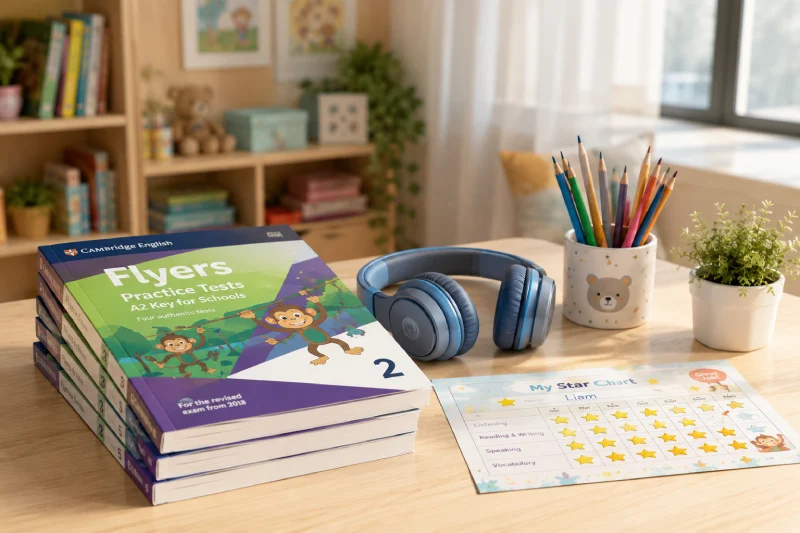
To best support students in preparing for the Flyers test, parents should consult official resources from reputable publishers:
-
Cambridge Flyers – Past Papers: Authentic past exam papers that help students become precisely familiar with the format and actual time management.
-
Fun for Flyers (Cambridge University Press): Integrates many language practice activities through vivid, age-appropriate illustrations.
-
Storyfun for Flyers: Supports the development of reading comprehension skills through relatable short stories.
-
Collins Practice Tests for Cambridge Flyers: Provides standard practice tests complete with audio files and detailed answer keys for self-study.
-
Get Ready for Flyers (Oxford University Press): Skill-based supplementary exercise systems for students who are new to test preparation.
The Cambridge Flyers certificate is not merely an award-winning exam, but a meaningful milestone that helps children affirm their abilities, build self-confidence, and nurture a lifelong passion for English. Comparing Flyers to an IELTS band 2.5 – 3.0 should only be viewed as a reference benchmark for language proficiency, by no means an equivalent conversion standard for parents to pressure their children into entering an adult academic roadmap too soon.
A child’s language learning journey must be built on an understanding of age-appropriate psychology and a scientific, progressive roadmap. Combining international-standard materials with a comfortable learning environment free from achievement pressure is the core key to helping children maintain their initiative and make a strong breakthrough toward higher rungs like KET, PET, or IELTS in the future.




 Khai giảng Khóa học Hè cực HOT.
No comments yet!