


Tóm Tắt Nội Dung Bài Viết
Are you preparing for the challenging IELTS exam and wondering if you’re truly ready? Don’t worry! An IELTS Mock Test is an effective solution to help you assess your current ability, get comfortable with exam-day pressure, and boost your confidence before the real test.
What is an IELTS Mock Test?
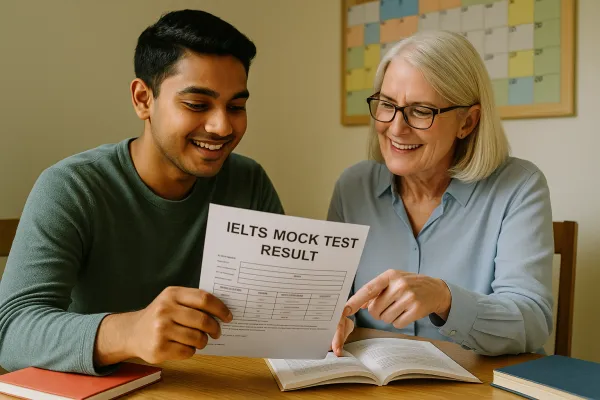
An IELTS Mock Test is designed to accurately simulate the official IELTS exam in terms of structure, format, timing, and test-day conditions. Its primary purpose is to give candidates a realistic preview of the actual exam, helping you prepare your mindset and knowledge as thoroughly as possible.
A full IELTS Mock Test covers all 4 skills:
- Listening: Approximately 40 minutes (30 minutes of audio plus 10 minutes to transfer answers).
- Speaking: Approximately 11–15 minutes.
- Reading: 60 minutes.
- Writing: 60 minutes.
Mock tests are typically held under strict supervision, mimicking the real exam environment, and the results are returned to help you gauge your current proficiency level.
Why should you take an IELTS Mock Test?
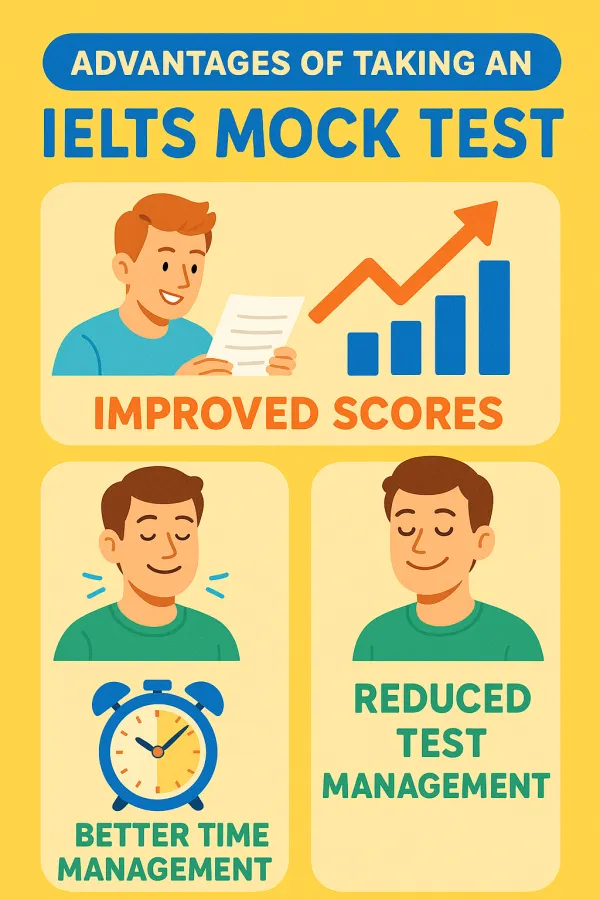
Participating in an IELTS Mock Test offers many practical benefits that you shouldn’t overlook:
-
Accurately assess your current level:
- A mock test provides an objective look at your strengths and weaknesses across all 4 skills.
- Results are graded according to official IELTS criteria, helping you identify common mistakes and areas for improvement. This allows you to adjust your study plan effectively.
-
Get familiar with the format and structure:
- You will become familiar with the timing for each section, the order of skills, common question types, and the scoring system.
- This is crucial for developing effective strategies, such as how to allocate time for Reading passages or Writing tasks.
-
Practice time management:
- Time pressure is one of the biggest challenges in the real IELTS exam. Mock tests help you practice allocating time wisely to ensure you complete all sections within the allotted timeframe.
- You will learn to control your pace, avoiding the “running out of time with questions left” scenario.
-
Build mental resilience:
- “Exam nerves” can significantly impact your performance. Getting used to the testing environment helps you handle pressure, reduce anxiety, and stay calm and confident on test day.
- You will gain practical experience with procedures, from entering the room and using equipment (headphones, computers) to interacting with invigilators and examiners.
-
Improve reflexes and synthesize knowledge:
- Taking multiple mock tests helps you speed up your response time to familiar question types, optimizing your performance.
- It’s a great opportunity to integrate skills (like note-taking, scanning, and paraphrasing) and consolidate what you’ve learned.
-
Interaction with native-level examiners (especially for Speaking):
- The Speaking test requires someone to listen and evaluate you. Taking a mock test at a reputable center allows you to speak with a qualified examiner and receive detailed feedback on your fluency, pronunciation, and intonation.
-
Save time and money:
- With a much lower cost (or even free in some places) compared to the real exam, mock tests allow you to check your level without a significant financial investment.
- Knowing your estimated band score helps you decide when you are truly ready to take the official exam, avoiding the need for multiple retakes and saving time and money for your study, work, or immigration goals.
Popular and reputable places for IELTS Mock Tests in Vietnam
You can find IELTS Mock Tests in many places, from official testing centers to test preparation centers and online platforms.
-
IDP Education and the British Council (BC):
- As the co-owners and official organizers of the IELTS exam worldwide, mock tests provided by these organizations are the most reliable and closest to the real exam.
- Pros:
- Free (usually requires a refundable deposit to hold your spot).
- Tests are provided by Cambridge, ensuring quality and difficulty equivalent to the real exam.
- The testing environment (paper, pens, headphones, space) is almost identical to the real exam.
- Opportunity to get used to the facilities if you choose to take the real test at the same location.
- Available in both paper-based and computer-delivered formats (depending on the center).
- How to register: Visit the IDP website (idp.com/vietnam/ielts/ielts-pre-test/) or the British Council website (britishcouncil.vn/thi/ielts/thuc-hanh-thi-ielts-tren-may-tinh), search for information on IELTS Pretest/Mock Test, and follow the instructions to register online or in person at their offices.
-
Reputable IELTS preparation centers
- Many large centers offer high-quality mock test services.
- Pros:
- Tests are often compiled by professional teams, updated with the latest exam trends.
- Fast results (usually within 24–48 hours).
- Options for detailed feedback and in-depth corrections from instructors (usually for an additional fee).
- Some centers use AI technology to help grade and analyze errors.
- May offer both online and offline testing options.
- Note: Mock test services at these centers usually incur a fee, though it is much lower than the actual exam fee.
-
Free online IELTS mock test websites:
- If you want a quick self-assessment or cannot visit a center, these websites are a good choice.
- Pros: Convenient, flexible, and accessible anytime, anywhere.
- Popular websites:
- IELTS Online Test (ieltsonlinetests.com): Offers a wide range of tests from Cambridge books, covering both Academic and General Training, with good audio quality and standard timing features.
- IELTS Buddy (ieltsbuddy.com): Provides various tests along with grammar lessons and vocabulary banks.
- IELTS Exam (ielts-exam.net): User-friendly interface with exercises categorized by type and skill.
- IELTS For Free (ieltsforfree.com): A collection of materials and tests with community support for questions.
- Mini IELTS (mini-ielts.com): Offers practice tests for Listening and Reading, along with helpful tips.
- Limitations: Speaking and Writing sections are often not graded, or only graded by AI (which is less accurate than a human examiner), and they lack the real-world testing environment.
How to optimize each skill in an IELTS Mock Test
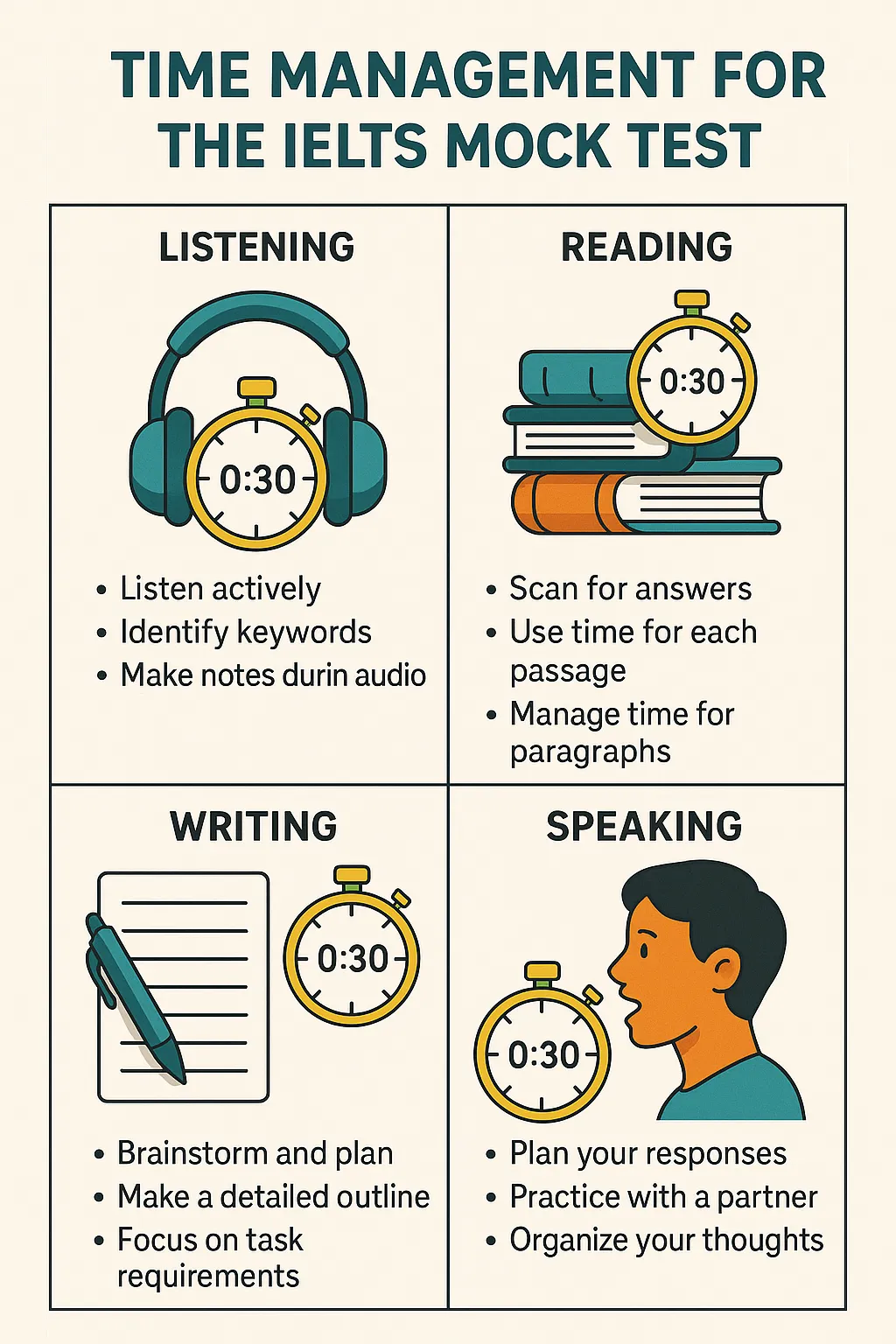
Optimizing Listening in an IELTS Mock Test
- Time: 30 minutes of audio + 10 minutes to transfer answers to the Answer Sheet.
- Strategy:
- Skim questions before listening: Use the transition time between sections to quickly read the upcoming questions. Underline keywords and predict the type of information needed (names, numbers, locations, objects, etc.).
- Stay focused and don’t panic: The audio plays only once. If you miss a question, move on immediately to focus on the next one to avoid losing more marks.
- Take notes quickly: Jot down important information, especially keywords or main ideas related to the questions. Don’t try to write full sentences.
- Check spelling and grammar: During the final 10 minutes, carefully review for spelling and grammar errors, and ensure your answers meet the word count requirements (e.g., “no more than three words”).
- Analyze errors after the test: Compare your answers with the transcript. Listen to the sections you got wrong and identify why: was it unfamiliar vocabulary, unclear pronunciation, distraction, or failure to recognize paraphrasing?
Optimizing Reading in an IELTS Mock Test
- Time: 60 minutes (3 passages, 40 questions).
- Strategy:
- Strict time management: Don’t spend too much time on one passage. You might use a 20-25-15 minute split (or 10-15-20 for higher bands) for the 3 passages, leaving 5 minutes at the end to review.
- Read questions before the text: Always read and underline keywords in the questions before reading the passage. This helps you target the information you need.
- Use Skimming & Scanning techniques:
- Skimming: Quickly read the title, introduction, conclusion, and topic sentences of each paragraph to grasp the main idea.
- Scanning: Used to find specific information (names, figures, dates) based on the keywords underlined in the questions.
- Handle different question types: Each type (Matching Headings, True/False/Not Given, Gap-filling, Multiple Choice) has its own approach. Practice regularly to master them.
- Never leave a blank: If you aren’t sure, make an educated guess. There is no penalty for wrong answers.
- After the test: Review every incorrect answer. Identify the type of error (vocabulary, inference, missing information) and the reason. Learn new vocabulary from the passage.
Optimizing Writing in an IELTS Mock Test
- Time: 60 minutes (20 minutes for Task 1, 40 minutes for Task 2).
- Strategy:
- Outline before writing: Spend 2–3 minutes per task sketching out main ideas and structure. This ensures your essay is coherent, logical, and stays on topic.
- Follow word counts: Ensure you write at least 150 words for Task 1 and 250 words for Task 2. Writing fewer words will result in a penalty.
- Focus on Task 2: Task 2 accounts for two-thirds of your total Writing score, so dedicate more time and effort to it.
- Use varied grammar and vocabulary: Demonstrate your language proficiency by using complex sentences and appropriate academic vocabulary.
- Spend the last 5 minutes reviewing: Check for spelling, grammar, punctuation, and the flow of your ideas.
- After the test: This skill requires feedback from a professional (teacher or examiner). Ask them to point out grammar errors, vocabulary issues, cohesion, and how to develop ideas. Read high-band sample essays to learn from them.
Optimizing Speaking in an IELTS Mock Test
- Time: 11–15 minutes (3 parts).
- Strategy:
- Create a simulated environment: If practicing alone, record your answers and practice in front of a mirror. If possible, practice with a native speaker or an experienced teacher.
- Practice speaking fluently and naturally: Don’t try to force complex vocabulary or difficult grammar if you aren’t confident. Prioritize coherence and natural communication.
- Develop your ideas: Expand your answers instead of just saying “yes” or “no.” Use examples and explanations to clarify your points.
- Pay attention to pronunciation and intonation: These are key factors affecting your score. Practice speaking clearly with natural intonation.
- Handling the parts:
- Part 1 (Introduction & Interview): Give concise, direct answers about yourself.
- Part 2 (Long Turn/Cue Card): Use the 1-minute preparation time to note down main points to develop your 1–2 minute talk.
- Part 3 (Discussion): Expand on ideas, provide personal opinions, and compare/contrast.
- After the test: Listen to your recording (if available) or get feedback from an examiner/teacher. Focus on the grading criteria (Fluency & Coherence, Lexical Resource, Grammatical Range & Accuracy, Pronunciation) to improve.
Strategies to make the most of your IELTS Mock Test
For a mock test to be truly valuable, you need the right strategy:
-
Treat the mock test like the real thing:
- Stick to the timing: Dedicate the full 2–3 hours (or more) to complete the test in one sitting, just like the real exam.
- Create a quiet environment: Minimize distractions as much as possible.
- Be honest with yourself: Do not cheat on time or look up answers.
- Prepare your tools: Have scratch paper, pencils, and an eraser ready.
-
Analyze results in detail:
- Don’t just look at the total score; examine your performance in each skill and section.
- Read feedback and comments from the examiner (if available) to understand where you went wrong and how to fix it.
- Make a list of recurring grammar, vocabulary, or strategy mistakes.
-
Build a study plan based on results:
- Focus on improving the skills or question types where you are weakest.
- Use your estimated band score to set more realistic goals for the actual exam.
- Take mock tests periodically (e.g., once a month) to track your progress and adjust your study plan.
-
Learn from test-taking strategies:
- Listening: Focus on keywords, use transition time to read ahead, and transfer answers in the final 10 minutes.
- Reading: Learn to allocate time (e.g., 20-25-10-5 minutes per passage), take notes, and always try to answer every question.
- Writing: Manage your time (20 minutes for Task 1, 35 minutes for Task 2, 5 minutes to review), outline before writing, and prioritize Task 2.
- Speaking: Practice your reflexes, record yourself for self-assessment, or ask others for feedback.
Conclusion
An IELTS Mock Test is not just a practice run; it is an essential tool in your journey to conquer the IELTS. It helps you prepare thoroughly in terms of knowledge, skills, and mindset, increasing your chances of achieving your dream band score on the official exam.
Treat every mock test as a valuable learning session and make the most of what it has to offer!



 Khai giảng Khóa học Hè cực HOT.
No comments yet!