


Tóm Tắt Nội Dung Bài Viết
The IELTS certificate is becoming increasingly popular in Vietnam as a globally recognized benchmark for English proficiency. For those just starting out or currently on their language-learning journey, a band score of 4.0 is a common target. So, what exactly is IELTS 4.0? Is this score high or low, what can you do with it, and how should you prepare to achieve it? This article provides a detailed overview of the IELTS 4.0 band score.
1. What is IELTS 4.0? What is the Equivalent Proficiency Level?
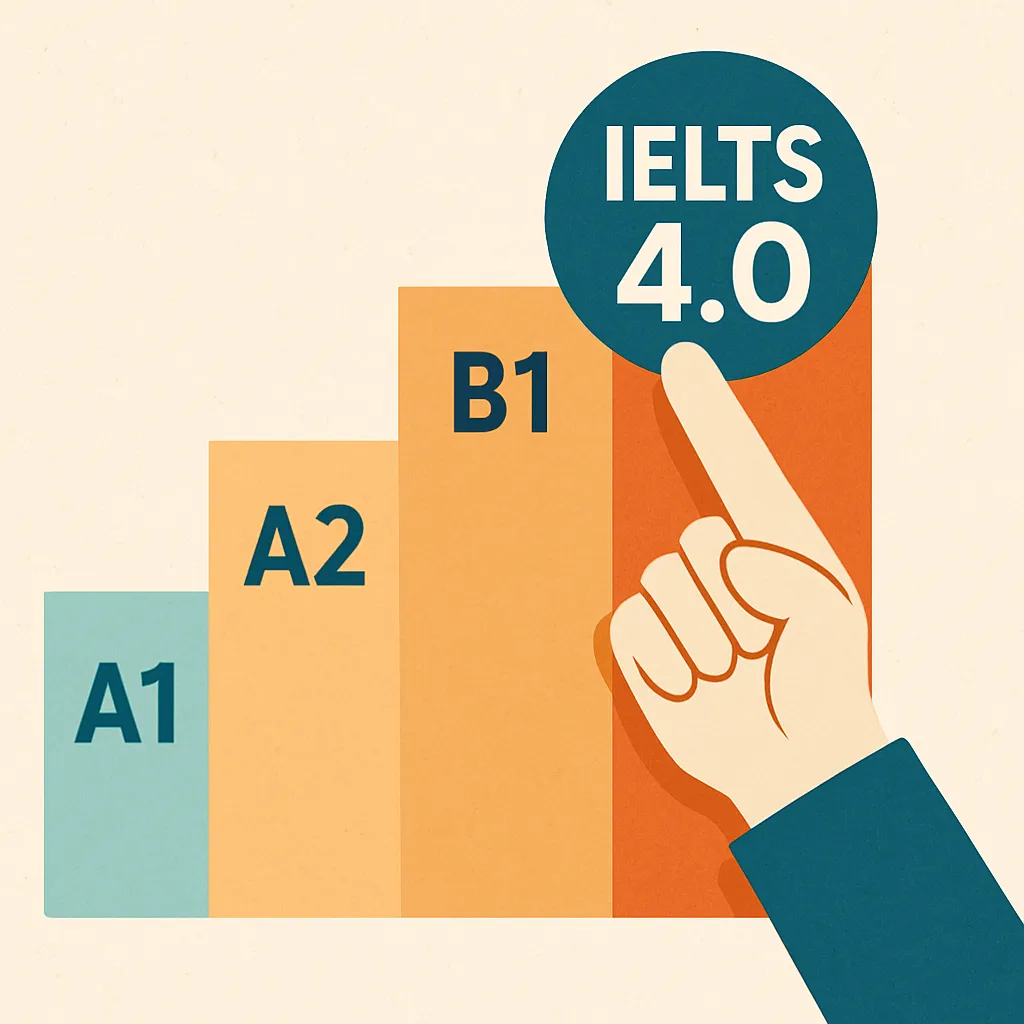
On the 0 to 9.0 scale of the IELTS exam, a 4.0 band is considered an “Intermediate” or “low-average” level. While not a high score on the IELTS scale, it indicates that the learner has established a certain foundation in English and possesses the ability to use the language at a basic level.
According to the Common European Framework of Reference for Languages (CEFR), IELTS 4.0 is equivalent to a B1 level. (Note: Some sources may equate 4.0 to B2 or a relatively high TOEIC score, but B1 is the more common and accurate equivalent).
An IELTS 4.0 holder can:
- Understand and use basic English structures in familiar, everyday situations.
- Communicate at a basic level about common topics such as themselves, family, hobbies, and work that does not require high-level expertise.
- Grasp the main points of simple, familiar spoken or written texts.
- Write simple sentences or short paragraphs on familiar topics, despite frequent grammatical and vocabulary errors.
In other words, at a 4.0 band, you have “started” to use English for simple communication and have laid the groundwork to progress to higher levels.
2. Is IELTS 4.0 High or Low? Is it Hard to Achieve?
Whether an IELTS 4.0 is considered high or low depends on your goals:
- If your goal is basic daily communication, reading simple documents, or meeting minimum requirements (such as exemption from the high school graduation English exam), then 4.0 is considered sufficient and a significant milestone.
- If your goal is to study abroad in English-speaking countries, apply to multinational companies requiring professional proficiency, or enroll in high-quality university/postgraduate programs, then 4.0 is a low score, and you will need significant effort to reach a higher band (usually 6.0 – 6.5 or above).
Regarding difficulty, IELTS is generally a comprehensive and academic assessment. However, achieving a 4.0 is not overly difficult, even for beginners. This score primarily requires you to master fundamental knowledge and become familiar with the basic exam format. The difficulty, if any, usually stems from a lack of a structured roadmap, inconsistency, or ineffective study methods.
3. How Long Does It Take to Reach IELTS 4.0 from Scratch?
To help you visualize the preparation journey, here is a suggested breakdown of stages from zero to band 4.0, along with estimated time and study hours for each phase:
Stage 1: Reaching band 3.0
- Study time: 3 months
- Estimated total study hours: 48 hours
- This stage focuses on building a foundation in vocabulary, basic grammar, simple listening/reading practice, and getting familiar with pronunciation.
Stage 2: Reaching band 4.0 (from a 3.0 foundation)
- Study time: 9 weeks (approx. over 2 months)
- Estimated total study hours: 45 hours
- This stage continues to expand vocabulary and grammar (learning compound sentences), practicing listening/reading with slightly longer and more complex texts, and further improving pronunciation.
In total, to go from zero to band 4.0 following this roadmap, you will need approximately 3 months + 9 weeks (about 5.5 months) with an estimated total of 48 + 45 = 93 study hours.
(Note: This is an estimate based on a specific reference roadmap; actual time may vary depending on individual learning capacity, intensity, and study methods. Other sources may suggest different timeframes and total hours depending on your starting point and preparation strategy).
4. What Can You Do with an IELTS 4.0?
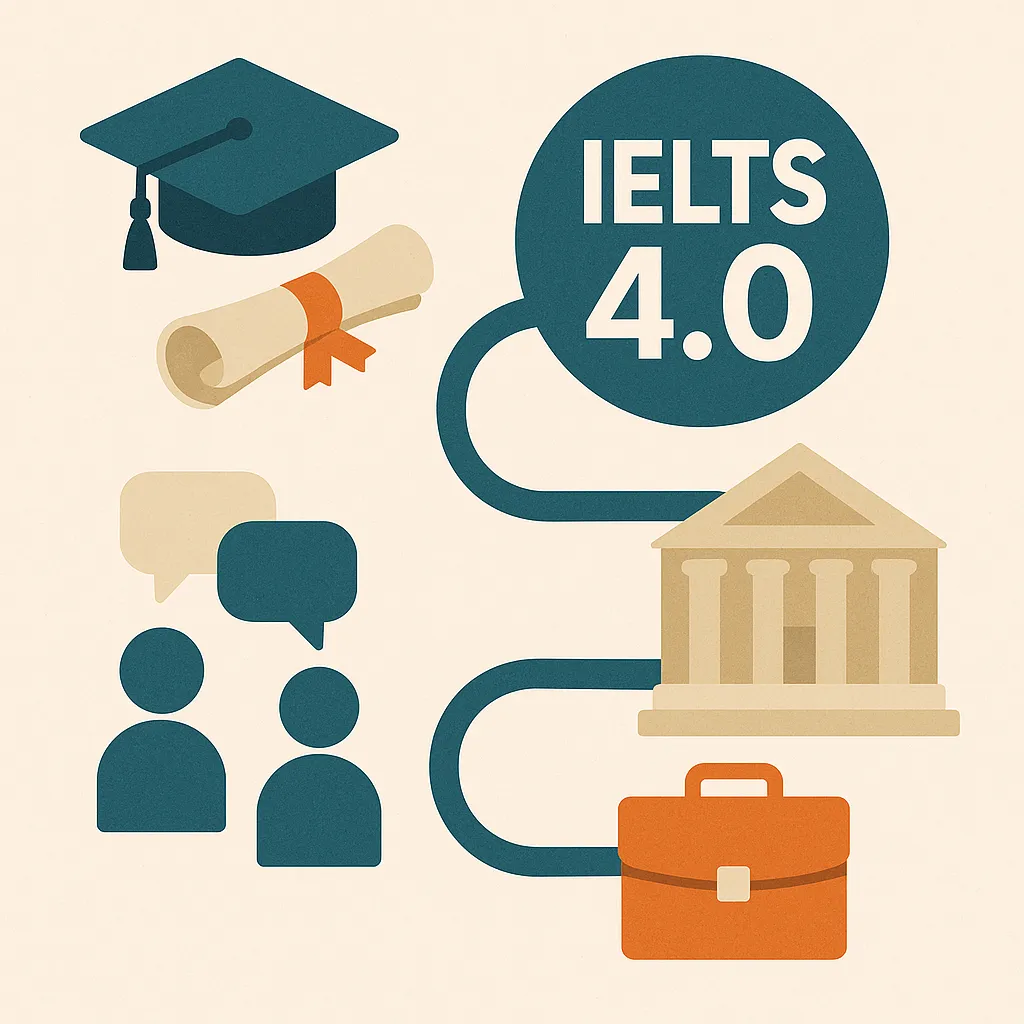
Although it is not a high score, an IELTS 4.0 certificate still offers practical benefits, especially within the context of Vietnam:
- Exemption from the High School Graduation English Exam: This is the most significant and common benefit. According to Ministry of Education and Training regulations, candidates with an IELTS certificate of 4.0 or higher (that is still valid) are exempt from the English exam and receive a score of 10 for the foreign language component of the high school graduation assessment. This significantly reduces pressure and allows candidates to focus on other subjects.
- University Admission Opportunities (Combined): While 4.0 is not enough for direct admission to most top-tier universities, many institutions now offer combined admission methods using an IELTS certificate (4.0+) alongside high school exam scores or academic transcripts. This provides an advantage in increasing admission chances for certain schools or majors.
- Using Basic English in Life and Work: A 4.0 certificate proves you have the ability to communicate and understand English at a basic level. This is useful for situations like traveling, reading simple documents, or working in positions that do not require intensive or frequent English use.
- A Solid Foundation: Reaching band 4.0 is an important stepping stone. It shows you are familiar with the exam format, have established initial study methods, and built a basic foundation, creating momentum to conquer higher bands like 5.0, 6.0, or 7.0 in the future.
5. Specific Criteria for Achieving Band 4.0 in Each Skill
The overall IELTS score is the average of the 4 skills. To achieve an Overall 4.0, you do not necessarily need exactly 4.0 in each skill; higher scores in one can compensate for lower scores in another, provided the average reaches 4.0 (rounded). Below are the grading criteria for band 4.0 in each skill:
- Listening: You need to answer approximately 10-12 out of 40 questions correctly. (Applies to both Academic & General Training).
- Reading:
- Academic: You need to answer approximately 10 out of 40 questions correctly.
- General Training: You need to answer approximately 15 out of 40 questions correctly. At band 4.0 Reading, you need the ability to grasp the main ideas and key details in simple, familiar texts, using basic skimming and scanning skills.
- Speaking: Evaluated based on 4 criteria (Fluency & Coherence, Lexical Resource, Grammatical Range & Accuracy, Pronunciation). At band 4.0 Speaking:
- You can answer basic questions but speak slowly, with frequent hesitation and repetition of words/ideas.
- Vocabulary is sufficient for familiar topics but limited and often misused.
- You use mainly simple sentence structures and make many basic grammatical errors that cause confusion.
- Pronunciation is not yet clear, making it difficult for the listener, despite attempts to control it. In short, you can convey ideas at a basic level but lack fluency, accuracy, and variety.
- Writing: Evaluated based on 4 criteria (Task Achievement/Response, Coherence & Cohesion, Lexical Resource, Grammatical Range & Accuracy). At band 4.0 Writing (for both Task 1 & 2):
- The writing attempts to cover the prompt but is incomplete, with unclear or repetitive ideas.
- Ideas are developed but lack coherence, with weak sentence/paragraph linking.
- Vocabulary is basic, with repetition, spelling errors, or inappropriate word usage.
- You use mainly simple sentence structures and make many basic grammatical errors. In short, you can write simple sentences/paragraphs but with many errors, and the writing is incomplete.
6. Common Challenges When Preparing for Band 4.0
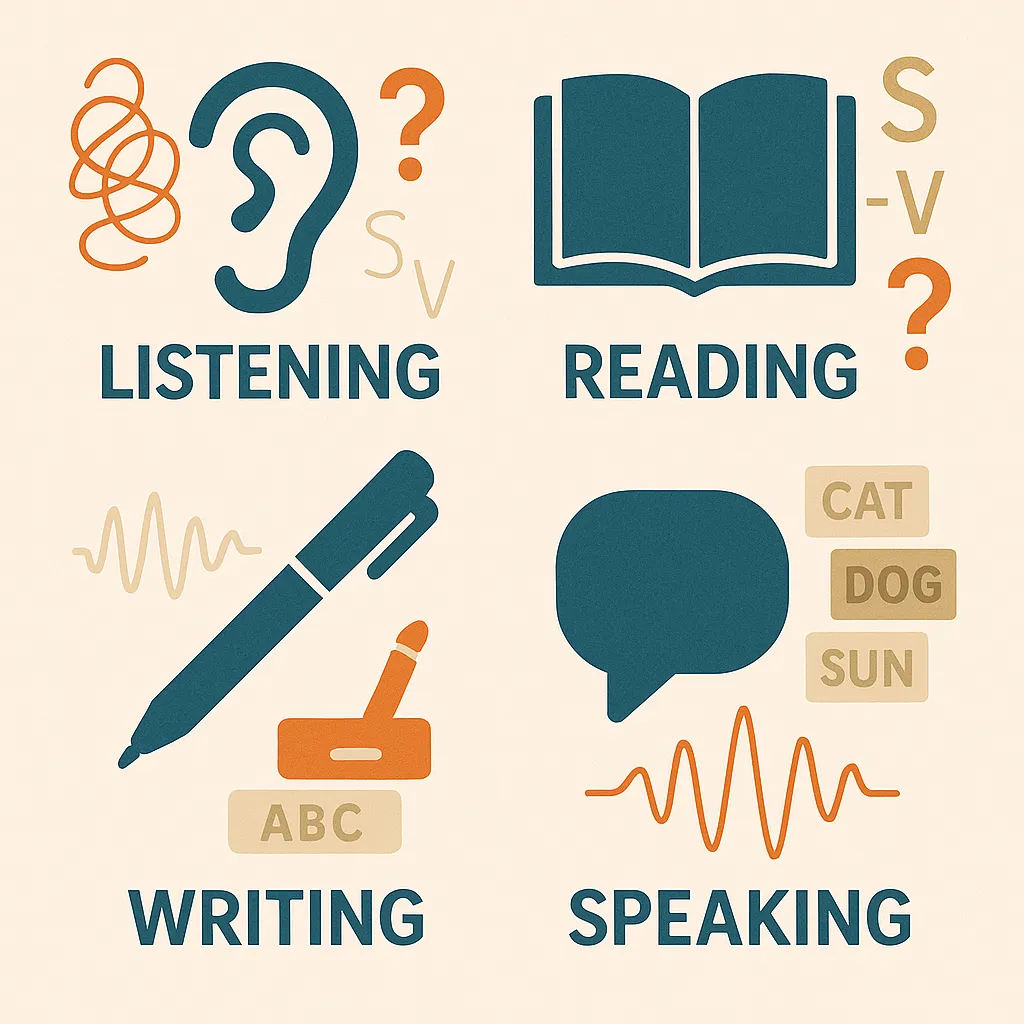
Learners at this level or aiming for band 4.0 often face the following challenges:
- Weak grammar foundation: This is the biggest barrier. A lack of basic grammar knowledge makes it difficult to construct sentences, write essays, or express ideas correctly.
- Limited vocabulary: Knowing only everyday words, making it difficult to handle unfamiliar topics or slightly more academic vocabulary.
- Poor pronunciation: Easily influenced by the native language, leading to difficulties in speaking or listening.
- Difficulty connecting ideas: Not knowing how to link simple sentences or organize ideas in short paragraphs or speeches.
- Unfamiliarity with the exam format: The question types in Reading, Listening, and the structure of Writing and Speaking tasks can be overwhelming.
7. Roadmap and Tips for Effective IELTS 4.0 Preparation
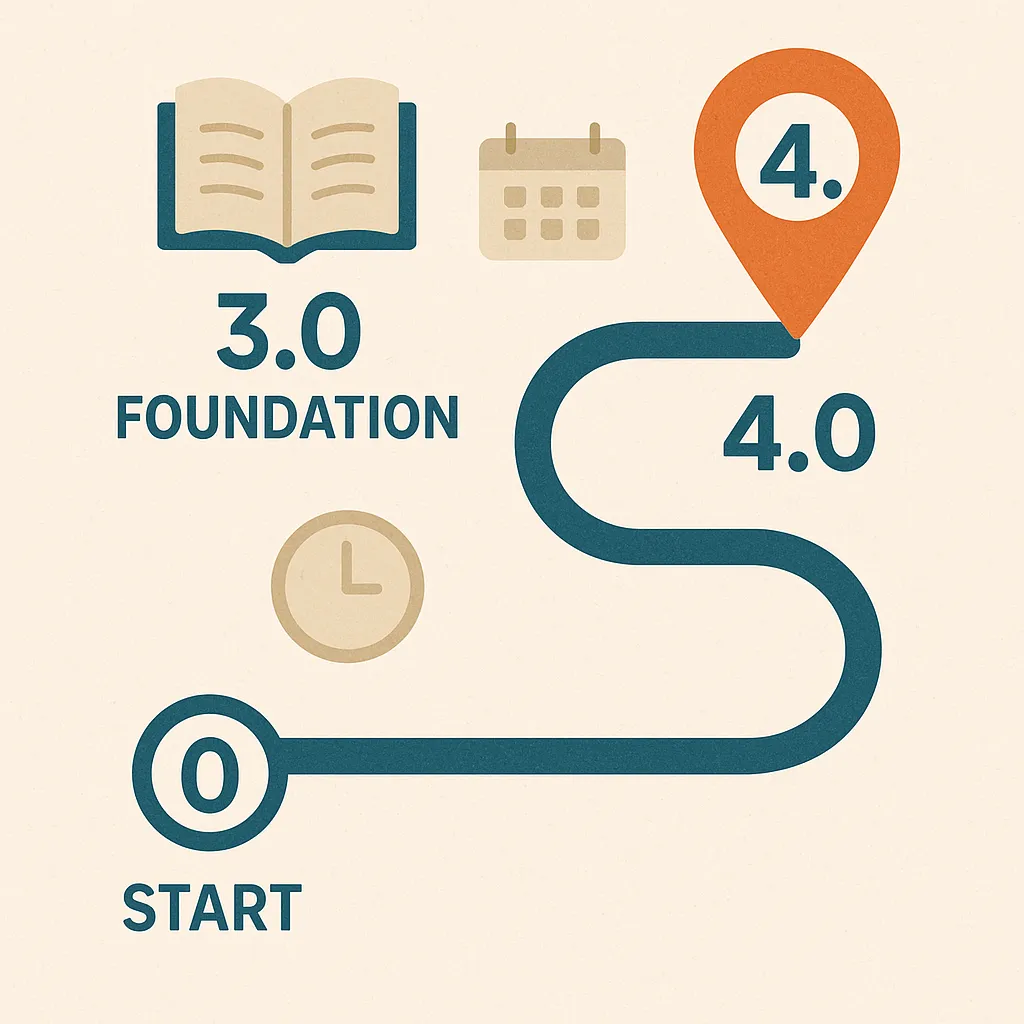
To conquer band 4.0, a structured study roadmap and persistence are crucial. Below are suggested steps and preparation tips:
- Step 1: Assess your current level & Set specific goals: Take placement tests to see where you stand and set a 4.0 goal within a reasonable timeframe.
- Step 2: Build a Solid Foundation (Stage 0 – 3.5/4.0): This is the most important stage.
- Grammar: Thoroughly review basic grammar: sentence structure, common tenses (present simple, past simple, future simple, present perfect), singular/plural nouns, articles, and simple sentence types (simple sentences, basic compound sentences). Practice by writing sentences and short paragraphs.
- Vocabulary: Learn vocabulary by familiar daily topics (family, hobbies, work, weather, food…). Focus on both pronunciation and word forms.
- Pronunciation: Learn the International Phonetic Alphabet (IPA). Practice individual sounds and words. Record your voice to compare and correct errors.
- Step 3: Get familiar with the Exam Format & Practice easier sections:
- Understand the overall structure of the 4-skill IELTS exam and common basic question types.
- Listening: Focus on practicing Parts 1 & 2 (conversations/monologues on daily life topics, at a slow/medium speed). Focus on listening for specific details (names, numbers, addresses…) and main ideas.
- Reading: Start with short, simple reading passages. Practice Skimming (for main ideas) and Scanning (for specific information) with easy gap-fill or True/False/Not Given questions. Make a habit of reading simple English materials daily (newspapers, stories…).
- Writing: Start by writing sentences that are grammatically and orthographically correct. Then, practice writing short paragraphs (~5-7 sentences) on familiar topics. Get familiar with the layout of Task 1 (describing simple charts) and Task 2 (giving simple opinions on an issue). Prioritize writing “correctly” and “clearly” before aiming for complexity.
- Speaking: Practice answering Part 1 questions about yourself, family, hobbies… Practice speaking simple sentences and try to extend your answers slightly (add examples, simple explanations). The most important thing at this band is basic fluency—try to speak continuously even if you stumble. Practice in front of a mirror or with friends/study partners.
- Step 4: Use appropriate reference materials: Choose books and materials at the elementary/pre-intermediate level (such as English Grammar/Vocabulary in Use, Get Ready for IELTS, Mindset for IELTS Level 1). Utilize free IELTS preparation websites that offer exercises by type.
- Step 5: Review and practice regularly: Dedicate at least 1-2 hours each day to studying English. Divide your time equally across all 4 skills and foundational knowledge (grammar, vocabulary, pronunciation). Consistency is key.
Conclusion
IELTS 4.0 is a foundational band score, marking the ability to use English at a basic intermediate level. While it may not be sufficient for academic or professional goals requiring intensive English, it offers practical benefits such as high school graduation exam exemption and opens doors for university admission at certain institutions. Achieving a 4.0 is entirely feasible if you build a scientific study roadmap, focus on consolidating basic grammar, vocabulary, and pronunciation, familiarize yourself with the exam format, and practice consistently. View 4.0 as an important stepping stone to continue developing and conquering higher band scores on your English learning journey.




 Khai giảng Khóa học Hè cực HOT.
No comments yet!