


Tóm Tắt Nội Dung Bài Viết
On your journey to mastering English, having a vast vocabulary is simply not enough. To communicate naturally, fluently, and with the kind of polish that impresses native speakers, you need to master how words naturally pair together—this is what we call collocations. And “Collocations in Use” from Cambridge University Press is one of the premier series designed to help learners master this essential skill.
In this article, the ECE language center provides a comprehensive, detailed look at the “Collocations in Use” series to help you decide if it’s the right “match” for your English learning journey.
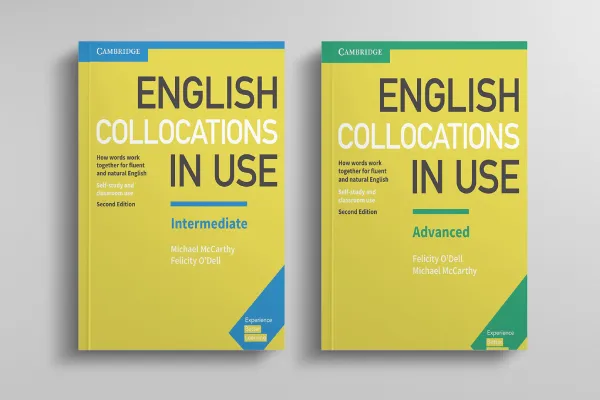
1. Overview of the “Collocations in Use” Series
- Authors: The “Collocations in Use” series is written by highly respected figures in English Language Teaching (ELT):
- Michael McCarthy: A prominent name in Applied Linguistics and ELT, known for numerous influential research papers and textbooks.
- Felicity O’Dell: Co-author of many successful English language teaching books, including the “English Vocabulary in Use” series.
- Eireann Aldrich (for the Advanced level): An expert with extensive experience in developing high-level English learning materials.
- Publisher: Cambridge University Press – one of the world’s oldest and most prestigious publishers, renowned for high-quality educational materials, particularly in the field of English Language Teaching (ELT).
- Estimated Price: The price of each “Collocations in Use” book varies depending on the retailer, the edition (paperback, with ebook/CD-ROM), and when you purchase it. However, the average price typically ranges from:
- 200,000 – 350,000 VND per book in the Vietnamese market.
- What does the series include? Currently, the “Collocations in Use” series consists of two main levels, catering to learners from intermediate to advanced proficiency:
- English Collocations in Use Intermediate: Designed for intermediate learners (equivalent to B1 – B2 on the CEFR scale).
- English Collocations in Use Advanced: Designed for advanced learners (equivalent to C1 – C2 on the CEFR scale).
2. Who Is This Series For?
Identifying the right target audience will help you maximize the effectiveness of these books.
English Collocations in Use Intermediate:
- Students: Those with a solid foundation in basic grammar and vocabulary (approx. 3,000 – 4,000 words) who want to improve their ability to express themselves more naturally and accurately.
- Professionals: Those who use English in their daily work and want to improve their email writing, reporting, and presentation skills to sound more professional and fluent.
- Independent learners: Those looking to expand their vocabulary and learn how to combine words systematically to improve all four skills: Listening, Speaking, Reading, and Writing.
- Candidates preparing for international English exams (IELTS, TOEFL, Cambridge Exams): Mastering collocations can significantly boost your scores in the Speaking and Writing sections. This book is particularly useful for those at an IELTS band score of 5.0 – 6.5.
English Collocations in Use Advanced:
- English majors or students studying in English-medium programs: Those who need to use academic and specialized language with nuance and precision.
- Professionals in senior roles who frequently communicate with international partners: Those aiming to perfect their English to a level of native-like fluency and naturalness.
- Advanced English learners: Those who already possess a wide vocabulary and strong grammar and want to conquer the finer aspects of the language, including less common and more academic collocations.
- Candidates preparing for advanced English certifications (IELTS 7.0+, TOEFL iBT 90+, CPE): This book provides “high-scoring” collocations that help make your performance more impressive.
General Note: Regardless of your level, you need self-discipline and persistence, as learning collocations requires consistent practice and memorization.
3. Detailed Review of the “Collocations in Use” Series
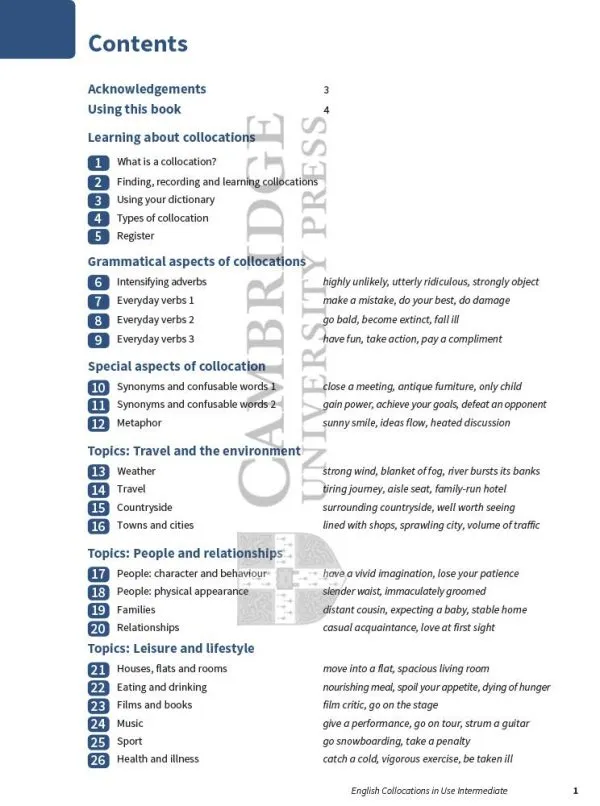
Both books in the “Collocations in Use” series feature a clear, logical structure focused on helping learners understand and use collocations effectively.
a. English Collocations in Use Intermediate
Structure:
- The book typically contains about 60 units, each focusing on a specific topic or type of collocation.
- Each unit is presented across two facing pages:
– Left-hand page: Introduces the theory, explains new collocations, and provides clear illustrative examples in specific contexts. Collocations are usually bolded or highlighted for easy identification.
– Right-hand page: Includes a variety of practice exercises to reinforce what you’ve learned. Common exercise types include fill-in-the-blanks, matching words to form collocations, error correction, and writing sentences using the learned collocations.
- Introduction: Covers what collocations are, their importance, and how to use the book effectively.
- Appendices: May include lists of common collocations by topic or further explanations of specific types of collocations.
- Answer Key: Provides detailed answers for all exercises, allowing for self-assessment.
- Index: Allows for quick lookup of collocations by individual words.
Key Content:
- Topic-based collocations: Covers familiar daily life and work topics such as Work and study, Leisure and lifestyle, People and relationships, Travel and tourism, The environment, Media and communication, Business, Health, etc.
- Word-type collocations: For example, collocations with common verbs (make, do, have, take, get, go, come), as well as nouns, adjectives, and adverbs.
- Concepts of collocations: Explains different types of collocations (e.g., strong collocations, weak collocations, common collocations).
- Effective learning methods: Provides tips and strategies for memorizing and using collocations.
Highlights:
- Clear, easy-to-understand explanations suitable for intermediate learners.
- Practical, relatable illustrative examples.
- Diverse exercises that help learners practice from multiple angles.
- Focuses on the most common collocations that intermediate learners need to master.
b. English Collocations in Use Advanced
Structure: Similar to the Intermediate level, the Advanced book also typically contains about 60 units presented on two facing pages, with theory on the left and practice on the right. It also includes an introduction, appendices, an answer key, and an index.
Key Content:
- Expands on topics from the Intermediate level: Delves deeper into more complex and nuanced aspects of familiar subjects.
- Introduces new, more academic and specialized topics: For example, Science and technology, Politics and public life, The arts, Economics and finance, Legal matters, etc.
- Focuses on less common, idiomatic, and formal collocations.
- Distinguishes between near-synonymous collocations: Helps learners understand the subtle differences in meaning between seemingly similar phrases.
- Collocations in academic writing and formal speech.
- How to use a collocation dictionary effectively.
Highlights:
- Provides a vast array of collocations at a more challenging and sophisticated level.
- Helps learners gain a deeper understanding of nuances and usage in diverse contexts, especially academic and professional settings.
- More challenging exercises that require higher-level linguistic thinking and analysis.
- A valuable resource for those aiming for native-like proficiency and naturalness in their English usage.
4. Pros of the “Collocations in Use” Series
- In-depth and systematic content: The series focuses exclusively on collocations, helping learners understand their nature and importance. Collocations are grouped by topic and word type logically, making them easy to follow and study.
- Cambridge University Press prestige: Ensures academic quality, accurate language, and a modern pedagogical approach.
- Clear explanations and practical examples: Theory is presented simply, accompanied by numerous examples that help learners visualize how to use collocations in context.
- Diverse and practical exercises: Exercises are designed to effectively test and reinforce knowledge while training you to apply collocations in real-world scenarios.
- User-friendly design: The clear layout with two facing pages per unit makes studying convenient. The detailed answer key and index are excellent for self-study.
- Focuses on essential and common collocations: The series prioritizes the word combinations that learners truly need for effective communication.
- Ideal for self-study: With its clear structure and included answer key, learners can easily study and progress on their own.
- Enhances naturalness and fluency: Mastering collocations helps your language sound more native-like, avoiding rigid “word-by-word” expressions.
5. How to Study Effectively with “Collocations in Use”
To get the most out of this series, consider these tips:
- Determine your level: Choose the book (Intermediate or Advanced) that matches your current proficiency to avoid it being too easy or too difficult.
- Study sequentially or by topic: You can work through the book from start to finish, or pick and choose the topics you find most necessary or interesting to study first.
- Read theory and examples carefully: Don’t just skim. Try to understand the meaning and usage of each collocation introduced. Pay attention to tips or important notes.
- Complete all exercises: This is a crucial step to test your understanding and retention. Try to complete them before checking the answer key.
- Take notes scientifically:
- Use a dedicated notebook: Record new collocations along with their meanings, examples, and potentially their word types (verb + noun, adj + noun, etc.).
- Learn in chunks, not single words: Always memorize collocations as complete phrases.
- Use flashcards: Write the collocation on one side and the meaning or an example sentence on the other for review.
- Mind maps: Create mind maps to link collocations by topic or root word.
- Review regularly (Spaced Repetition): Don’t just study once and forget. Schedule reviews of what you’ve learned after one day, one week, and one month to deepen your retention.
- Actively apply them in practice:
- In speaking and writing: Try to use the collocations you’ve learned as naturally as possible. Don’t be afraid of making mistakes; practice until they become second nature.
- In reading and listening: Pay attention to how native speakers use collocations in books, newspapers, movies, and podcasts. This helps reinforce your knowledge and introduces you to new ones.
- Use a collocation dictionary: Dictionaries like the Oxford Collocations Dictionary or the Longman Collocations Dictionary and Thesaurus are powerful tools when you want to look up which words typically pair with others.
- Study in groups (if possible): Discussing, asking questions, and practicing with friends can make learning more engaging and effective.
- Set realistic goals and be persistent: Don’t get discouraged if you can’t remember everything immediately. Language learning is a long process; consistency and persistence are the keys to success.
- Utilize Ebooks and CD-ROMs (if available): Many versions of the books come with Ebooks (convenient for lookup and mobile study) or CD-ROMs (which may contain interactive exercises or pronunciation guides).
Conclusion
The “Collocations in Use” series from Cambridge University Press is an incredibly valuable resource for anyone looking to improve their English, especially for those aiming for natural and accurate native-like expression. With its rich content, scientific structure, and effective approach, it is certainly a worthy investment for your English learning journey.
Remember, owning the books is just the first step. More importantly, you need diligence, persistence, and the right study methods. ECE wishes you success on your path to mastering collocations and becoming more confident in your English communication!





 Khai giảng Khóa học Hè cực HOT.
No comments yet!