


Tóm Tắt Nội Dung Bài Viết
Struggling with your English listening skills? The Tactics for Listening series by Jack C. Richards offers a comprehensive solution for every level, from Basic to Expanding. In this article, the ECE language center provides a detailed review of all three books, along with tips on how to study effectively and choose the right level for your needs.
An Introduction to Tactics for Listening
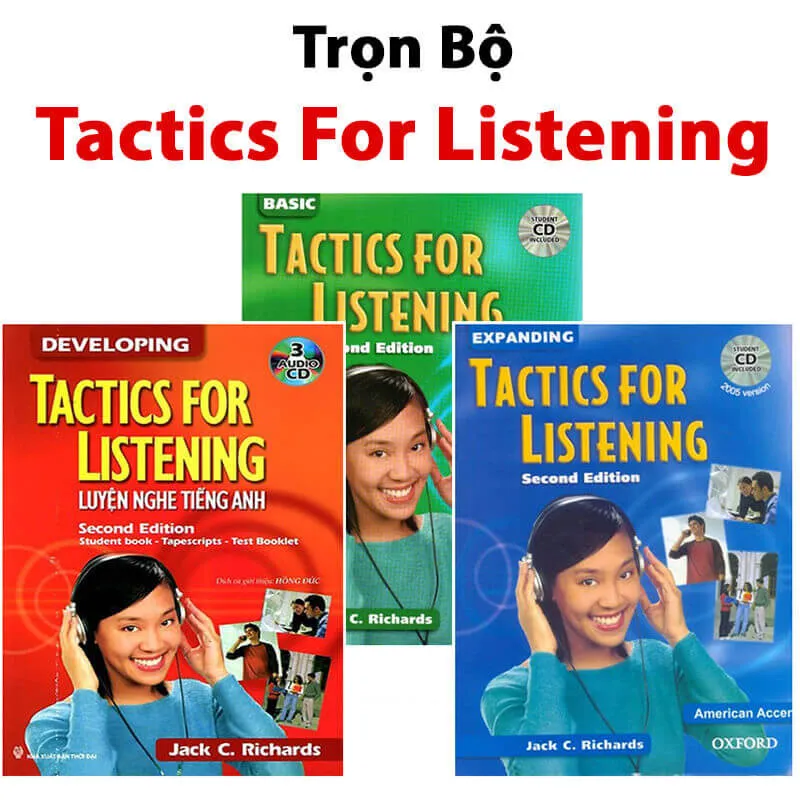
- Author: Jack C. Richards – A Master of Applied Linguistics
Jack C. Richards is more than just an author; he is a renowned applied linguist and an honorary professor at the University of Sydney, Australia, and Victoria University of Wellington, New Zealand. With over 50 years of experience in teaching, research, and developing effective English learning methodologies, his works—including the “Tactics for Listening” series—are used worldwide and highly regarded for their practical application and effectiveness.
- Publisher: Oxford University Press
Oxford University Press (OUP) is more than just a publisher; it is a hallmark of quality and prestige in education. With a history spanning over 500 years, OUP is one of the world’s largest and oldest university presses, specializing in high-quality academic publications, textbooks, dictionaries, and English learning materials. The fact that Tactics for Listening is published by OUP guarantees the content’s value, accuracy, and reliability.
- The “Tactics for Listening” Trio: A Roadmap from Basic to Advanced
The Tactics for Listening series consists of three books, corresponding to three proficiency levels:
Basic Tactics for Listening: Designed for beginners (A1 – A2 level). This book focuses on building foundational listening skills through simple, accessible lessons centered on familiar everyday topics.
Developing Tactics for Listening: Aimed at intermediate learners (B1 – B2 level). This book expands on the skills introduced in the Basic level, featuring longer, more complex audio tracks and a wider variety of topics.
Expanding Tactics for Listening: Tailored for advanced learners (C1 – C2 level). This book helps learners master their listening skills with academic, in-depth audio content and complex, sophisticated topics.
Decoding the Structure and Content of the Tactics for Listening Series
“Tactics for Listening” is not just a listening textbook; it is a meticulously designed, scientific system that helps learners develop their listening skills comprehensively. Below is a detailed breakdown of the structure and content of each book, revealing the “secret” behind the series’ success:
Basic Tactics for Listening: A Solid Foundation for Beginners
Target Audience: Absolute beginners (A1 – A2 level according to the Common European Framework of Reference for Languages – CEFR).
Objectives:
- Build foundational listening skills.
- Get familiar with basic English sounds, words, phrases, and sentence structures.
- Develop the ability to understand short, simple conversations on familiar topics.
- Boost initial confidence in listening to English.
Unit Structure: Each unit is designed as a “mini-lesson,” focusing on a specific theme and including the following sections:
Getting Ready:
- Picture: A large, colorful image—often a photograph or illustration—that visually introduces the lesson’s theme. For example, a picture of a family eating dinner might introduce the “Family” topic.
- Vocabulary: About 5-10 key words related to the topic, presented with illustrations and IPA transcriptions. For example, in the “Clothes” unit, you might see words like “shirt,” “pants,” “dress,” etc.
- Warm-up Questions: 2-3 simple questions related to the topic to stimulate thinking and curiosity. For example: “What are you wearing today?” or “What’s your favorite color?”
Listening 1 & 2:
- Short Conversations: Each listening section typically features 2-3 short conversations (about 30-60 seconds), focusing on specific communication scenarios. For example, in the “Time” unit, you might hear conversations about asking for the time or setting appointments.
- Variety of Listening Tasks: Exercises designed to develop specific listening skills:
- Multiple Choice: Listen and select the correct answer (A, B, C).
- Gap-fill: Listen and fill in the missing words in a sentence or paragraph.
- Matching: Listen and match corresponding information (e.g., matching names to professions).
- Short Answer: Listen and answer brief questions about the content.
- True/False: Listen and determine if statements are correct or incorrect.
- Focus on Specific Listening Skills:
- Listening for Gist: Understanding the overall content of the audio.
- Listening for Details: Listening for specific information like names, numbers, times, etc.
- Audio Script: Usually provided at the back of the book or in the Teacher’s Book, helping learners check parts they didn’t catch or study sentence structures and vocabulary in more depth.
Pronunciation:
- Focus on Basic Sounds: Practice vowels, consonants, and specific English sounds (e.g., the /θ/ sound in “think” or the /ð/ sound in “this”).
- Word Stress: Practice placing stress correctly on multi-syllable words.
- Sentence Stress and Intonation: Practice rhythm and pitch to convey meaning and emotion.
- Practice Activities:
- Listen and Repeat: Listen and mimic words, phrases, and sentences from the audio file.
- Minimal Pairs: Listen and distinguish between easily confused sounds (e.g., “ship” and “sheep”).
- Stress Marking: Listen and mark the stress in words and sentences.
Speaking:
- Pair Work/Group Work: Speaking activities designed to encourage communication and the use of learned vocabulary and structures.
- Role-Plays: Learners act out characters in specific situations based on the lesson content.
- Simple Dialogues: Provides short, simple conversation models for reference and practice.
- Guided Discussions: Prompt questions to help learners discuss the lesson topic.
Review:
- Vocabulary Review: Exercises to reinforce learned vocabulary (e.g., gap-fills, matching, synonyms/antonyms).
- Grammar Review: Exercises to review basic grammar structures from the listening tracks (e.g., verb conjugation, prepositions).
- Listening Review: Comprehensive exercises to test listening skills.
- Language Games: Fun, small activities (e.g., crossword puzzles, word searches) to review knowledge in an engaging way.
Main Topics: Familiar, everyday themes that make it easy for learners to relate and apply knowledge to real life, such as:
- Names and Titles
- The Time
- Clothes
- Describing People
- Activities
- Places
- Family
- Food
- …
Download Basic Tactics for Listening [PDF + AUDIO]: HERE
3.2. Developing Tactics for Listening: A Solid Step Up to Intermediate Level
Target Audience: Intermediate learners (B1-B2 according to CEFR).
Objectives:
- Expand and enhance the listening skills introduced in the Basic book.
- Get accustomed to longer, more complex conversations with faster pacing and more natural speech.
- Develop the ability to understand a wider range of topics, including abstract and specialized subjects.
- Increase confidence in listening during real-world communication.
Unit Structure:
- Getting Ready: Similar to the Basic level, but with upgraded vocabulary and warm-up questions suited for intermediate learners.
-
-
- Vocabulary: A larger volume of words, including more complex terms and phrases.
- Warm-up Questions: Questions that require deeper thinking, personal opinions, or sharing experiences.
-
- Listening 1, 2 & 3:
-
- Longer Conversations and Talks: Audio tracks lasting 1-3 minutes, including both conversations and monologues (e.g., short presentations, interviews).
- Faster Pace and More Natural Speech: Tracks recorded at a speed closer to natural native speech, including features like connected speech, elision, and sentence stress.
- More Challenging Listening Tasks:
- Note-Taking: Listen and record key information.
- Summarizing: Listen and summarize the main content.
- Inference: Listen and deduce information not explicitly stated.
- Distinguishing Facts from Opinions: Determine whether information is objective fact or subjective opinion.
- Focus on Advanced Listening Skills:
- Listening for Main Ideas: Identify the core message of the entire track or specific sections.
- Listening for Specific Information: Search for details like names, numbers, dates, locations, etc.
- Listening for Attitude and Opinion: Recognize the speaker’s tone and perspective.
-
- Pronunciation:
-
-
- Focus on More Complex Aspects of Pronunciation:
- Connected Speech: Practice linking sounds between words.
- Weak Forms: Practice pronouncing function words (e.g., “and,” “of,” “to”) in their weak forms.
- Intonation Patterns: Practice various intonation styles (e.g., rising, falling, rise-fall).
- Practice Activities:
- Listen and Repeat with Connected Speech: Practice linking sounds.
- Intonation Practice: Practice various intonation patterns.
- Shadowing: Listen and repeat simultaneously, mimicking the speaker’s speed and intonation.
- Focus on More Complex Aspects of Pronunciation:
-
- Speaking:
-
-
- More Realistic Communication Activities:
- Discussions: Discuss topics related to the listening content.
- Debates: Debate controversial issues.
- Role-Plays: Act out characters in more complex communication scenarios.
- Presentations: Give short presentations on a topic.
- More Complex Dialogues: Provides conversation models with richer grammar and vocabulary.
- More Realistic Communication Activities:
-
- Listening & Culture/Listening & Speaking:
-
-
- Cultural Insights: Audio tracks providing information about the culture, customs, and traditions of English-speaking countries.
- Communication Strategies: Helps learners develop effective strategies for various situations.
-
- Review:
-
-
- Advanced Vocabulary and Grammar Review: Exercises to review more complex vocabulary and grammar.
- Comprehensive Listening Review: Integrated exercises to review all learned listening skills.
-
-
Main Topics: Expanded to include:
- Travel
- Work
- Education
- Culture
- Society
- Environment
- Technology
- …
Download Developing Tactics for Listening [PDF + AUDIO]: HERE
3.3. Expanding Tactics for Listening: Mastering Advanced Listening
Target Audience: Advanced learners (C1-C2 according to CEFR).
Objectives:
- Perfect listening skills to reach a level of mastery.
- Understand lectures, presentations, interviews, debates, and other complex audio materials.
- Develop the ability to understand various accents, speaking speeds, and styles.
- Use English confidently and effectively in academic and professional environments.
Unit Structure:
- Getting Ready: High-level academic and specialized vocabulary, with open-ended questions requiring critical thinking and analysis.
-
-
- Vocabulary: Specialized terminology, idioms, and complex phrasal verbs.
- Warm-up Questions: Questions requiring deep thought, expressing viewpoints, and analyzing issues.
-
- Listening 1, 2 & 3:
-
-
- Authentic and Challenging Listening Materials: Audio tracks featuring lectures, presentations, interviews, and debates sourced from real-world content (e.g., TED Talks, BBC, NPR).
- Fast Pace and Diverse Accents: Fast-paced audio close to natural native speed, featuring various accents (e.g., British, American, Australian).
- Advanced Listening Tasks:
- Analyzing Arguments: Listen and analyze points, evidence, and reasoning.
- Evaluating Information: Listen and evaluate the accuracy, reliability, and objectivity of information.
- Synthesizing Information: Listen and synthesize information from multiple sources.
- Critical Listening: Listen and provide critical feedback on the content.
- Focus on Academic and Professional Listening Skills:
- Listening to Lectures: Understand lecture structure, take notes on key information, and summarize main points.
- Listening to Presentations: Understand the purpose of a presentation, follow main arguments, and evaluate effectiveness.
- Listening to Interviews: Understand the purpose of an interview, follow the Q&A, and evaluate the interviewee’s attitude.
- Listening to Debates: Understand different viewpoints, analyze arguments and evidence, and evaluate persuasiveness.
-
- Pronunciation:
-
-
- Focus on Advanced Features of Connected Speech:
- Elision: Practice omitting sounds in words or phrases.
- Assimilation: Practice how sounds change when they appear next to each other.
- Focus on Advanced Features of Connected Speech:
-
Download Expanding Tactics for Listening [PDF + AUDIO]: HERE
Key Advantages of the Tactics for Listening Series
- Comprehensive and Integrated Learning Path: The series provides a clear roadmap from basic to advanced, with strong links between levels. Skills are built gradually, ensuring learners aren’t overwhelmed when moving up.
- Rich, Diverse, and Updated Content: Topics cover a wide range of fields and are regularly updated to reflect societal and global changes.
- Scientific and Flexible Approach: The series combines various learning methods, from traditional listening practice to real-world communication activities, helping learners develop language skills holistically.
- Practical, High-Application, and Challenging Exercises: Exercises are designed not just to test knowledge but to encourage critical thinking, analysis, and real-world application.
- High-Quality Support Materials: Audio files, answer keys, scripts, and supplementary materials (like the Teacher’s Book) are meticulously prepared to provide maximum support.
- Engaging and Visual Design: The books are printed in color with vivid illustrations and a clear layout, making learning more interesting and accessible.
- Easy access to search for and download audio files.
Tips for Studying “Tactics for Listening” Effectively
- Assess Your Level and Choose the Right Book: Start with the book that matches your current proficiency. If you are a beginner, start with Basic Tactics for Listening. If you have a foundation, try Developing Tactics for Listening. If you want to challenge yourself at the highest level, choose Expanding Tactics for Listening.
- Follow the Order and Don’t “Skip”: Each book is designed to build on the foundation of the previous one. Follow the sequence to ensure you don’t miss any critical knowledge.
- Make the Most of Every Unit Section: Don’t skip any part of a unit. Each section plays a vital role in developing your listening skills.
- Listen Actively and Repeat: Listen multiple times, focusing on both the main ideas and key details. Use the audio script to check your work and repeat words, phrases, and sentences to improve pronunciation and listening ability.
- Integrate with Other Skills: Listening practice isn’t just about listening. Combine it with pronunciation, speaking, reading, and writing for holistic development.
- Complete Exercises Diligently: Finish all exercises in the book to reinforce your skills. Don’t be afraid of difficult tasks—that’s how you improve.
- Self-Assess and Adjust: Use the answer keys to check your work and correct mistakes. Regularly evaluate your progress and adjust your study methods if necessary.
- Seek Supplementary Materials: Don’t limit yourself to just the textbook. Explore other listening resources on similar topics or levels, such as podcasts, videos, movies, and songs, to expand your vocabulary and practice further.
- Create a Positive Learning Environment: Learning English is a long journey that requires persistence and passion. Create a positive environment, find study partners, or join English clubs to stay motivated and enjoy the process.
Conclusion
With its rich content, scientific methodology, and comprehensive support materials, Tactics for Listening is a reliable English listening series for all levels. Start your journey to mastering listening skills with Tactics for Listening today to communicate with confidence and open up new opportunities!




 Khai giảng Khóa học Hè cực HOT.
No comments yet!