


Tóm Tắt Nội Dung Bài Viết
The IELTS exam requires comprehensive preparation across all four skills: Listening, Reading, Writing, and Speaking. As of March 30, 2025, with the paper-based format completely phased out, all candidates will take the Listening, Reading, and Writing (LRW) sections on a computer (IELTS on Computer – IoC). This shift also brings specific regulations regarding the Speaking test schedule that you need to understand to develop the best possible strategy.
One of the most common concerns remains: should you take the Speaking test before or after the three LRW sections on the same day, and which time slot is ideal? This article analyzes these options and provides advice based on the reality of the computer-based format, while also considering the psychological factors and common challenges faced by Vietnamese candidates.
Current Regulations for the IELTS Speaking Schedule
- LRW Format: Since March 30, 2025, the Listening, Reading, and Writing sections are only available on computer (IoC).
- Speaking Format: The Speaking test remains a 1-on-1 face-to-face interview with an examiner; this has not changed.
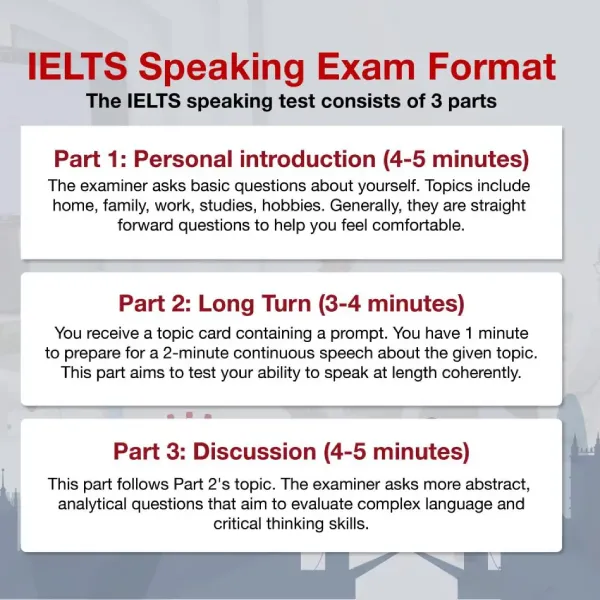
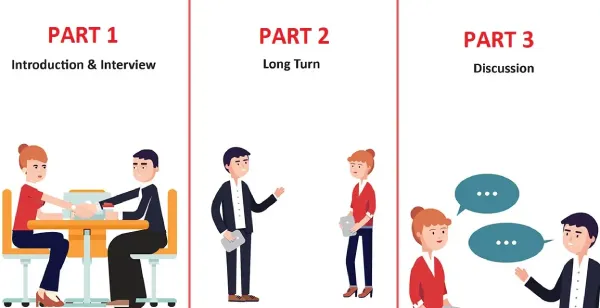
To give you a better overview, the IELTS Speaking test consists of three main parts:
– Part 1 (4–5 minutes): Introduction and interview on familiar topics such as family, work, studies, and hobbies.
– Part 2 (3–4 minutes): You receive a topic (cue card), have 1 minute to prepare, and then speak continuously for 1–2 minutes on that topic.
– Part 3 (4–5 minutes): The examiner asks deeper, more abstract discussion questions related to the topic from Part 2. The entire test lasts approximately 11–14 minutes.
- Speaking Schedule Regulations: While you previously had the flexibility to schedule your Speaking test up to 7 days before or after your paper-based exam, the current standard for computer-delivered IELTS is that the Speaking test is held on the same day as the three LRW sections. You will take the Speaking test either in the morning (before LRW) or in the afternoon (after LRW) on your official test day.
=> Advice: When registering for your exam, confirm your specific Speaking time slot with the test center (IDP or British Council) to ensure you are fully prepared.
Should you take the Speaking test before or after the other three skills?
This is a choice (or assignment) that requires careful consideration of the pros and cons, especially regarding the psychological impact.
2.1. Taking the Speaking test before the other three skills (Usually in the morning)
Pros
- Completing a high-pressure section early can help relieve overall psychological burden.
- You can take advantage of your peak mental alertness in the morning.
Cons
- HIGH PSYCHOLOGICAL RISK: This is a critical weakness, especially for many Vietnamese candidates who may not feel most confident in Speaking. If the initial Speaking test doesn’t go as planned, feelings of disappointment or anxiety can severely impact your concentration and performance during the subsequent, high-stakes LRW sections. This risk could cost you points in areas where you are otherwise strong.
- Significant pressure when starting the exam day with a “difficult” skill.
- You may not have had enough time to “warm up” and reach your full fluency.
2.2. Taking the Speaking test after the other three skills (Usually in the afternoon)
Pros
- PSYCHOLOGICALLY SAFER (For the LRW sections): You can focus all your energy on the long LRW exam without being distracted by the outcome of the Speaking test. This helps protect your overall score, especially if Speaking is not your strongest suit.
- You are already accustomed to the test environment, and your language skills are “warmed up.”
Cons
- PHYSICAL AND MENTAL FATIGUE: After nearly 3 hours of intense focus on the LRW sections, you will inevitably be tired. This fatigue can reduce your alertness, processing speed, energy, and fluency during the Speaking test.
- A poor performance in the LRW sections (if it occurs) can also negatively affect your mindset for the final Speaking test.
3. Some tips for you

- Verify your specific schedule: As soon as you receive the confirmation email from IDP or the British Council, read it carefully and save the important details. Double-check your personal information to ensure there are no errors. If anything is unclear or you need to confirm details (e.g., whether Speaking is exactly before or after LRW, or the specific time slot), proactively contact the test center via their hotline or email. Remember to note the required arrival time (usually 30–45 minutes before the test) to complete check-in procedures.
- Thorough preparation is the foundation: Your IELTS score reflects your actual English proficiency. No “hacks” or “tricks” can replace a solid knowledge base and well-practiced skills. Thorough preparation not only boosts your confidence but also equips you to adapt flexibly to different question types and situations in the exam room.
How to prepare:
Build your vocabulary: Learn vocabulary by topic and understand how to use words in context, including common collocations and idioms.
Master your grammar: Use a variety of grammatical structures, from simple to complex, accurately. Understand how to use tenses, relative clauses, conditional sentences, etc.
Improve your pronunciation: Practice difficult sounds, intonation, word stress, and sentence stress to ensure you are clear and easy to understand.
Develop fluency and coherence: Practice speaking regularly to increase your reflex speed, reduce hesitation, and use linking words to connect ideas logically.
Practice with Speaking test formats: Get familiar with the three-part structure of the Speaking test. Practice answering sample questions, record yourself, and listen back to identify and correct mistakes. Join English speaking clubs to enhance your reflexes.
Don’t just memorize answers: Expand your knowledge of various social topics to have a wealth of ideas when answering questions.
- Focus on your own performance: In the Speaking exam room, the only thing you can control is your own performance. Worrying too much about the examiner (whether they are friendly, how they are grading you) or comparing yourself to other candidates will only distract you, increase pressure, and negatively affect your results. Remember that examiners are trained to assess based on clear, objective criteria.
Conclusion
The current IELTS exam requires you to take all four skills on the same day. Taking the Speaking test before or after the LRW sections has its own pros and cons, but for many Vietnamese candidates, taking the Speaking test afterward may be a safer strategic choice to protect their mindset for the LRW sections, despite the challenge of potential fatigue.
Remember, regardless of your schedule, thorough preparation, good health, a steady mindset, and the ability to adapt are the most important factors in helping you succeed in the exam.




 Khai giảng Khóa học Hè cực HOT.
No comments yet!