


Tóm Tắt Nội Dung Bài Viết
Among English tenses, the Present Perfect acts as a unique bridge between the past and the present. It is a crucial tense that often confuses learners, especially those whose native languages lack a direct equivalent. However, mastering this tense is essential for expressing complex ideas involving experiences, results, or actions that have continued from the past into the present.
A clear understanding of the definition, usage, and structure of the Present Perfect not only helps you express ideas accurately and avoid common mistakes but also serves as an indispensable foundation if you aim to conquer standardized English tests like IELTS. In IELTS, proficiency in the Present Perfect demonstrates grammatical flexibility and precision—key components of the “Grammatical Range and Accuracy” assessment criterion.
What is the Present Perfect?
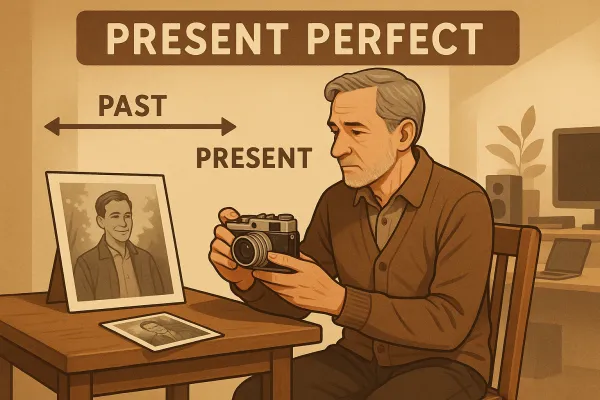
The Present Perfect is used to describe an action or event that:
-
Started in the past and continues into the present:
Example: She has lived in Hanoi for five years. (She started living in Hanoi five years ago and still lives there.)
Example: We have studied English since 2020. (We started studying English in 2020 and are still continuing.)
-
Occurred at an unspecified time in the past, but has a clear result or impact on the present:
Example: I have lost my keys. (The act of losing them happened in the past, but the result is that I don’t have them now.)
Example: They have finished their project. (The completion happened in the past, but the result is that the project is now done.)
-
Describes life experiences, where the specific time is not important:
Example: I have never been to Paris.
Example: He has visited London twice.
-
Just happened (often used with “just”):
Example: She has just arrived.
-
Describes an action repeated in the past up to the present (often used with “several times”, “many times”):
Example: I have called him several times today. (The action is repeated and may continue.)
Present Perfect Formulas
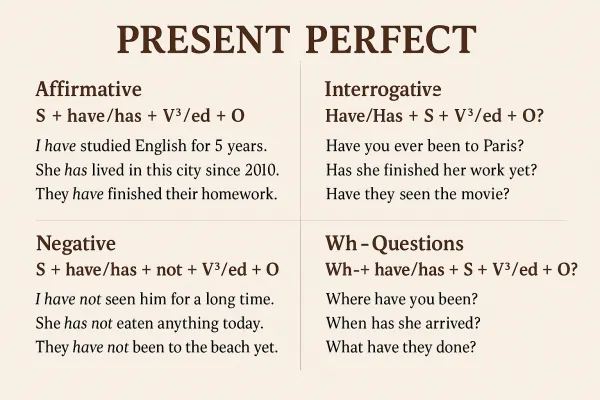
Mastering the formulas helps you construct grammatically correct sentences, especially with irregular verbs.
(Note: S: Subject, V3/ed: Past Participle, O: Object, A: Adverbial)
Using “have/has”:
- Has: Used for third-person singular subjects (He, She, It, singular nouns, uncountable nouns).
- Have: Used for subjects I, You, We, They, and plural nouns.
Detailed Usage of the Present Perfect
Understanding these specific use cases allows you to apply the tense flexibly and accurately, especially in situations requiring a connection between the past and present.
-
Actions starting in the past and continuing to the present (with “for” or “since”):
- “For” + duration: Describes how long an action has been happening.
- Example: I have known him for ten years.
- She has been a doctor for 20 years.
- “Since” + specific point in time: Describes the starting point of an action.
- Example: We haven’t seen each other since last Christmas.
- He has worked for this company since he graduated.
- Application in IELTS Speaking Part 1 & 3: Use this when asked about work, study, or living experiences. Example: How long have you lived in your current city? – I have lived in Hanoi for five years. Or for trends: The internet has revolutionized communication over the past two decades.
- “For” + duration: Describes how long an action has been happening.
-
Life experiences (often used with “ever”, “never”, “before”, “once”, “twice”, “many times”):
- The action happened at an unspecified time; what matters is whether it has occurred.
- Example: Have you ever tried skydiving?
- I have never visited Canada before.
- She has seen that movie three times.
- Application in IELTS Speaking Part 1 & 2: Useful for personal narratives. Example: I have travelled to many countries, but my trip to Japan was the most memorable. (Note: switch to Past Simple when detailing specific events.)
- The action happened at an unspecified time; what matters is whether it has occurred.
-
Actions that just happened and have present relevance (often with “just”):
- Example: I have just finished my lunch.
- The train has just departed.
- Application: Useful for updates or announcing recent news.
-
Actions in the past with results that still affect the present:
- The timing is less important than the current result.
- Example: He has broken his leg.
- I have cleaned my room.
- Comparison with Past Simple: I broke my leg yesterday. (Finished in the past, specific time.) I have broken my leg. (Result is still relevant.) This distinction is vital for IELTS.
- The timing is less important than the current result.
-
Actions not yet completed (often with “yet” in negative/interrogative, “already” in affirmative, “still” in negative):
- Yet: Used in questions and negatives, usually at the end of the sentence.
- Example: Has she arrived yet?
- No, she hasn’t arrived yet.
- Already: Used in affirmative sentences, usually between the auxiliary and main verb, or at the end.
- Example: I have already seen that movie.
- They have finished their work already.
- Still: Used in negative sentences, before “haven’t/hasn’t”.
- Example: He still hasn’t called me back.
- Application: Expressing expectations or completion status.
- Yet: Used in questions and negatives, usually at the end of the sentence.
-
In emphatic structures:
- This is the first/second/best/worst time + S + have/has + V3/ed.
- Example: This is the first time I have tried sushi.
- It’s been a long time since + S + V2/ed.
- Example: It’s been a long time since I last visited my hometown.
- Application in IELTS Speaking & Writing: Helps create complex sentences to boost your Grammatical Range score.
- This is the first/second/best/worst time + S + have/has + V3/ed.
Indicators of the Present Perfect
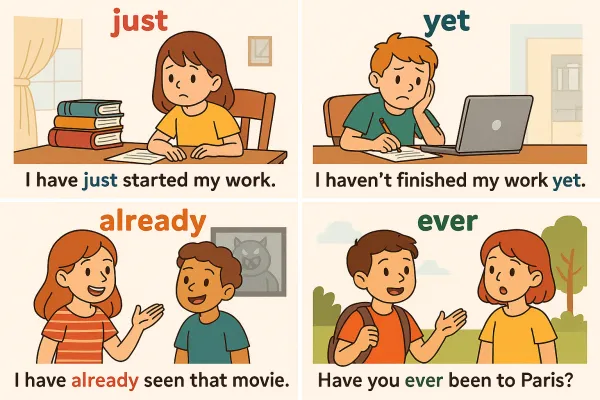
Correctly identifying the tense is crucial for comprehension. The Present Perfect is often accompanied by specific adverbs and phrases that help establish the link between past actions and the present.
-
Adverbs of unspecified time:
- Just: Recently.
Example: He has just left the office.
-
- Already: Used in affirmative sentences to show something happened sooner than expected.
Example: I have already finished my report.
-
- Yet: Not yet (negative); already/not yet (interrogative).
Example: She hasn’t arrived yet. / Have you met him yet?
-
- Ever: Used in questions or with “the first time”.
Example: Have you ever been to Vietnam?
-
- Never: Used in negative sentences to mean “not at any time”.
Example: I have never seen such a beautiful sunset.
-
- Still: Used in negative sentences, before “haven’t/hasn’t”, emphasizing that something expected hasn’t happened.
Example: They still haven’t replied to my email.
-
Phrases indicating a duration up to the present:
- For + duration: for a week, for two months, for ages, for a long time, for many years…
Example: We have lived here for five years.
-
- Since + specific point: since 2020, since last Monday, since I was a child, since she left…
Example: He has worked at this company since he graduated.
-
- So far / Until now / Up to now / Up to the present: Up to this moment.
Example: I haven’t received any complaints so far.
The team has won all their matches up to now.
-
Phrases indicating frequency up to the present:
- Several times, many times, a few times, once, twice, three times…
Example: She has called you three times today.
-
- This week / This month / This year / Today / Lately / Recently: (When the period is not yet finished).
Example: I haven’t seen her this week.
What have you been doing recently?
-
Implicit Context: Sometimes, no specific adverb is needed; the context itself implies the Present Perfect, especially when describing present results.
Example: I can’t open the door. I’ve lost my key.
The road is wet. It has rained.
Rules for Conjugating the Present Perfect
Accurate conjugation, especially using the correct Past Participle (V3/ed), is key. This often challenges learners due to the difference between regular and irregular verbs.
A. Basic Rules for Regular Verbs
-
Regular Verbs: Add “-ed” to the base form.
-
Examples:
- work -> worked -> has worked
- play -> played -> has played
- start -> started -> has started
- arrive -> arrived -> has arrived
-
Special cases for adding “-ed”:
- Verbs ending in “-e”: Add “-d”.
- live -> lived
- love -> loved
- One-syllable verbs ending in a consonant preceded by a vowel (except w, x, y): Double the final consonant and add “-ed”.
- stop -> stopped
- plan -> planned
- Two-syllable verbs ending in a consonant preceded by a vowel, with stress on the final syllable: Double the final consonant and add “-ed”.
- prefer -> preferred
- permit -> permitted
- Verbs ending in “-y”:
- If preceded by a consonant: Change “-y” to “-i” and add “-ed”.
- study -> studied
- try -> tried
- If preceded by a vowel: Keep “-y” and add “-ed”.
- play -> played
- enjoy -> enjoyed
- If preceded by a consonant: Change “-y” to “-i” and add “-ed”.
- Verbs ending in “-e”: Add “-d”.
-
-
Irregular Verbs: These do not follow the “-ed” rule and have their own Past Participle (V3) forms. You must memorize these.
-
Examples:
- be -> was/were -> been (He has been to New York.)
- go -> went -> gone/been (She has gone to the library. / I have been to the bank.)
- do -> did -> done (They have done their best.)
- see -> saw -> seen (I have seen that movie before.)
- eat -> ate -> eaten (She has eaten all the cake.)
- write -> wrote -> written (He has written a novel.)
- buy -> bought -> bought (We have bought a new car.)
- make -> made -> made (They have made a decision.)
-
Distinguishing “gone” and “been”:
- Gone (to): Went to a place and has not returned.
- He has gone to the supermarket. (He is there or on his way.)
- Been (to): Visited a place and has returned (describing experience).
Chia sẻ:
- Gone (to): Went to a place and has not returned.
-




 Khai giảng Khóa học Hè cực HOT.
No comments yet!