


Tóm Tắt Nội Dung Bài Viết
Among English verb tenses, the Present Perfect Continuous Tense plays a vital role in describing actions that began in the past and are still ongoing or have just concluded at the present moment, with a focus on the continuity of the action. While it is often confused with the Present Perfect Simple, mastering the differences will help you express your ideas with greater nuance and precision.
A clear understanding of the definition, usage, and structure of the Present Perfect Continuous not only helps you avoid common mistakes but also serves as essential foundational knowledge if you are aiming to conquer standardized English exams like IELTS. In IELTS, proficiency in this tense will demonstrate your flexibility and precision in terms of Grammatical Range and Accuracy, especially when describing processes, prolonged activities, or situations involving continuity.
What is the Present Perfect Continuous?

The Present Perfect Continuous Tense is used to describe:
-
An action that started in the past and is still continuing into the present: This is the most common usage, emphasizing the continuity and process of the action.
Example: She has been studying English for five hours. (She started five hours ago and is still studying now.)
Example: We have been living in this city since 2010. (We moved here in 2010 and still live here today.)
-
An action that has just finished in the recent past, but its results or evidence are still clearly visible in the present: Emphasizing the cause of the current situation.
Example: Your eyes are red. Have you been crying?
Example: The ground is wet. It has been raining.
-
An action that repeats over a period of time from the past to the present: Expressing the continuity of the repetition.
Example: I have been trying to call you all morning. (The act of trying has been repeated continuously.)
Present Perfect Continuous Formulas
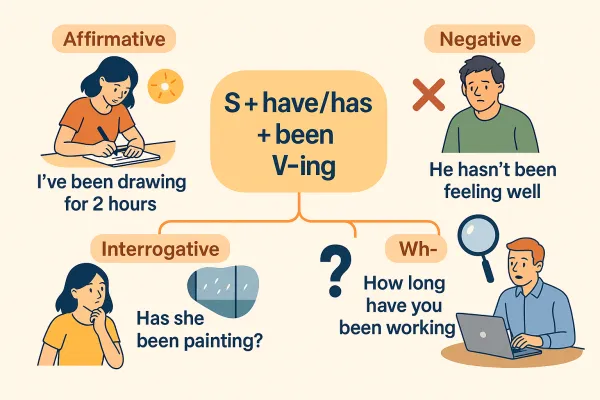
Mastering the formula helps you construct grammatically correct sentences, especially by using the “have/has been + V-ing” form correctly.
(Note: S: Subject, V-ing: Verb + -ing (present participle), O: Object, A: Adverbial) Contractions: have not = haven’t, has not = hasn’t
Subject-Verb Agreement for “have/has”:
- Has: Used with third-person singular subjects (He, She, It, singular nouns, uncountable nouns).
- Have: Used with I, You, We, They, and plural nouns.
Detailed Usage of the Present Perfect Continuous
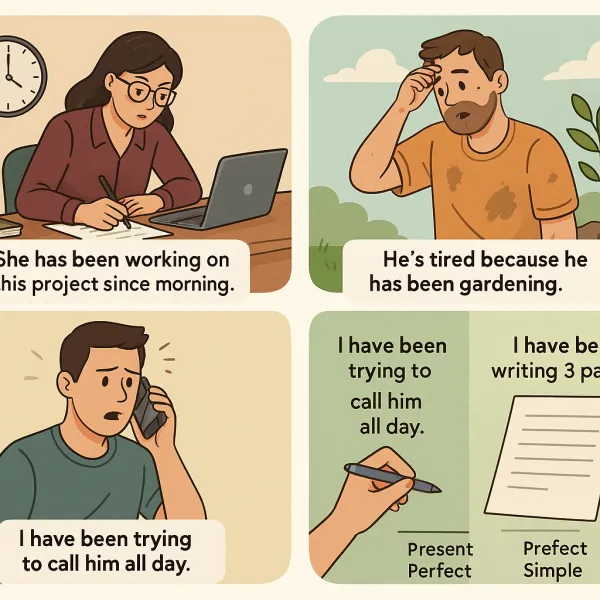
Understanding these usage cases helps you apply this tense flexibly and accurately, especially to emphasize the continuity of an action.
Describing an action that started in the past and is still ongoing
- Emphasizes the continuity and process of the action. It is often accompanied by time expressions (for, since) to clarify the duration.
Example: I have been working on this project all week. (And I am still working on it.)
Example: It has been snowing for three hours. (And it is still snowing.)
- Comparison with Present Perfect Simple:
- Present Perfect Continuous (emphasizing the process): I have been writing this report for three hours. (Emphasizes the process of writing; it may not be finished yet.)
- Present Perfect Simple (emphasizing the result): I have written three pages of this report. (Emphasizes the result: three pages are completed.)
Note: Certain state verbs such as know, believe, understand, like, love, hate, want, need, seem, possess, own, belong, have (possession)… are generally not used in continuous tenses. In these cases, use the Present Perfect Simple.
Example: I have known her for ten years. (DO NOT use I have been knowing her).
Application in IELTS Speaking & Writing: Very useful when talking about how long you have lived, studied, or worked somewhere, or when describing a continuous trend/activity.
Describing an action that just finished, leaving a result/evidence in the present
- The action has ended, but its consequences or evidence remain clear at the time of speaking.
Example: Why are your clothes so dirty? I have been playing football. (The game is over, but the dirty clothes are the result.)
Example: The street is wet. Someone has been washing their car.
- Application: Used when explaining the cause of a current situation, common in daily conversation.
Describing an action that repeats over a period of time
- Emphasizes the continuity of the repeated action.
Example: He has been calling me every five minutes.
Example: I have been trying to fix this computer since morning.
Application: Expresses persistence, or sometimes annoyance with a repetitive action.
Identifying the Present Perfect Continuous

Correctly identifying verb tenses is crucial for understanding the exact meaning of a sentence. The Present Perfect Continuous is often accompanied by characteristic adverbs and phrases that indicate an action is continuous and extends to the present.
Phrases indicating a duration extending to the present:
- For + duration: for two hours, for ages, for a long time, for many years, for a while…
Example: She has been reading for three hours.
- Since + specific point in time: since 2020, since last Monday, since I was a child, since she left…
Example: We have been waiting since noon.
- All day / All morning / All week / All year:
Example: It has been raining all day.
- Lately / Recently:
Example: What have you been doing lately?
Implicit Context: Sometimes, even without time markers, the context of the sentence is enough to indicate the Present Perfect Continuous, especially when explaining the cause of a current state.
Example: Your hands are dirty. (Implied: You have been working in the garden.)
Example: He looks exhausted. (Implied: He has been studying very hard.)
Rules for Conjugating the Present Perfect Continuous
Accurately conjugating verbs in the Present Perfect Continuous requires combining the auxiliary verbs “have/has”, “been”, and the main verb with “-ing”.
With the main verb ending in “-ing” (V-ing)
This is the most important rule. Most verbs simply add -ing to the end.
-
Basic rule: Add
-ingto the base form of the verb.- work → working
- play → playing
- study → studying
-
Verbs ending in “-e”: Drop the “-e” and add “-ing”.
- make → making
- write → writing
- live → living
- Exception: be → being (Do not drop the e)
-
Verbs ending in “-ie”: Change “-ie” to “-y” and add “-ing”.
- lie → lying
- die → dying
-
One-syllable verbs ending in a consonant preceded by a vowel: Double the final consonant and add “-ing”.
- run → running
- stop → stopping
- swim → swimming
-
Two-syllable verbs ending in a consonant preceded by a vowel, with the stress on the final syllable: Double the final consonant and add “-ing”.
- begin → beginning
- prefer → preferring
Subject-Verb Agreement with “have/has”
The basic rule is: Singular subjects take “has been”, plural subjects take “have been”.
-
Subjects I, You, We, They or plural nouns: Use have been + V-ing.
Example: We have been waiting for you.
Example: The students have been preparing for the presentation.
-
Subjects He, She, It or singular/uncountable nouns: Use has been + V-ing.
Example: She has been working hard.
Example: The machine has been running for an hour.
Example: The water has been leaking all night.
-
Special cases to note:
- Prepositional phrases between the subject and verb: The auxiliary verb agrees with the main subject.
Example: The quality of these products has been improving steadily. (The subject is “quality”, which is singular).
-
- Compound subjects joined by “and”: Usually take have been (plural).
Example: My brother and sister have been planning a trip.
-
- Indefinite pronouns (always singular): everyone, everybody, everything, someone, somebody, something, anyone, anybody, anything, no one, nobody, nothing, each, either, neither. Always use has been.
Example: Everybody has been discussing the new policy.
The Present Perfect Continuous in Specific Contexts
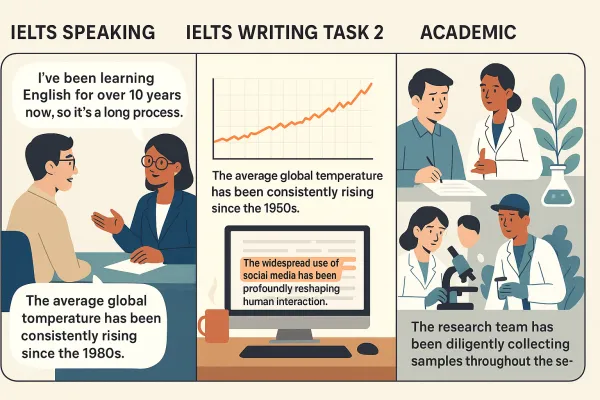
In General Academic Writing
The Present Perfect Continuous is used to:
- Describe a process or phenomenon that has been and is currently occurring: Often appears when analyzing continuous trends.
Example: The global climate has been warming consistently over the past century, leading to various environmental challenges.
Example: Research in this field has been progressing rapidly, with new discoveries being made constantly.
- Present activities that have been carried out continuously in a study/project:
Example: The research team has been collecting data from remote sensors since January.
In IELTS Writing Task 1 (Academic – Describing charts, maps, processes)
Although the Present Simple and Past Simple are the primary tenses, the Present Perfect Continuous can be used in specific cases:
- Describing a continuous process or trend extending to the present (less common than the Present Perfect Simple, but can be used to emphasize continuity if there is evidence):
Example: The average temperature in the region has been rising steadily over the last two decades.
Note: Usually, the Present Perfect Simple (“has risen”) is sufficient and safer. Only use the Present Perfect Continuous when you really want to emphasize the continuous process of that change.
In IELTS Writing Task 1 (General Training – Letter Writing)
The Present Perfect Continuous is very useful when you need to explain an ongoing situation or problem.
- Explaining an ongoing situation or a recently finished one that caused a problem:
Example: I am writing to complain because the heating system in my apartment has been making strange noises for the past week.
Example: I have been trying to contact your customer service for three days, but I haven’t received any response.
In IELTS Writing Task 2 (Essay Writing)
The Present Perfect Continuous helps build arguments regarding social issues, trends, or challenges that have been and are currently unfolding.
- Describing social issues and trends that have been developing:
Example: The widespread use of social media has been transforming human communication patterns, leading to both positive and negative consequences.
Example: Environmental pollution has been increasing at an alarming rate, posing a serious threat to public health.
- Stating measures or efforts that are being implemented continuously:
Example: Governments worldwide have been implementing various policies to promote sustainable development.
In IELTS Speaking Part 1 (Answering personal questions)
This is a section where the Present Perfect Continuous is frequently used when the examiner asks about your activities that extend to the present.
- Activities you have been doing:
- Q: How long have you been studying English? A: I have been studying English for about 10 years now.
- Q: What have you been doing recently? A: Recently, I have been working on a big project at work, so I’ve been quite busy.
- Explaining the cause of a current state:
- Q: Why do you look so tired? A: Oh, I have been studying for my exams all night.
In IELTS Speaking Part 2 (Topic Description – Long Turn)
Although this part often requires storytelling (using past tenses), the Present Perfect Continuous is still necessary when you:
- Describe an activity/experience you have been participating in continuously:
(Describe a hobby you enjoy) I have been playing the guitar since I was 15, so for almost 10 years now. I have been practicing almost every day.
- Describe an ongoing situation related to the topic:
(Describe a difficult challenge you have faced) One challenge I have been dealing with recently is trying to balance my work and studies.
In IELTS Speaking Part 3 (In-depth Discussion)
The Present Perfect Continuous is an essential tool for discussing abstract issues, social trends that have been unfolding, and their ongoing impacts.
- Discussing social trends and general issues that have been developing:
- Q: How has social media been affecting young people? A: Social media has been impacting young people’s mental health quite significantly, as many have been spending excessive time online.
- Q: What changes have been happening in your city recently? A: My city has been undergoing rapid urbanization. New buildings have been constructed, and the transportation system has also been improving.
- Stating efforts and solutions being implemented continuously:
- Q: What measures have governments been taking to address environmental issues? A: Governments have been investing more in renewable energy and have been promoting public awareness campaigns.
Elevating Your Expression with the Present Perfect Continuous in IELTS
To make your writing and speaking more natural, flexible, and impressive—especially in exams like IELTS—using a variety of structures and accompanying adverbs with the Present Perfect Continuous is essential.
Using advanced adverbs and phrases to emphasize continuity:
- Continuously / Constantly / Persistently:
Example: The company has been continuously investing in new technologies.
- For an extended period / For a considerable time:
Example: Researchers have been conducting experiments for an extended period to validate their findings.
- Non-stop / Around the clock: (Often used in the context of machinery or heavy work).
Example: The factory has been operating non-stop since Monday morning.
- Up until now / To date:
Example: The project has been progressing smoothly up until now.
Combining with other structures to create complex sentences:
- Chia sẻ:




 Khai giảng Khóa học Hè cực HOT.
No comments yet!