


Tóm Tắt Nội Dung Bài Viết
In English, the Past Simple is a fundamental tense used to describe actions or events that occurred and were completed entirely in the past, at a specific or implied time. Mastering the Past Simple allows you to tell stories, recount events, and describe history clearly and accurately.
Understanding the definition, usage, and structure of the Past Simple not only helps you avoid common mistakes in daily communication but is also core knowledge for achieving high scores in standardized English exams like IELTS. Especially in sections such as IELTS Speaking Part 2 (describing an experience or event) or IELTS Writing Task 1 (Academic – describing past trends), using the Past Simple correctly is a crucial factor in demonstrating grammatical accuracy and coherence in your expression.
What is the Past Simple?
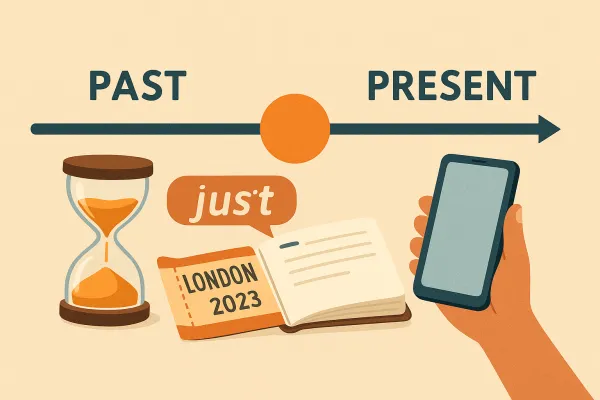
The Past Simple is used to describe:
-
An action or event that happened and finished completely at a specific time in the past: The specific time may be explicitly mentioned or implied by the context.
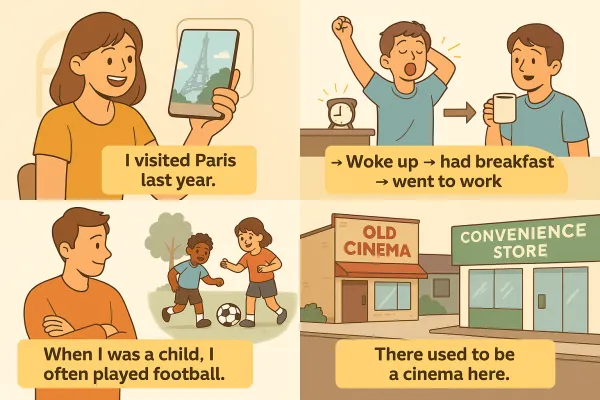
Example: I visited my grandparents last weekend.
Example: She graduated from university in 2020.
-
A sequence of actions that happened consecutively in the past:
Example: He woke up, had breakfast, and then went to work.
-
A habit or repeated action in the past (no longer true now): Often accompanied by frequency adverbs or phrases indicating past habits.
Example: When I was a child, I often played with dolls.
Example: She used to travel a lot for work.
-
A fact or state that was true in the past but is no longer true in the present:
Example: He was a student here five years ago.
Example: They lived in London for a short time.
Past Simple Formulas
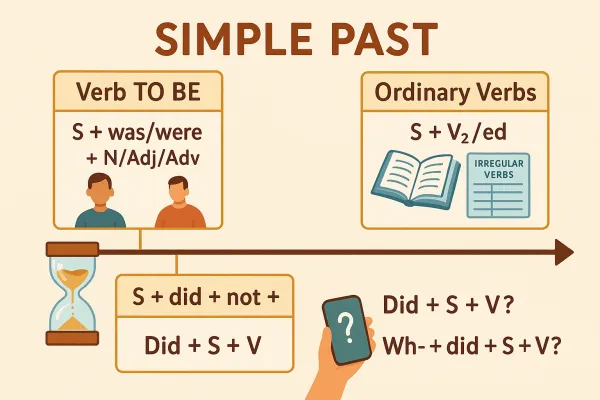
Mastering the formulas helps you form grammatically correct sentences, especially with irregular verbs.
(Note: S: Subject, V: Base verb, V2/ed: Past simple form of the verb, N: Noun, Adj: Adjective, Adv: Adverb, O: Object, A: Adverbial)
How to use “was/were”:
- Was: Used for subjects I, He, She, It, singular nouns, and uncountable nouns.
- Were: Used for subjects You, We, They, and plural nouns.
Detailed Usage of the Past Simple
Understanding these specific cases helps you apply this tense flexibly and accurately, especially when recounting past events.
-
Describing an action that happened and finished at a specific time in the past: This is the most common usage, often accompanied by specific time adverbs in the past.
Example: I finished my project yesterday afternoon.
Example: They moved to Canada three years ago.
Application: When recounting events, whether in IELTS Speaking Part 2 (describing an event/experience) or IELTS Writing Task 1 (describing past data).
-
Describing a sequence of consecutive actions in the past:
Example: She opened the door, walked in, and sat down on the sofa.
Application: Excellent for storytelling or narrating a series of events in chronological order.
-
Describing a habit or repeated action in the past that no longer exists: Often used with frequency adverbs like often, sometimes, always, never or the structure used to.
Example: When I was young, I often went swimming.
Example: He used to smoke, but he quit last year.
Note: Used to emphasizes a past habit that has ended in the present.
-
Describing a fact or state that was true in the past: Often used with the verb to be or state verbs.
Example: The weather was very cold last winter.
Example: He believed in ghosts when he was a child.
-
In second conditional sentences: (Describing an unreal condition in the present or future).
- Structure: If + S + V2/ed, S + would/could/might + V.
Example: If I had a car, I would drive to work. (In reality, I don’t have a car now.)
-
In the structure “It’s time…” / “It’s high time…”: (Expressing that it is time for someone to do something).
- Structure: It’s time + S + V2/ed.
Example: It’s time we left for the airport.
-
In Reported Speech: When the reporting verb is in the past, the tenses in the direct speech usually shift back into the past.
Example: She said, “I am happy.” She said that she was happy.
Example: He said, “I went to the park.” He said that he had gone to the park. (Past Simple shifts to Past Perfect, though it can sometimes remain Past Simple if the context is clear).
Identifying the Past Simple
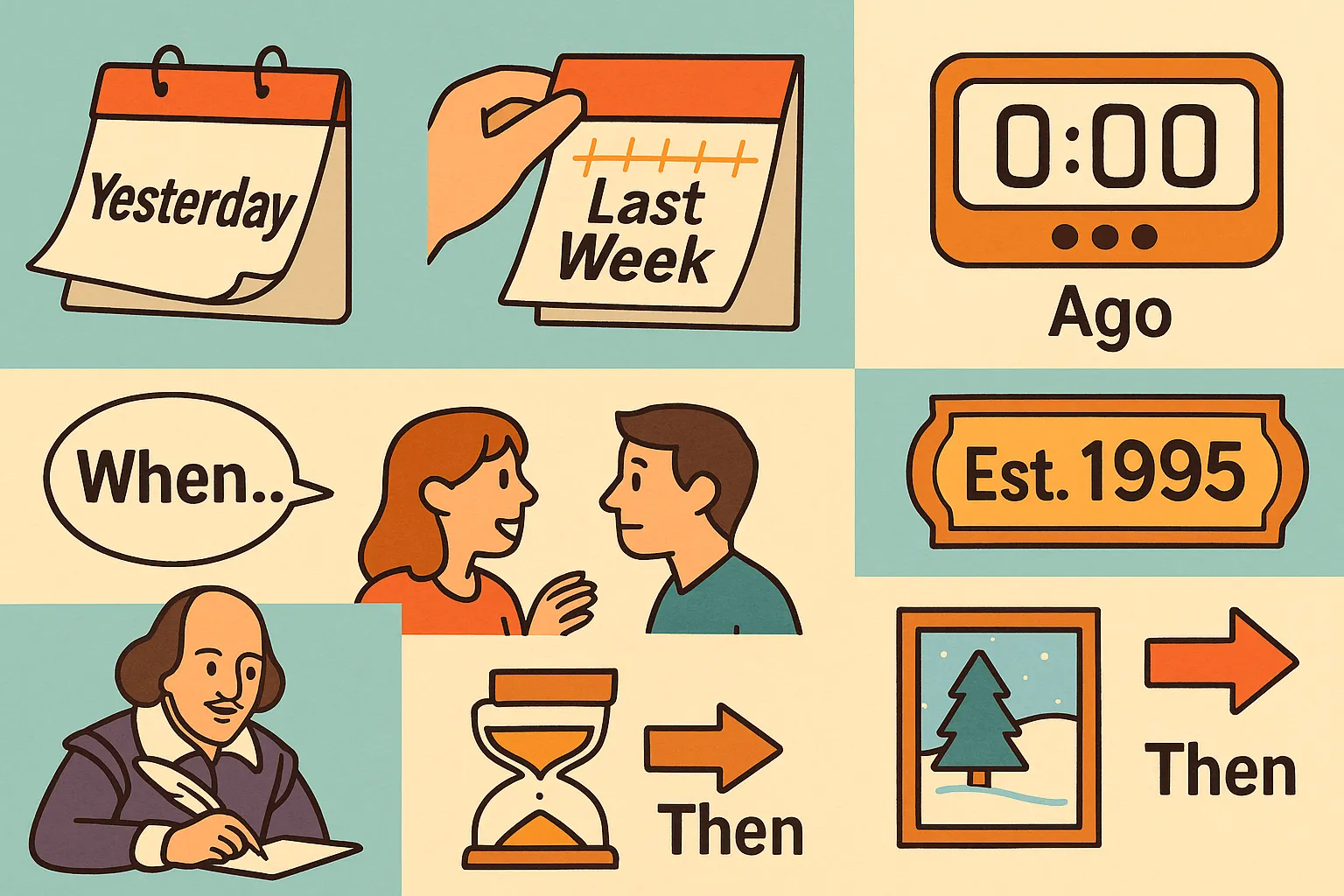
Correctly identifying the tense of a verb is crucial for understanding the exact meaning of a sentence. The Past Simple is often accompanied by specific time adverbs and phrases in the past, helping us determine that an action or state has been completed.
Adverbs and phrases indicating specific past time
- Yesterday:
Example: I met her yesterday.
- Last + time (week/month/year/night/weekend/Monday…):
Example: They travelled to Paris last summer.
- Ago: (usually follows a period of time).
Example: He finished his studies five years ago.
- In + year/month/season in the past: In 1999, in October, in the winter of 2003…
Example: The company was established in 2005.
- When + Past Simple clause:
Example: When I was a child, I played outside a lot.
- At that time:
Example: She was living in London at that time.
- Then:
Example: He finished his work, then he went home.
Implicit Context
Sometimes, without specific time adverbs or phrases, the context of the sentence is enough to indicate the Past Simple, especially when storytelling or referring to a known historical event.
Example: Shakespeare wrote many famous plays. (Although there is no specific timestamp, the fact that Shakespeare wrote plays is a completed historical fact.)
Example: The meeting was very productive. (Implies that the meeting has ended and you are talking about its outcome.)
Rules for Conjugating Past Simple Verbs
Conjugating verbs correctly in the Past Simple is one of the most basic foundations of English grammar. Mastering these rules not only helps you express yourself clearly but also shows care and professionalism in your writing and speaking. In particular, using the correct past form of the verb (V2/ed) is an important criterion in language proficiency tests like IELTS.
A. Basic rules for regular verbs
-
Regular Verbs: Add “-ed” to the end of the base verb.
Example:
work worked
play played
start started
arrive arrived
-
-
Note special cases when adding “-ed”:
- Verbs ending in “-e”: Just add “-d”.
- live lived
- love loved
- One-syllable verbs ending in a single consonant preceded by a single vowel (except w, x, y): Double the final consonant then add “-ed”.
- stop stopped
- plan planned
- Two-syllable verbs ending in a single consonant preceded by a single vowel, with the stress on the final syllable: Double the final consonant then add “-ed”.
- prefer preferred
- permit permitted
- Verbs ending in “-y”:
- If preceded by a consonant: Change “-y” to “-i” then add “-ed”.
- study studied
- try tried
- If preceded by a vowel: Keep “-y” and add “-ed”.
- play played
- enjoy enjoyed
- If preceded by a consonant: Change “-y” to “-i” then add “-ed”.
- Verbs ending in “-e”: Just add “-d”.
-
-
Irregular Verbs: These verbs do not follow the “-ed” rule and have their own unique past simple form (V2). You need to memorize the list of irregular verbs.
Example:
be was/were (I was there. They were happy.)
go went (She went to school.)
do did (He did his homework.)
see saw (I saw her yesterday.)
eat ate (They ate dinner early.)
write wrote (He wrote a letter.)
buy bought (We bought a new car.)
make made (She made a cake.)
B. Subject-Verb Agreement (SVA) with Was/Were
The basic rule is: Singular subjects take “was”, plural subjects take “were”.
-
Subjects I, He, She, It, singular nouns, or uncountable nouns: Use was.
Example: I was tired.
Example: The book was interesting.
Example: The information was useful.
-
Subjects You, We, They, or plural nouns: Use were.
Example: You were late.
Example: They were happy with the results.
Example: The students were in the classroom.
-
Special cases to note (similar to Present Simple and Present Perfect):
- Prepositional phrases between subject and verb: The verb agrees with the main subject.
Example: The manager of the two departments was on vacation last week. (Subject is “manager”, singular).
-
- Compound subjects joined by “and”: Usually take were (plural).
Example: My brother and sister were at the party.
-
-
- Exception: When two nouns joined by “and” refer to a single person/thing/concept.
-
Example: Bread and butter was my breakfast this morning. (Bread and butter as a single dish)
-
- Compound subjects joined by “or”, “nor”, “either…or”, “neither…nor”: The verb agrees with the subject closest to it.
Example: Neither the students nor the teacher was in the room.
Example: Neither the teacher nor the students were in the room.
-
- Indefinite pronouns:
- Always singular (use was): everyone, everybody, everything, someone, somebody, something, anyone, anybody, anything, no one, nobody, nothing, each, either, neither.
- Indefinite pronouns:
Example: Everybody was surprised by the news.
-
-
- Always plural (use were): few, many, several, both.
-
Example: Many were against the proposal.
-
- Collective Nouns: team, family, government, committee, audience, class, group…
- Usually treated as singular when emphasizing the group as a whole (use was).
- Collective Nouns: team, family, government, committee, audience, class, group…
Example: The team was confident after the win.
-
- “There was / There were” structure: The verb “was/were” agrees with the noun that follows it.
Example: There was a car accident yesterday.
Example: There were many people at the event.
-
- Nouns plural in form but singular in meaning: news, mathematics, physics, economics, politics, measles, mumps…
Example: The news was shocking.
Past Simple in Specific Contexts
In General Academic Writing
The Past Simple is used extensively when presenting research results, describing methodology, or referencing past events/documents.
- Describing research methods or experiments
Chia sẻ:




 Khai giảng Khóa học Hè cực HOT.
No comments yet!