


Tóm Tắt Nội Dung Bài Viết
In English, the Past Perfect Tense is an essential grammatical tool that allows us to describe an action that occurred and was completed before another action in the past, or before a specific point in the past. This tense helps you “sequence” past events chronologically, making your stories or narratives clearer, more logical, and easier to follow—especially when multiple events have taken place in the past.
Mastering the definition, usage, and structure of the Past Perfect is not only key to avoiding common mistakes but also serves as a fundamental building block if you aim to conquer standardized English tests like IELTS. Particularly in sections such as IELTS Speaking Part 2 (telling a complex story) or IELTS Writing Task 1 & 2 (describing historical events or cause-and-effect relationships in the past), using this tense proficiently will demonstrate your grammatical range and accuracy—one of the four critical assessment criteria.
What is the Past Perfect Tense?
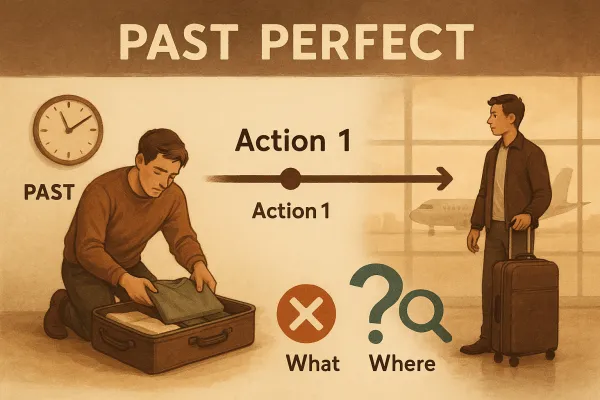
The Past Perfect Tense is used to express:
-
An action that occurred and was completed BEFORE another action in the past: The action in the Past Perfect is the one that happened first.
Example: When I arrived at the station, the train had already left. (The train left before I arrived.)
Example: She had finished her homework before she went to bed. (Finishing homework happened first.)
-
An action that occurred and was completed BEFORE a specific point in the past:
Example: By 2020, I had worked for this company for ten years. (The work was completed for a 10-year duration leading up to the 2020 milestone.)
Example: She had never seen a tiger until she visited the zoo last year.
-
The cause of a past action: The action in the Past Perfect serves as the reason for the action in the Simple Past.
Example: He was tired because he hadn’t slept well.
Example: I couldn’t enter the house because I had lost my keys.
-
In Third Conditional sentences: To describe an unreal condition in the past and its hypothetical result.
Structure: If + S + had + V3/ed, S + would/could/might + have + V3/ed.
Example: If I had known about the party, I would have gone. (In reality, I didn’t know, so I didn’t go.)
2. Past Perfect Formulas
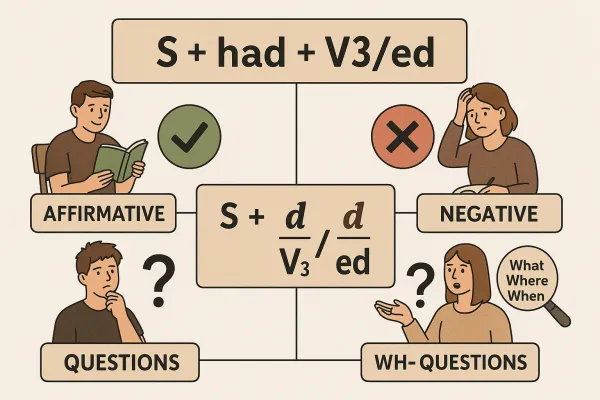
Mastering the formula helps you construct grammatically correct sentences, especially by using the “had + V3/ed” form correctly.
(Note: S: Subject, V3/ed: Past Participle, O: Object, A: Adverbial) Contraction: had not = hadn’t
Key Point: The auxiliary verb “had” does not change based on the subject (regardless of whether it is singular, plural, or first/second/third person). This makes conjugating verbs in this tense simpler than in other perfect tenses.
Detailed Usage of the Past Perfect Tense
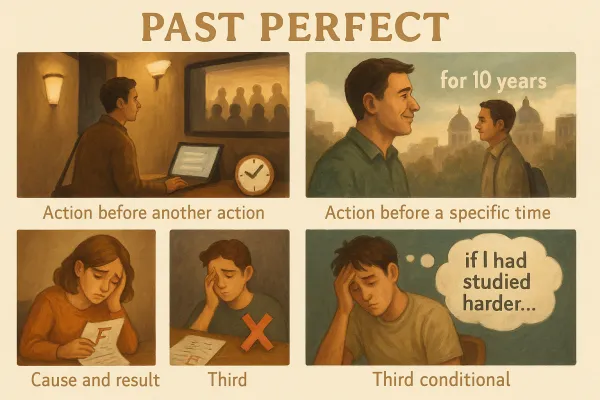
Understanding these cases helps you apply this tense flexibly and accurately, especially for establishing the chronological order of past events.
Action occurring BEFORE another action in the past
- This is the most important usage, helping to clearly distinguish between two past actions. The action that happened first uses the Past Perfect, while the subsequent action uses the Simple Past.
- Often accompanied by time conjunctions such as: when, by the time, before, after, as soon as, until.
Example: By the time I got to the airport, the plane had already taken off.
Example: After they had finished lunch, they went for a walk.
Example: She didn’t start the test until she had read all the instructions.
- Application in IELTS Speaking Part 2 & 3, Writing Task 1 & 2: Very useful when storytelling, narrating sequences of events, or explaining cause-and-effect relationships of past occurrences.
Action occurring BEFORE a specific point in the past
- Accompanied by time phrases containing “by” or “before” and a past time marker.
Example: By midnight, all the guests had left.
Example: He had completed his degree before 2015.
- Application: Commonly found in academic writing or reports on historical events.
Expressing the cause of a past action
- Use the Past Perfect to explain the reason or context for an action in the Simple Past.
Example: I was tired because I had worked all day.
Example: She was sad because her best friend had moved to another city.
- Application: Adds depth to stories or arguments by clarifying causal relationships.
In Third Conditional sentences
- Describes an unreal hypothetical situation in the past and its hypothetical result.
- Structure: If + S + had + V3/ed, S + would/could/might + have + V3/ed.
Example: If you had told me earlier, I would have helped you. (In reality, you didn’t tell me, so I didn’t help.)
Application in IELTS Writing Task 2 & Speaking Part 3: Used to analyze hypothetical situations, express regrets, or criticize what happened (or didn’t happen) in the past.
With “never” or “ever” to express experience before a past point
Example: She had never seen such a beautiful sunset before that day.
Example: It was the best vacation I had ever had.
Application: Common in storytelling to emphasize a personal experience before another event.
Identifying the Past Perfect Tense
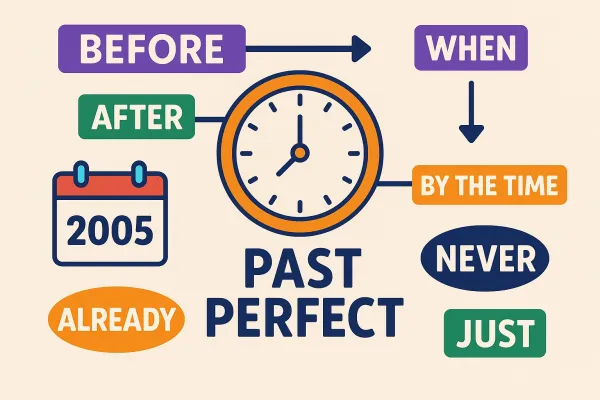
Correctly identifying verb tenses is crucial for understanding the exact meaning of a sentence. The Past Perfect is often accompanied by conjunctions and time adverbs that help establish the sequence of past actions.
-
Time conjunctions connecting two past actions:
- When:
Example: When I came home, my brother had already eaten dinner.
-
- Before:
Example: He had finished his report before the meeting started.
-
- After:
Example: After she had completed her studies, she moved abroad.
-
- By the time:
Example: By the time the police arrived, the thieves had escaped.
-
- As soon as:
Example: As soon as I had closed the door, I realized I left my keys inside.
-
Adverbs or time phrases combined with a past time marker:
- By + past time marker: by 2005, by midnight, by then…
Example: By 2010, I had visited 10 countries.
-
- Before + past time marker: before yesterday, before she was 10…
Example: He had lived in London before he moved to Paris.
-
Other adverbs (often used for emphasis):
- Already:
Example: The movie had already started when we arrived.
-
- Never:
Example: She had never flown before that trip.
-
- Just:
Example: He had just left when I called.
-
Implicit Context: Sometimes, even without specific connectors or adverbs, the reader/listener can infer the before-after relationship.
Example: He didn’t have any money. He had lost his wallet. (Losing the wallet happened first and caused the lack of money.)
Rules for Conjugating the Past Perfect
Accurately conjugating verbs in the Past Perfect requires using the correct auxiliary “had” and the past participle (V3/ed) of the main verb.
Using the past participle (V3/ed)
This is a crucial rule.
-
Regular Verbs: Add “-ed” to the base form. (The rules for adding -ed are the same as for the Simple Past; refer back to that section if you need more details).
- work worked
- play played
- start started
- arrive arrived
-
Irregular Verbs: Use the past participle (V3) form. This requires memorizing the irregular verb table.
- be been (She had been to Paris.)
- go gone (He had gone home.)
- do done (They had done their homework.)
- see seen (I had seen that movie.)
- eat eaten (We had eaten dinner.)
- write written (He had written a letter.)
- buy bought (We had bought a new car.)
- make made (She had made a cake.)
The auxiliary “had” is invariant
- This is a convenient feature of the Past Perfect. The auxiliary “had” is always used, regardless of whether the subject is first, second, or third person, singular or plural.
Example: I had finished.
Example: He had finished.
Example: They had finished.
Past Perfect in Specific Contexts
In General Academic Writing
The Past Perfect is crucial when presenting a sequence of historical events, research results, or explaining cause-and-effect in the past.
- Describing an event/development completed before another past event:
Example: By the time the new policy was implemented in 1990, the economic recession had already led to widespread unemployment.
- Describing the cause of a past phenomenon/result:
Example: The failure of the initial experiment was attributed to the fact that the researchers had not adequately controlled for external variables.
- When referencing studies or work completed before a certain time:
Example: Prior to 2000, several studies had explored the relationship between urban development and environmental degradation.
In IELTS Writing Task 1 (Academic – Describing charts, maps, processes)
This tense is used when describing changes that occurred before a specific point in the past, or to clarify the sequence of changes on a map.
- Describing changes completed before a point on a chart:
Example: By 2005, the percentage of students enrolled in online courses had increased significantly compared to 1995.
- Describing development/change
Chia sẻ:




 Khai giảng Khóa học Hè cực HOT.
No comments yet!