


Tóm Tắt Nội Dung Bài Viết
Have you ever found yourself in a situation where you needed to explain that something had been happening continuously for a long time before another event occurred in the past? For example, you were exhausted because you had been jogging for hours before collapsing. Or perhaps you didn’t understand the lesson because you hadn’t been paying attention since the start of class until the teacher asked a question? To accurately describe these complex temporal relationships and emphasize that “process” in the past, we need a special grammatical tense: The Past Perfect Continuous Tense.
While not as common as the Past Simple or Present Perfect, this tense is a crucial “piece of the puzzle” that helps make your narrative of the past more complete and nuanced. Mastering it not only helps you avoid basic errors but is also the key to demonstrating grammatical sophistication and flexibility, especially when tackling standardized tests like IELTS.
What is the Past Perfect Continuous?
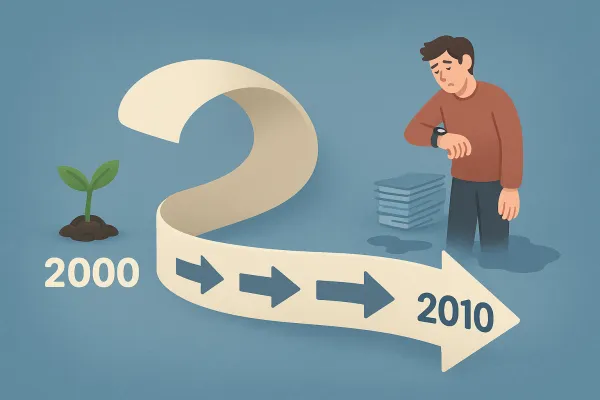
The Past Perfect Continuous tense is used to express:
-
An action that began in the past and continued up to (or nearly up to) another point or action in the past: The action in this tense happens first and continues until another past milestone.
Example: When I arrived, she had been waiting for an hour. (The action of “waiting” started before I arrived and continued until I arrived.)
Example: By the time he graduated, he had been studying for five years. (The action of “studying” started before and continued until his graduation.)
-
The cause of a past action or state: The action in the Past Perfect Continuous serves as the ongoing cause leading to a result in the Past Simple.
Example: He was tired because he had been working all day. (The continuous action of “working” led to his exhaustion.)
Example: Her eyes were red because she had been crying. (The continuous action of “crying” was the cause.)
Past Perfect Continuous Formulas
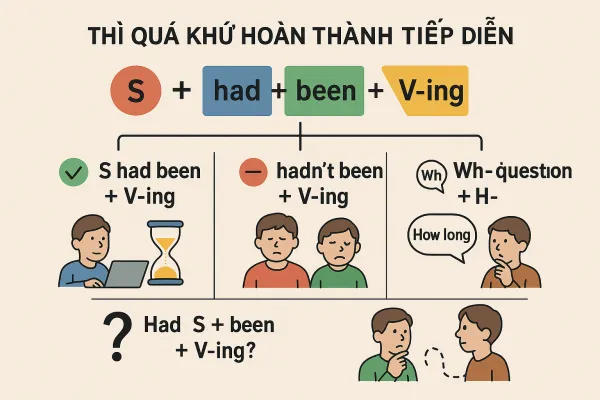
Mastering the formula helps you construct grammatically correct sentences, especially by using the “had been + V-ing” structure correctly.
(Note: S: Subject, V-ing: Present participle, O: Object, A: Adverbial) Contraction: had not = hadn’t
Key Point: Similar to the Past Perfect Simple, the auxiliary verb “had” does not change based on the subject (regardless of whether it is singular, plural, first, second, or third person). This makes subject-verb agreement in this tense straightforward.
Detailed Usage of the Past Perfect Continuous
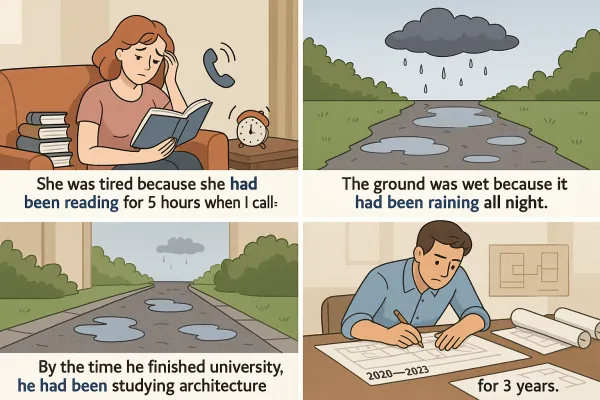
Understanding these usage scenarios helps you apply this tense flexibly and accurately, especially for establishing temporal relationships and cause-and-effect connections for ongoing past actions.
Actions continuing up to a point or another action in the past
This is the primary usage, emphasizing the duration and continuity of an action occurring before a past milestone. It is often accompanied by time expressions (for, since, all day/morning/week) and linked to an action in the Past Simple.
Example: She was tired because she had been teaching all day. (The teaching started before and continued until she was tired.)
Example: By the time the rescuers arrived, the climbers had been waiting for more than 24 hours.
Example: I finally found the book that I had been looking for.
Comparison with Past Perfect Simple:
- Past Perfect Continuous (emphasizing process/duration): I was tired because I had been working on the computer for hours.
- Past Perfect Simple (emphasizing result/completion): I was happy because I had finished my work on the computer.
Note: Certain state verbs are generally not used in continuous tenses. In such cases, use the Past Perfect Simple instead.
Example: I had known him for ten years before he moved away. (DO NOT use I had been knowing him).
Application in IELTS Speaking Part 2 & 3, Writing Task 2: Very useful for storytelling, explaining the causes of past situations, or describing an ongoing process in reports or essays.
Expressing the cause of a past action or state
The action in the Past Perfect Continuous acts as a continuous cause leading to a result or state in the Past Simple.
Example: His clothes were still wet because he had been swimming.
Example: The roads were slippery because it had been snowing all night.
Application: Adds depth to your story or argument by clarifying long-standing causal relationships.
In Reported Speech
When the direct speech is in the Present Perfect Continuous or Past Continuous, it usually shifts back to the Past Perfect Continuous in reported speech.
Example: She said, “I have been waiting for an hour.” She said that she had been waiting for an hour.
Example: He said, “I was working all day yesterday.” He said that he had been working all day the previous day.
Identifying the Past Perfect Continuous
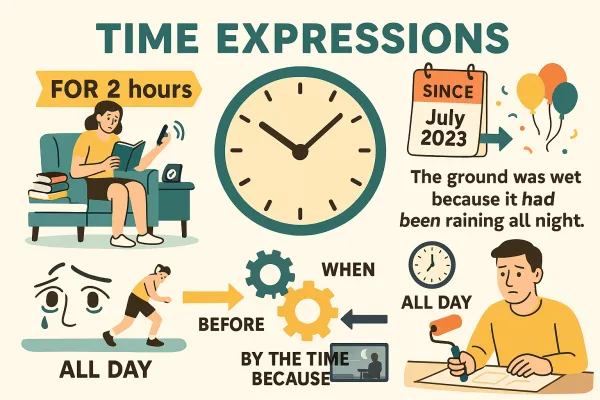
Correctly identifying verb tenses is crucial for understanding the exact meaning of a sentence. The Past Perfect Continuous is often accompanied by adverbs, time phrases, and conjunctions that establish sequence and continuity in the past.
Phrases indicating duration leading up to a past milestone:
- For + duration: for two hours, for ages, for a long time, for many years… (Often accompanied by a subsequent past milestone).
Example: He had been driving for three hours when he realized he was lost.
- Since + past time marker: since Monday, since 2010, since she left… (Often accompanied by a subsequent past milestone).
Example: They had been living in that house since 1990 before they sold it.
- All day / All morning / All week / All year: (until a past milestone).
Example: I was exhausted because I had been running all morning.
Conjunctions linking two actions/time markers in the past: (The action in the Past Perfect Continuous happens first and continues until the action in the Past Simple).
- When:
Example: When I met her, she had been waiting for half an hour.
- Before / By the time:
Example: By the time he got home, his wife had been cooking dinner for a while.
- Because / So: Expressing cause-and-effect. (The Past Perfect Continuous is the cause).
Example: He was so tired because he had been working too hard.
Implicit Context: Sometimes, even without specific connectors or adverbs, the reader/listener can infer the cause-and-effect relationship.
Example: The garden was flooded. It had been raining heavily for hours. (The prolonged rain was the cause of the flooding.)
Conjugation Rules for the Past Perfect Continuous
Accurately conjugating the Past Perfect Continuous requires the correct use of the auxiliary “had”, “been”, and the present participle (V-ing) of the main verb.
Main verb in Present Participle (V-ing) form
This is a key rule. (The rules for adding -ing are similar to the Present Continuous and Present Perfect Continuous; refer back to those if you need more details).
- work working
- make making
- run running
- study studying
The auxiliary “had been” remains unchanged
This is a convenient feature of the Past Perfect Continuous. The auxiliary phrase “had been” is always used, regardless of whether the subject is first, second, or third person, singular or plural.
Example: I had been working.
Example: He had been working.
Example: They had been working.
Past Perfect Continuous in Specific Contexts
In General Academic Writing
The Past Perfect Continuous is very useful when presenting prolonged processes, developments, or causes leading to historical events in the past.
- Describing a process that took place continuously up to a past milestone:
Example: Prior to the 2008 financial crisis, the housing market had been experiencing a period of unsustainable growth for several years.
- Explaining a prolonged cause leading to a past result or state:
Example: The research project faced significant delays because the team had been struggling with unforeseen technical issues.
In IELTS Writing Task 1 (Academic – Describing charts, maps, processes)
This tense is used less frequently in Task 1, but it can appear when describing a trend or activity that continued up to a specific point on a past chart or map.
Example: By 1995, the factory had been operating at full capacity for over two decades, leading to considerable environmental impact in the surrounding area.
Note: Usually, the Past Perfect Simple (“had operated”) or Past Simple is more common for describing data. Use the continuous form only when you want to clearly emphasize the continuity of the action.
In IELTS Writing Task 1 (General Training – Letter Writing)
The Past Perfect Continuous is often used to explain the details behind a problem or situation in the past.
- Explaining a prolonged cause leading to a current/past situation:
Example: I am writing to inform you that I missed my flight yesterday because my taxi had been stuck in a massive traffic jam for an hour.
Example: My child was very upset when we arrived because she had been waiting for us for a long time.
In IELTS Writing Task 2 (Essay Writing)
The Past Perfect Continuous adds depth to arguments by establishing long-standing causal relationships or historical context.
- When analyzing a prolonged cause that led to a past consequence:
Example: The social unrest that erupted in the 1960s was partly a result of inequalities that the previous generations had been experiencing for decades.
- Describing a process occurring during a significant historical period:
Example: Prior to the digital revolution, societies had been slowly transitioning from industrial to service-based economies.
In IELTS Speaking Part 1 (Answering personal questions)
This tense is less common than the Past Perfect Simple, but it can be used when you want to explain the prolonged cause of a past state or action.
Example:
Q: Why were you so tired yesterday? A: I was tired because I had been studying for my exams all night.
In IELTS Speaking Part 2 (Long Turn)
This is a section where the Past Perfect Continuous is very useful for explaining causes and the prolonged context of an event, adding depth to your story.
- Explaining the reason for a past situation or emotion:
Example: (Describe a time you were very happy) I was extremely happy when I received my exam results because I had been working incredibly hard for months to prepare for it.
- Describing a prolonged activity that led to an event:
Example: (Describe a difficult challenge) I remember one time I felt utterly exhausted after a hiking trip because we had been walking uphill for over six hours.
In IELTS Speaking Part 3 (In-depth discussion)
The Past Perfect Continuous helps discuss historical issues, past trends, and complex causal relationships.
- Discussing historical events and the prolonged causes leading to them:
Example: The global economic recession that started in 2008 was largely due to the fact that banks had been lending money irresponsibly for years.
- Describing social processes that were occurring in the past:
Example: In many developing countries, the problem of poverty had been worsening for decades before significant international aid initiatives began.
Upgrading your expression with the Past Perfect Continuous in IELTS
To make your writing and speaking more natural, flexible, and impressive—especially in exams like IELTS—using a variety of structures and adverbs with the Past Perfect Continuous is essential.
a. Using adverbs and phrases to emphasize duration/continuity:
- Constantly / Continually / Persistently:
Example: The ancient civilization had been constantly developing new irrigation techniques.
- For an extended period / For a considerable duration:
Example: Researchers had been conducting experiments for a considerable duration before they achieved a breakthrough.
- All along:
Example: He realized he had been misunderstanding the instructions all along.
b. Combining accurately with other past tenses:
- Past Perfect Continuous + Past Simple: Always a prolonged action (cause/context) + a subsequent action.
Example: They had been arguing for an hour when I walked in.
- Past Perfect Continuous + Past Simple (expressing result):
Example: Her voice was hoarse because she had been shouting.
c. Using phrases to express causal relationships:
- As a result of (the fact that…):
Example: As a result of the fact that the company had been losing money for months, it finally went bankrupt.
- The reason (why/for) was that…:
Example: The reason for his exhaustion was that he had been working overtime every day.
Important Note for IELTS:
- Accuracy: Ensure you use the “had been + V-ing” structure correctly. Be especially careful with state verbs that are not used in continuous tenses (switch to Past Perfect Simple).
- Range: Use the Past Perfect Continuous purposefully to emphasize the continuity and duration of past actions, especially when explaining causes. This demonstrates advanced grammatical control.
- Coherence and Cohesion: Use conjunctions (“when”, “before”, “by the time”, “because”) and time adverbs (“for”, “since”, “all day”) accurately to link ideas and clarify the temporal relationships of prolonged past actions.
- Lexical Resource: Using advanced adverbs and nuanced expressions of continuity and causality will help you achieve a higher score.
Past Perfect Continuous Exercises and Answer Key
Exercise 1: Conjugate the verbs in parentheses (Past Perfect Continuous).
- When I found her, she (cry) ____________ for an hour.
- He was tired because he (run) ____________ all morning.
- By the time the guests arrived, we (wait) ____________ for them for half an hour.
- The streets were wet because it (rain) ____________ since midnight.
- She got a promotion because she (work) ____________ very hard.
- How long (you / learn) ____________ English before you moved to the UK?
- I finally caught the train, but I (run) ____________ for 10 minutes.
- They (live) ____________ in that city for five years before they moved to another one.
Exercise 2: Rewrite into complete sentences using the Past Perfect Continuous or Past Simple (depending on context).
- (His eyes were red because / he / watch / TV / for too long) __________________________________________________________________________________
- (By the time / she / start / her new job / she / work / in the same field / for three years) __________________________________________________________________________________
- (When / I / arrive / they /
Chia sẻ:




 Khai giảng Khóa học Hè cực HOT.
No comments yet!