


Tóm Tắt Nội Dung Bài Viết
Is a limited vocabulary holding you back from communicating in English? The Oxford Word Skills series from Oxford University Press offers a comprehensive solution for every level, from Basic to Advanced. This article provides a detailed review of all three books, along with tips on how to study effectively and build a rock-solid vocabulary foundation.
1. An Overview of Oxford Word Skills
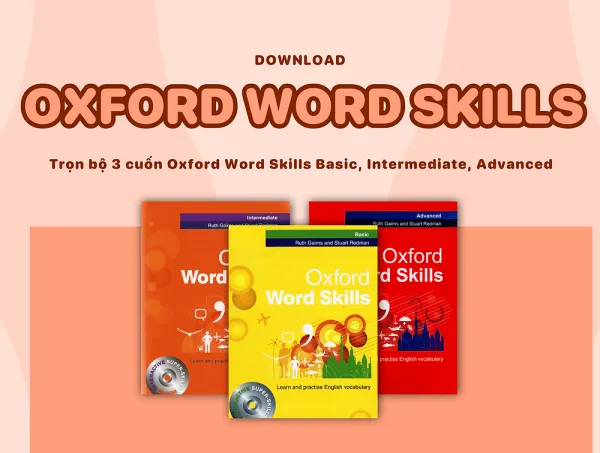
- Authors: Ruth Gairns and Stuart Redman – Leading Experts in Vocabulary Teaching
Ruth Gairns and Stuart Redman are more than just textbook authors; they are applied linguistics experts with years of experience in Teaching English as a Foreign Language (TEFL). They have dedicated extensive research to how the human brain acquires and retains vocabulary, developing effective learning methods that are applied throughout the “Oxford Word Skills” series. Key features of their approach include:
- Contextual Learning: Instead of learning words in isolation, Gairns and Redman emphasize the importance of learning vocabulary within specific contexts, helping learners fully grasp the meaning and usage of each word.
- Visual Learning: Using vivid illustrations to stimulate memory and help learners associate vocabulary with concrete images.
- Varied and Practical Practice: Designing diverse exercises, ranging from simple matching tasks to more complex activities like paragraph writing, to help learners practice and use vocabulary effectively.
- Publisher: Oxford University Press – A Titan in Language Education
Oxford University Press (OUP) is one of the world’s largest and most prestigious university presses, with a history spanning over 500 years. OUP is not only renowned for its academic publications and dictionaries but is also a global leader in publishing English language teaching (ELT) textbooks and materials.
2. Who Should Use the Oxford Word Skills Series?
The “Oxford Word Skills” series, with its three levels (Basic, Intermediate, Advanced), is designed to serve a wide range of learners, including:
-
English Learners at All Levels:
- Basic: For beginners (A1-A2) who need to build a fundamental vocabulary foundation.
- Intermediate: For intermediate learners (B1-B2) who want to expand their vocabulary and communicate with greater confidence.
- Advanced: For advanced learners (C1-C2) who aim for proficiency and want to use vocabulary with nuance and precision in academic and professional settings.
-
Students:
- Those studying English at school, language centers, or through self-study.
- Those needing to reinforce and expand their vocabulary for academic purposes, exams, and daily communication.
-
Working Professionals:
- Those who need English for work, communicating with colleagues, partners, and clients.
- Those looking to improve their English skills to advance their careers.
-
English Enthusiasts:
- Those who love English and want to enrich their vocabulary for reading, watching movies, listening to music, traveling, etc.
- Those who want to challenge themselves and reach a higher level of English.
-
English Teachers:
- Using it as a reference resource.
- Using it as a primary textbook.
3. Decoding the Structure and Content of the Oxford Word Skills Series
Below is a detailed breakdown of the structure and content of each book, helping you understand the “secret” behind the success of this series:
3.1. Oxford Word Skills Basic: A Solid Foundation for Beginners
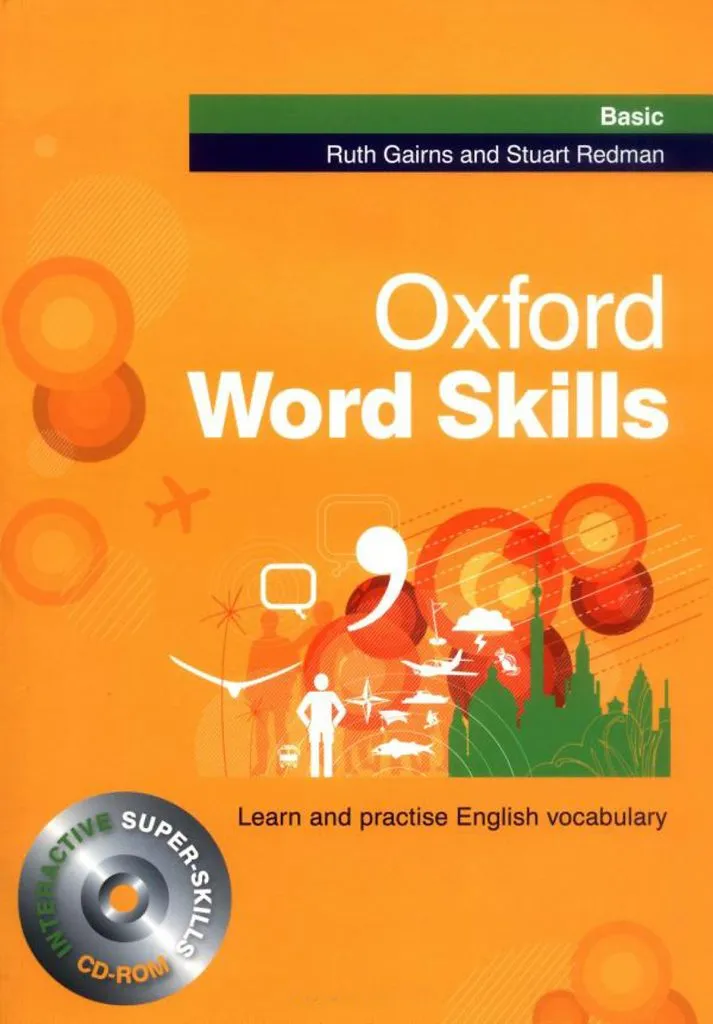
Target Audience: English beginners (A1-A2 level according to the Common European Framework of Reference for Languages – CEFR).
Objectives:
- Provide approximately 2,000 of the most common English words and phrases.
- Help learners understand and use vocabulary in specific everyday communication contexts.
- Build a solid vocabulary foundation for higher levels of English study.
- Foster initial confidence in using English.
Unit Structure: Each unit is designed as a “mini-lesson,” focusing on a specific topic and including the following sections:
- Presentation:
-
-
- Visuals: Each lesson typically begins with one or more large, colorful images illustrating the lesson’s theme. For example, a picture of a supermarket might introduce the topic “Shopping.”
- Vocabulary: New words are introduced through images, simple English definitions, illustrative examples, and sometimes phonetic transcriptions (IPA).
- Mini-exercises: Short exercises to help learners get familiar with new words, such as matching words to images or fill-in-the-blank tasks.
-
- Practice:
-
-
- Diverse Exercises: A wide variety of exercises helps learners practice and memorize vocabulary effectively:
- Matching: Connecting words with definitions, images, or synonyms/antonyms.
- Gap-fill: Filling in missing words in sentences or paragraphs.
- Multiple Choice: Selecting the correct answer from given options.
- Crossword Puzzles: Solving puzzles using learned vocabulary.
- Word Searches: Finding learned words in a letter grid.
- Sentence Writing: Writing sentences using the new vocabulary.
- Contextualization: Exercises always place vocabulary in specific contexts, helping learners understand how to use the words correctly.
- Diverse Exercises: A wide variety of exercises helps learners practice and memorize vocabulary effectively:
-
- ‘I can…’ statements:
-
-
- Each lesson ends with one or more “I can…” statements, describing what learners can do after completing the lesson. For example: “I can talk about my family.”
- These goals help learners track their progress and stay motivated.
-
- Review sections:
-
-
- After every few lessons, there is a review section to help learners consolidate the vocabulary they have learned.
- Review exercises are diverse and cover multiple topics.
-
Main Topics: Topics are closely related to daily life, making it easy for learners to relate and apply knowledge in practice. Examples:
- Myself
- Family and Friends
- Everyday Life
- Food and Drink
- Time, Days, and Dates
- Weather
- Shopping
- Travel
- … (and many other topics)
Download link: PDF
3.2. Oxford Word Skills Intermediate: Expand Your Vocabulary, Communicate Confidently
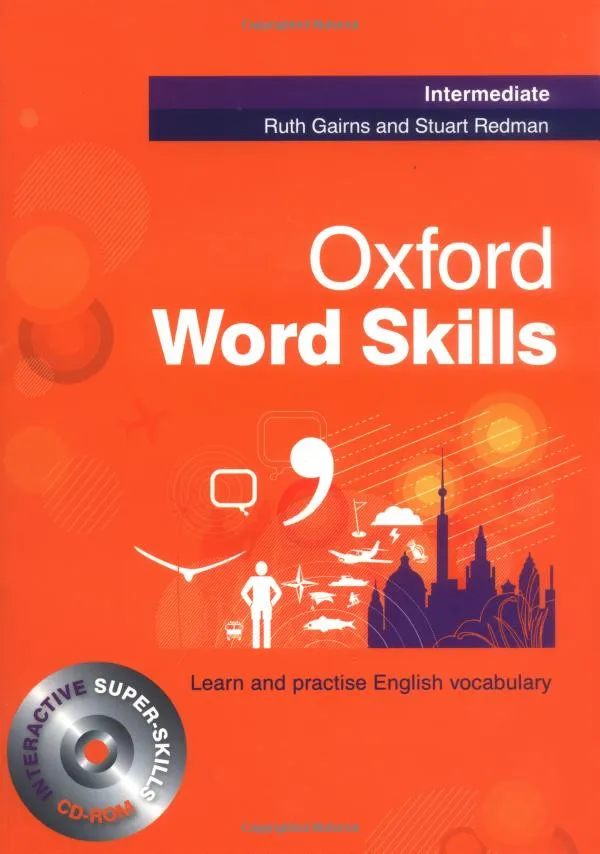
Target Audience: Intermediate English learners (B1-B2 level according to CEFR).
Objectives:
- Expand vocabulary to approximately 4,500 words and phrases.
- Help learners use vocabulary more confidently and accurately in various contexts.
- Develop the ability to use vocabulary in communication and writing.
- Prepare for English exams such as IELTS and TOEFL.
Unit Structure: Basically, the unit structure of the Intermediate book is similar to the Basic level, but with some upgrades and differences:
- Presentation:
-
-
- Fewer images: Instead of focusing on images, this section focuses on explaining the meaning and usage of vocabulary through definitions, examples, and mini-exercises.
- More complex vocabulary: Words introduced at this level are more sophisticated, including synonyms, antonyms, phrasal verbs, idioms, and collocations.
-
- Practice:
-
-
- Advanced exercises: Exercises not only require learners to memorize vocabulary but also to understand and use it flexibly.
- New exercise types:
- Word Formation: Practicing how to create different parts of speech (nouns, verbs, adjectives, adverbs) from a root word.
- Error Correction: Finding and fixing mistakes in vocabulary usage.
- Paraphrasing: Rewriting sentences using different vocabulary while maintaining the original meaning.
- Text Completion: Filling in blanks in longer paragraphs.
-
- ‘Learn this!’ boxes: Provide detailed explanations of grammar points or special word usage. For example: explaining the difference between synonyms or how to use different prepositions with a specific verb.
- ‘Spotlight’ boxes: Focus on specific aspects of vocabulary, helping learners understand word usage more deeply. Examples:
- Collocations: “make a mistake,” “do your homework.”
- Idioms: “break a leg,” “piece of cake.”
- Phrasal Verbs: “look up to,” “get along with.”
- ‘I can…’ statements: Goals at this level are more complex, requiring learners to use vocabulary more flexibly and creatively.
- Review sections: Review exercises at this level are also more challenging, requiring learners to synthesize knowledge from multiple lessons.
Main Topics: Expanding into areas such as:
- Work
- Education
- Environment
- Society
- Culture
- Entertainment
- Health
- Technology
- … (and many other topics)
Download link: PDF
3.3. Oxford Word Skills Advanced: Mastering High-Level Vocabulary
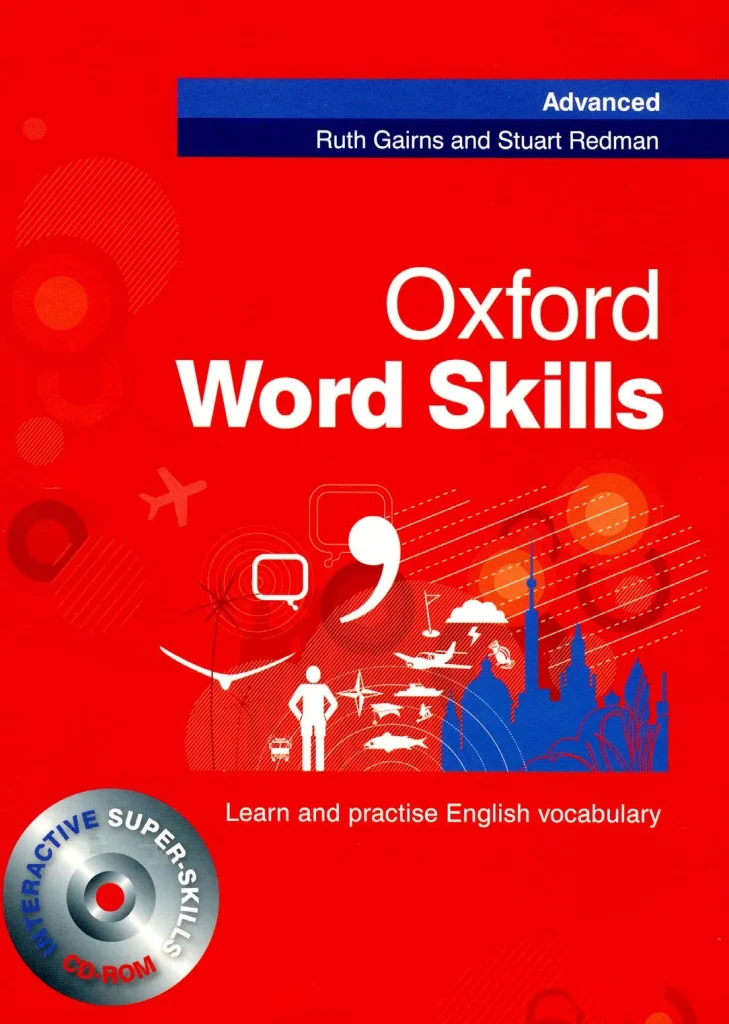
Target Audience: Advanced English learners (C1-C2 level according to CEFR).
Objectives:
- Increase vocabulary to approximately 8,000 words and phrases.
- Help learners use vocabulary proficiently, subtly, and accurately in academic and professional situations.
- Develop the ability to understand and use different nuances of meaning.
- Prepare for advanced English exams such as IELTS, TOEFL, CAE, and CPE.
Unit Structure:
- Presentation:
-
-
- Academic and specialized vocabulary: Words introduced at this level are highly academic and specialized, often appearing in scientific papers, essays, and presentations.
- Fewer images, focus on definitions and examples: This section focuses on explaining meaning and usage through detailed definitions and illustrative examples in academic and professional contexts.
-
- Practice:
-
-
- Challenging exercises: Exercises require learners to have deep vocabulary knowledge and critical thinking skills.
- New exercise types:
- Analyzing Texts: Analyzing vocabulary usage in academic or specialized texts.
- Evaluating Arguments: Evaluating how vocabulary is used to persuade readers/listeners.
- Writing Essays: Writing short essays using the learned vocabulary.
-
- ‘Note’ boxes: Provide additional details and tips on vocabulary usage, such as word variations, commonly confused words, and related idioms.
- ‘I can…’ statements: Goals at this level are very high, requiring learners to use vocabulary proficiently and professionally.
- Review sections: Review exercises at this level are very difficult, requiring learners to synthesize knowledge from multiple lessons and apply it to real-world situations.
Main Topics: Academic and specialized topics, such as:
-
- Science
- Technology
- Economics
- Politics
- Art
- Literature
- … (and many other topics)
Download link: PDF
4. Outstanding Advantages of Oxford Word Skills
-
Contextual Learning: This is the series’ most prominent strength. Instead of learning words in isolation, learners encounter vocabulary in specific contexts through sentences, paragraphs, dialogues, and illustrations. This helps learners:
- Understand the meaning and usage of words in different situations.
- Memorize vocabulary more naturally and for the long term.
- Develop the ability to use vocabulary flexibly and creatively.
-
Visual Learning: Vivid, colorful illustrations help learners:
- Associate vocabulary with concrete images, stimulating memory and increasing retention.
- Understand word meanings intuitively, especially for abstract terms.
- Make learning more engaging and enjoyable.
-
Diverse and Practical Exercises: Exercises are designed in various formats, from simple to complex, helping learners:
- Practice and consolidate vocabulary knowledge comprehensively.
- Develop different vocabulary-related skills (listening, speaking, reading, writing).
- Apply vocabulary to real-life communication situations.
-
Rich Supplementary Materials: CD-ROMs or supporting software (if available) provide:
- Interactive exercises that make vocabulary practice fun.
- Native-speaker pronunciation to help with listening and speaking.
- Other learning tools like dictionaries, games, etc.
-
Focus on Vocabulary Skills: Beyond just learning meanings, the series helps learners:
- Pronounce words correctly.
- Spell words accurately.
- Use words in various grammatical structures.
- Use words in specific communication situations.
-
Clear Learning Path: The series is divided into three levels (Basic, Intermediate, Advanced), helping learners:
- Easily choose the level that matches their current proficiency.
- Systematically track their learning progress.
- Set clear goals to strive for.
-
High Practicality: The words and phrases in the books are common, frequently used in daily communication as well as academic and professional settings.
5. Tips for Studying Oxford Word Skills Effectively
-
Study by Topic: Learning vocabulary by topic helps you link words together, creating “vocabulary networks” in your memory, which aids in systematic and effective retention.
- How to do it:
- Focus on one topic per study session.
- Use mind maps to organize vocabulary related to that topic.
- Seek out additional materials related to the topic (articles, videos, podcasts, etc.) to expand your vocabulary.
- How to do it:
-
Practice Regularly: Consistent practice is the key to long-term vocabulary retention.
- How to do it:
- Dedicate at least 15-20 minutes every day to vocabulary study.
- Review previously learned vocabulary frequently.
- Use vocabulary learning apps (like Quizlet or Memrise) for fun practice.
- How to do it:
-
Use Vocabulary in Context: Using words in context helps you understand how to use them and memorize them naturally.
- How to do it:
- Try to use new words in real-life communication (talking to friends, writing emails, participating in online forums, etc.).
- Write sentences or paragraphs using your new vocabulary.
- Practice asking and answering questions using the new words.
- How to do it:
-
Combine with Other Skills: Combining vocabulary study with listening, speaking, reading, and writing helps you develop comprehensive language skills and use vocabulary flexibly.
- How to do it:
- Listen to songs, podcasts, and watch movies or TV shows in English with subtitles.
- Read books, newspapers, and stories in English.
- Join English clubs or communication classes.
- Write a diary, blog, or short stories in English.
- How to do it:
- Chia sẻ:




 Khai giảng Khóa học Hè cực HOT.
No comments yet!