


Tóm Tắt Nội Dung Bài Viết
You’ve just received your IELTS mock test results with an average score of 6.75 and are wondering: will your official Overall band score be a 6.5 or a 7.0? Or how exactly is an average of 6.125 calculated? The rules for rounding IELTS scores, especially the Overall band score, are among the most common questions candidates have, yet they are frequently misunderstood.
In this article, the ECE Language Center will dive deep to decode every aspect of IELTS score rounding with precision. We won’t just repeat the basics; we’ll provide an in-depth perspective so you can confidently calculate your score and build an effective study strategy.
Only the “Overall” band score follows mathematical rounding rules
This is the core point to grasp first. Across the entire IELTS Test Report Form, only the Overall Band Score is the result of an arithmetic mean calculation that is then rounded according to official conventions.
Individual skill scores (Listening, Reading, Writing, Speaking) are NOT rounded using mathematical formulas. The score you receive for each skill is a final grade determined by specific criteria, without any intermediate rounding steps. We will analyze this in more detail below.
Detailed IELTS Overall rounding rules
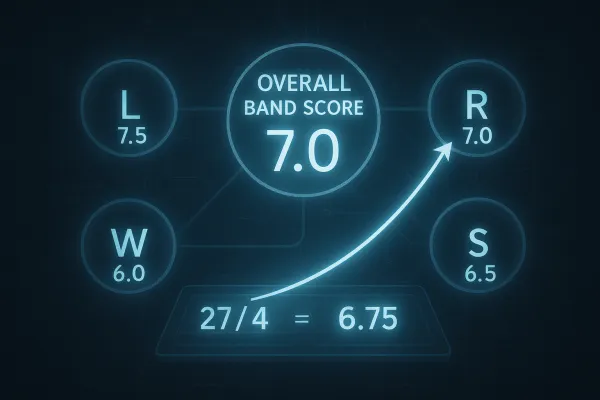
The Overall score is the arithmetic mean of the four skills: Listening, Reading, Writing, and Speaking.
The formula for calculating the average is: Average Score = (Listening + Reading + Writing + Speaking) / 4
Once you have the average, the examining body applies a rounding rule to the nearest half-band (.5) or whole band (.0). This rule is applied consistently and precisely as follows:
The immutable rules
- If the decimal fraction of the average score is .25: The score is rounded up to the nearest half-band (.5).
- Example: An average score of 6.25 The final Overall score is 6.5.
- If the decimal fraction of the average score is .75: The score is rounded up to the next whole band (.0).
- Example: An average score of 6.75 The final Overall score is 7.0.
- For all other cases: The score is rounded to the nearest .0 or .5.
- If the decimal is less than .25 (e.g., .1, .125, .2): It is rounded down to the nearest whole band (.0).
- Example: An average score of 6.125 Closer to 6.0 than 6.5 The Overall score is 6.0.
- If the decimal is greater than .25 and less than .75 (e.g., .375, .4, .6, .625): It is rounded to the nearest half-band (.5).
- Example 1: An average score of 6.375 Closer to 6.5 than 6.0 The Overall score is 6.5.
- Example 2: An average score of 6.625 Closer to 6.5 than 7.0 The Overall score is 6.5.
- If the decimal is greater than .75 (e.g., .8, .875, .9): It is rounded up to the nearest whole band (.0).
- Example: An average score of 6.875 Closer to 7.0 than 6.5 The Overall score is 7.0.
- If the decimal is less than .25 (e.g., .1, .125, .2): It is rounded down to the nearest whole band (.0).
Visual table of IELTS score rounding
To help you visualize this, take a look at the summary table of common IELTS Overall rounding scenarios:
Why isn’t rounding applied to individual IELTS skills?
As mentioned, individual skill scores are not rounded mathematically. The score you receive is the result of a direct assessment process.
Listening and Reading
For these two skills, your band score is determined through a direct conversion system based on the number of correct answers (raw score).
- No rounding: This is a “mapping” mechanism. For example, if you answer 30 questions correctly in the Academic Reading test, you are mapped directly to a band 7.0. There is no intermediate calculation or rounding involved.
- Similar to measuring height: You don’t “round” your height. You stand against a scale and see where the mark lands; your score is determined similarly on the conversion table.
Writing and Speaking
For these two skills, the score is a comprehensive evaluation by an examiner based on 4 criteria (Task Achievement/Response, Coherence and Cohesion, Lexical Resource, Grammatical Range and Accuracy).
- Examiner’s direct decision: The examiner considers your performance across all 4 criteria to assign a single band score, which can be a whole number (e.g., 6.0, 7.0) or a half-band (e.g., 6.5, 7.5).
- Not an arithmetic mean: The final score for Writing or Speaking is not the result of adding the 4 criteria scores, dividing by 4, and rounding. It is a professional, holistic judgment by the examiner to determine the band score that best reflects your proficiency.
How IELTS rounding helps boost your Overall band score
- The power of “.25” and “.75”: These are “golden scores.” If your average is 6.25, you are “pushed” up to 6.5. Similarly, 6.75 helps you reach the 7.0 mark. Reaching these thresholds can be the deciding factor in whether you qualify for study abroad or meet the language requirements for university admission.
- Setting realistic goals: If your goal is an Overall 7.0, you don’t necessarily need to score 7.0 in all four skills. A combination like Listening 8.0, Reading 7.5, Writing 6.0, and Speaking 6.5 results in an average of 7.0. Or another combination like 7.0, 7.0, 6.5, 6.5 (average 6.75) will also be rounded up to 7.0.
- Balancing strengths and weaknesses: Understanding rounding rules helps you leverage your strengths to “carry” your weaker skills. For example, if you are weak in Writing and only aim for a 6.0, you can compensate by striving for a 7.5 or 8.0 in Listening or Reading to pull your average up to beneficial thresholds like .25 or .75.
Frequently Asked Questions about IELTS rounding
- Does the official Test Report Form ever show an Overall score of 6.25?
Answer: Never. The Overall score on the official report is always a whole number (.0) or a half-band (.5).
- If my average score is 6.6, how is it rounded?
Answer: According to the rules, 6.6 is rounded down to 6.5 because it is closer to the 6.5 mark (0.1 away) than the 7.0 mark (0.4 away).
- Do these rounding rules differ between IELTS Academic and General Training?
Answer: No. The Overall rounding rules are exactly the same for both test formats. The only difference lies in the score conversion table for the Reading skill.
Conclusion
IELTS score rounding is a process with clear, logical rules that apply only to the Overall score. Mastering these rules not only helps you accurately predict your results but also provides a strategic advantage in setting goals and allocating your study time. Turn this knowledge into part of your plan to conquer your dream IELTS band score!





 Khai giảng Khóa học Hè cực HOT.
No comments yet!