


Tóm Tắt Nội Dung Bài Viết
While second and third conditional sentences help you hypothesize about situations entirely in the present or entirely in the past, real-life scenarios—and especially academic IELTS tasks—often involve overlapping timeframes. That is where Mixed Conditionals come into play.
This is considered a powerful tool for achieving a Band 7.0+ in the Grammatical Range and Accuracy criterion. Mastering mixed conditionals allows you to construct nuanced counter-arguments and establish logical connections between a past cause and a present result, or vice versa.
This in-depth guide from ECE English will help you grasp the core concepts, learn precise verb conjugation formulas, master advanced inversion techniques, and practice with 40 exercises on mixed conditionals.
1. Nature and Formula of Past-to-Present Mixed Conditionals
This is the most common type of mixed conditional, frequently appearing in both everyday communication and academic essays.
1.1 Concept and Temporal Logic
This structure is used to express a hypothesis contrary to a past reality, leading to a result contrary to a present reality. In other words: If the past had been different, the current outcome would be different.
The Fact: You didn’t study English hard in the past, so you don’t have an IELTS certificate to study abroad now.
Mixed Conditional: If I had studied English harder in the past, I would have an IELTS certificate now.
1.2 Formula and Verb Conjugation

Structurally, this sentence borrows the If-clause from the third conditional (past) and combines it with the main clause from the second conditional (present).
Formula: If + S + had + V3/V-ed, S + would/could/might + V-inf (base form)
Recognition Tips: Look for time markers that clearly distinguish the two clauses, such as: yesterday, last year, in the past (in the If-clause) and now, at present, today (in the main clause).
Example: If the IT team had upgraded the technical sitemap index last month, the website traffic would grow consistently today.
2. Nature and Formula of Present-to-Past Mixed Conditionals
This form is less common but is an extremely valuable structure that adds uniqueness and grammatical sophistication to your writing.
2.1 Concept and Temporal Logic
This structure is used to express a hypothesis contrary to a present fact or fixed characteristic, which has influenced a result that occurred and concluded in the past.
The Fact: You are naturally afraid of heights (a fixed present state). Therefore, you didn’t go skydiving with your friends yesterday (a past action).
Mixed Conditional: If I were not afraid of heights, I would have participated in the skydiving activity yesterday.
2.2 Formula and Verb Conjugation

Structurally, this sentence borrows the If-clause from the second conditional (present) and combines it with the main clause from the third conditional (past).
Formula: If + S + V_past_simple (To be is always WERE), S + would/could/might + have + V3/V-ed
Special Note: Because the If-clause borrows from the second conditional, the verb “to be” must be conjugated as WERE for all subjects (I were, she were, it were, the company were).
Example: If the office manager were an expert in technology, he could have integrated the CRM software smoothly last annual quarter.
3. Inversion Techniques for Mixed Conditionals
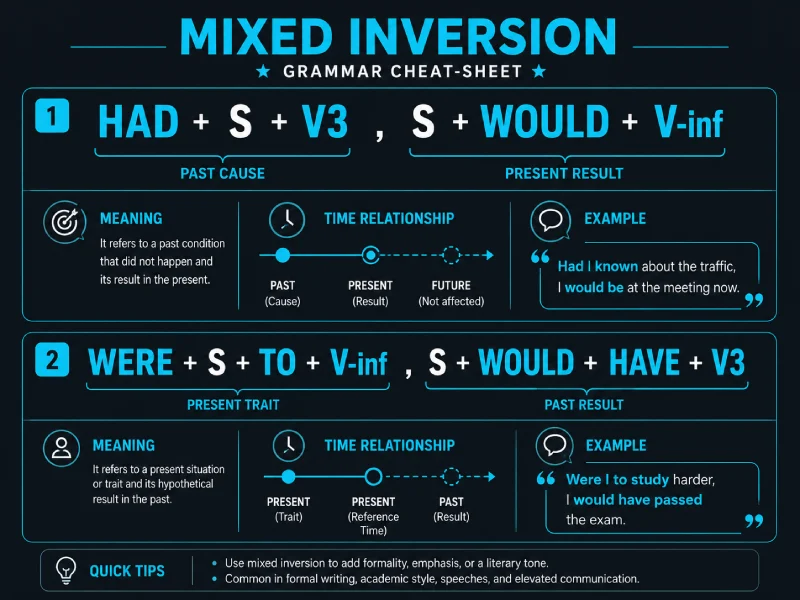
Since mixed conditionals are essentially a combination of second and third conditional clauses, when writing inverted sentences, apply the inversion rule corresponding to the type of If-clause used. The main clause remains unchanged.
3.1 Past-to-Present Inversion (Borrowing Third Conditional Inversion)
Since the If-clause is in the Past Perfect, simply remove “If” and move the auxiliary verb Had to the beginning of the sentence, before the subject.
Structure: Had + S + (not) + V3/V-ed, S + would/could + V-inf
Original: If the intensive training curriculum had been transparent in May, the students would follow the lessons easily now.
Inverted: Had the intensive training curriculum been transparent in May, the students would follow the lessons easily now.
3.2 Present-to-Past Inversion (Borrowing Second Conditional Inversion)
Since the If-clause is in the Past Simple, remove “If” and move Were to the beginning. If the sentence uses a regular verb, use the Were S to V structure.
Structure with To be: Were + S + (not) + Noun/Adj, S + would/could/might + have + V3/V-ed
Structure with Regular Verbs: Were + S + (not) to + V-inf, S + would/could/might + have + V3/V-ed
Original (To be): If I were a professional web developer, I would have implemented the JavaScript code yesterday.
Inverted: Were I a professional web developer, I would have implemented the JavaScript code yesterday.
Original (Regular verb): If the company faced a lack of data inputs consistently, the data scientists would not have deployed the algorithm last week.
Inverted: Were the company to face a lack of data inputs consistently, the data scientists would not have deployed the algorithm last week.
4. Applying Mixed Conditionals in the IELTS Exam
4.1 Application in IELTS Writing
In essays discussing socio-economic solutions or policies, linking past causes to present consequences is an excellent way to build a tight, logical argument.
Standard approach (Band 5.5): The government reduced educational subsidies last year. Therefore, top academies face financial shortages today.
Upgraded with inverted mixed conditional (Band 7.5+): Had the government not reduced educational subsidies last year, top academies would not face severe financial shortages today.
4.2 Extending answers in IELTS Speaking Part 3
When the examiner asks you to compare the past and present or analyze a long-term consequence, use mixed conditionals to create smooth transitions.
Question: Do you think people are working longer hours today compared to the past?
Answer: Absolutely. In the past, corporate targets were not so aggressive. If traditional working conditions were still maintained today, employees would not have experienced such severe mental burnout last year.
Conjunctions replacing “If” in Mixed Conditionals
You can replace “If” with the following academic connectors to diversify your Lexical Resource:
-
Provided that / As long as: Provided that the logistics team had used a specialized crane last week, the heavy ornamental plant would be safely placed in the garden now.
-
Unless: Unless the webmaster had resolved the technical errors yesterday, Google robots would not index our URLs today.
Mixed Conditional Practice Exercises
Part 1: Conjugate the verbs in parentheses
1. If the financial advisor (analyze) ________ the competitor’s strategy last year, the firm (not / face) ________________ severe financial losses now.
2. Provided that the administration (update) ________ the client database on time last week, no data errors (occur) ________________ today.
3. Unless the company (experience) ________ severe crawling drops in the past, the website ranking (be) ________________ more stable now.
4. If the office equipment (not / be) ________ so outdated, the manager (not / have) ________________ to approve a new procurement draft yesterday.
5. If I (be) ________ in the manager’s shoes now, I (implement) ________________ the CRM software last monthly quarter.
6. The web developer (notice) ________________ the current drop if he (check) ________________ the Google Search Console logs yesterday.
7. If Anna (not / know) ________ how to manage forty employees as a fixed trait, she (not / accept) ________________ the leadership role last enrollment.
8. We (enjoy) ________________ a relaxing day today if the logistics team (transport) ________________ the heavy ornamental plant successfully yesterday.
9. Without your professional essay draft last week, I (not / understand) ________________ the office management theories today.
10. If the intensive IELTS course (start) ________ three weeks ago, the students (possess) ________________ enough academic skills for the test today.
Part 2: Find and correct one error in each sentence
11. If the government had raised the minimum wage last enrollment, the quality of traditional working conditions will improve now.
12. Hadn’t the marketing team based the strategy on topic clusters last year, the website traffic would be very low today.
13. Were the company to check the technical sitemap index yesterday, they would notice the indexing errors today.
14. If I had had enough money now, I would have bought that heavy ornamental plant for the English center last week.
15. If I were a professional police officer last year, I would investigate this corporate financial fraud now.
16. Provided that the webmaster updates the XML sitemap index yesterday, the crawling drop would be resolved today.
17. Had the manager checked the website traffic logs last week, he would have detected the server errors now.
18. Supposing you are an executive director of this academy, which changes would you have made last annual quarter?
19. If the automated technology were not evolving so rapidly today, it would not threaten traditional working conditions last decade.
20. Had the entrance requirements not been so strict in 2025, more candidates would study at the journalism academy today.
Part 3: Rewrite using inversion
21. If the tech startup had not faced a sudden lack of data inputs last month, they would deploy the algorithm now.
-> Had ____________________________________________________________________
22. If local authorities had upgraded the bus system last year, citizens would use public transit more today.
-> Had ____________________________________________________________________
23. If the office equipment had been more ergonomic in the past, the current working conditions would be much better.
-> Had ____________________________________________________________________
24. If the assistant had implemented the JavaScript code yesterday, the newsletter form would function smoothly today.
-> Had ____________________________________________________________________
25. If the employees had worked longer hours under high pressure last week, their health would be declining now.
-> Had ____________________________________________________________________
26. If the state did not possess massive financial reserves, top academies would not have built more laboratories last year.
-> Were ____________________________________________________________________
27. If the marketing team were flexible in strategy, the campaign would have attracted more customers last month.
-> Were ____________________________________________________________________
28. If the database were not accessible to unauthorized users, no data leaks would have happened last night.
-> Were ____________________________________________________________________
29. If the company did not change its target audience constantly, they could have dominated the market last annual quarter.
-> Were ____________________________________________________________________
30. If we had checked the technical sitemap index last week, we would not suffer from these severe indexing drops now.
-> Had ____________________________________________________________________
Part 4: Rewrite based on real-life situations
31. The website contained too many technical errors yesterday, so Google robots cannot index our URLs today.
-> If ______________________________________________________________________
32. I did not have enough free time last week, so I cannot help you edit the academic essay draft today.
-> If ______________________________________________________________________
33. Lương Thảo Nhi did not provide her instructional materials, so the marketing team cannot write the blog post today.
-> If ______________________________________________________________________
34. The entrance requirements of the academy were extremely high, so few students are studying here today.
-> If ______________________________________________________________________
35. The office manager did not integrate a CRM platform last month, so he cannot monitor the teachers’ current performance.
-> If ______________________________________________________________________
36. We are a very small company with forty employees, so we could not organize a premium holiday package last summer.
-> If we ___________________________________________________________________
37. This specific Podocarpus macrophyllus plant is naturally very heavy, so the team could not transport it without a crane yesterday.
-> If this specific Podocarpus macrophyllus plant ___________________________
38. The university does not provide financial scholarships at present, so international students did not enroll last enrollment.
-> Unless __________________________________________________________________
39. The working conditions were extremely stressful last month, so many employees are looking for another job today.
-> If ______________________________________________________________________
40. The marketing strategy was not based on topic clusters, so the website traffic did not grow consistently last year.
-> If ______________________________________________________________________
Answer Key
Part 1 Answers:
1. had analyzed / would not face
2. had updated / would occur
3. had experienced / would be
4. were not / would not have had
5. were / would have implemented
6. would notice / had checked
7. did not know / would not have accepted
8. would enjoy / had transported
9. would not understand
10. had started / would possess
Part 2 Answers:
11. Error: will improve -> Correction: would improve.
12. Error: Hadn’t the marketing -> Correction: Had the marketing team not.
13. Error: Were the company to check -> Correction: Had the company checked.
14. Error: If I had had -> Correction: If I had.
15. Error: If I were … would investigate -> Correction: If I had been … would investigate.
16. Error: updates -> Correction: had updated.
17. Error: would have detected -> Correction: would detect.
18. Error: are -> Correction: were.
19. Error: would not threaten -> Correction: would not have threatened.
20. No error.
Part 3 Answers:
21. Had the tech startup not faced a sudden lack of data inputs last month, they would deploy the algorithm now.
22. Had local authorities upgraded the bus system last year, citizens would use public transit more today.
23. Had the office equipment been more ergonomic in the past, the current working conditions would be much better.
24. Had the assistant implemented the JavaScript code yesterday, the newsletter form would function smoothly today.
25. Had the employees worked longer hours under high pressure last week, their health would be declining now.
26. Were the state not to possess massive financial reserves, top academies would not have built more laboratories last year.
27. Were the marketing team flexible in strategy, the campaign would have attracted more customers last month.
28. Were the database not accessible to unauthorized users, no data leaks would have happened last night.
29. Were the company not to change its target audience constantly, they could have dominated the market last annual quarter.
30. Had we checked the technical sitemap index last week, we would not suffer from these severe indexing drops now.
Part 4 Answers:
31. If the website had not contained too many technical errors yesterday, Google robots could index our URLs today.
32. If I had had enough free time last week, I could help you edit the academic essay draft today.
33. If Lương Thảo Nhi had provided her instructional materials, the marketing team could write the blog post today.





 Khai giảng Khóa học Hè cực HOT.
No comments yet!