


Tóm Tắt Nội Dung Bài Viết
Are you looking for a detailed breakdown of the reading passage “The Step Pyramid of Djoser”? This text falls under the History and Archaeology category, a common topic in the IELTS Reading section. The article explores the pyramid widely considered to be the first monumental stone structure, which laid the foundation for all the great Egyptian pyramids that followed.
To help you master this engaging passage, the following article from the ECE language center provides comprehensive information, including the text, questions, a summary, key vocabulary, and, most importantly, the answers with detailed explanations for every question.
About “The Step Pyramid of Djoser”
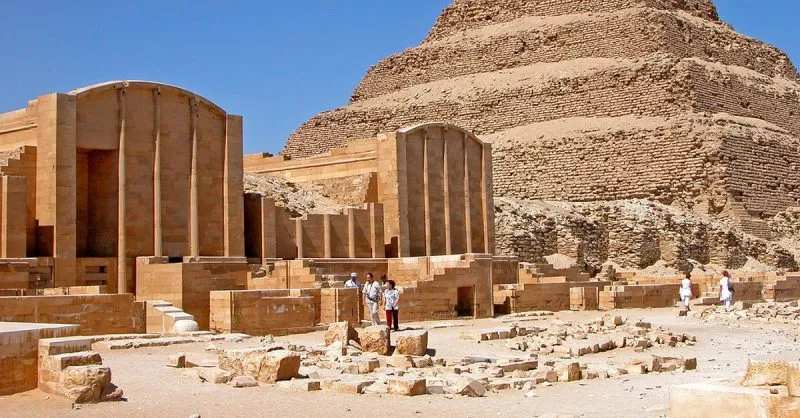
The Step Pyramid of Djoser
A
The pyramids are the most famous monuments of ancient Egypt and still hold enormous interest for people in the present day. These grand, impressive tributes to the memory of the Egyptian kings have become linked with the country even though other cultures, such as the Chinese and Mayan, also built pyramids. The evolution of the pyramid form has been written and argued about for centuries. However, there is no question that, as far as Egypt is concerned, it began with one monument to one king designed by one brilliant architect: the Step Pyramid of Djoser at Saqqara.
B
Djoser was the first king of the Third Dynasty of Egypt and the first to build in stone. Prior to Djoser’s reign, tombs were rectangular monuments made of dried clay brick, which covered underground passages where the deceased person was buried. For reasons which remain unclear, Djoser’s main official, whose name was Imhotep, conceived of building a taller, more impressive tomb for his king by stacking stone slabs on top of one another, progressively making them smaller, to form the shape now known as the Step Pyramid. Djoser is thought to have reigned for 19 years, but some historians and scholars attribute a much longer time for his rule, owing to the number and size of the monuments he built.
C
The Step Pyramid has been thoroughly examined and investigated over the last century, and it is now known that the building process went through many different stages. Historian Marc Van de Mieroop comments on this, writing ‘Much experimentation was involved, which is especially clear in the construction of the pyramid in the center of the complex. It had several plans … before it became the first Step Pyramid in history, piling six levels on top of one another … The weight of the enormous mass was a challenge for the builders, who placed the stones at an inward incline in order to prevent the monument breaking up.’
D
When finally completed, the Step Pyramid rose 62 meters high and was the tallest structure of its time. The complex in which it was built was the size of a city in ancient Egypt and included a temple, courtyards, shrines, and living quarters for the priests. It covered a region of 16 hectares and was surrounded by a wall 10.5 meters high. The wall had 13 false doors cut into it with only one true entrance cut into the south-east corner; the entire wall was then ringed by a trench 750 meters long and 40 meters wide. The false doors and the trench were incorporated into the complex to discourage unwanted visitors. If someone wished to enter, he or she would have needed to know in advance how to find the location of the true opening in the wall. Djoser was so proud of his accomplishment that he broke the tradition of having only his own name on the monument and had Imhotep’s name carved on it as well.
E
The burial chamber of the tomb, where the king’s body was laid to rest, was dug beneath the base of the pyramid, surrounded by a vast maze of long tunnels that had rooms off them to discourage robbers. One of the most mysterious discoveries found inside the pyramid was a large number of stone vessels. Over 40,000 of these vessels, of various forms and shapes, were discovered in storerooms of the pyramid’s underground passages. They are inscribed with the names of rulers from the First and Second Dynasties of Egypt and made from different kinds of stone. There is no agreement among scholars and archaeologists on why the vessels were placed in the tomb of Djoser or what they were supposed to represent. The archaeologist Jean-Philippe Lauer, who excavated most of the pyramid and complex, believes they were originally stored and then given a ‘proper burial’ by Djoser in his pyramid to honor his predecessors. There are other historians, however, who claim the vessels were dumped into the shafts as yet another attempt to prevent grave robbers from getting to the king’s burial chamber.
F
Unfortunately, all of the precautions and intricate design of the underground network did not prevent ancient robbers from finding a way in. Djoser’s grave goods, and even his body, were stolen at some point in the past and all archaeologists found were a small number of his valuables overlooked by the thieves. There was enough left throughout the pyramid and its complex, however, to astonish and amaze the archaeologists who excavated it.
G
Egyptologist Miroslav Verner writes, ‘Few monuments hold a place in human history as significant as that of the Step Pyramid in Saqqara … It can be said without exaggeration that this pyramid complex constitutes a milestone in the evolution of monumental stone architecture in Egypt and in the world as a whole.’ The Step Pyramid was a revolutionary advance in architecture and became the archetype which all the other great pyramid builders of Egypt would follow.
Questions 14 – 20
Reading Passage 2 has seven paragraphs, A-G.
Choose the correct heading for each paragraph from the list of headings below.
Write the correct number, i-ix, in boxes 14 – 20 on your answer sheet.
List of Headings
i The areas and artefacts within the pyramid itself
ii A difficult task for those involved
iii A king who saved his people
iv A single certainty among other less definite facts
v An overview of the external buildings and areas
vi A pyramid design that others copied
vii An idea for changing the design of burial structures
viii An incredible experience despite the few remains
ix The answers to some unexpected questions
Questions 21 – 24
Complete the notes below.
Choose ONE WORD ONLY from the passage for each answer.
Write your answers in boxes 21 – 24 on your answer sheet.
The Step Pyramid of Djoser
The complex that includes the Step Pyramid and its surroundings is considered to be as big as an Egyptian 21. of the past. The area outside the pyramid included accommodation that was occupied by 22. , along with many other buildings and features.
A wall ran around the outside of the complex and a number of false entrances were built into this. In addition, a long 23. encircled the wall. As a result, any visitors who had not been invited were cleverly prevented from entering the pyramid grounds unless they knew the 24. of the real entrance.
Questions 25 – 26
Choose TWO letters, A – E.
Write the correct letters in boxes 25 and 26 on your answer sheet.
Which TWO of the following points does the writer make about King Djoser?
A. Initially he had to be persuaded to build in stone rather than clay.
B. There is disagreement concerning the length of his reign.
C. He failed to appreciate Imhotep’s part in the design of the Step Pyramid.
D. A few of his possessions were still in his tomb when archaeologists found it.
E. He criticised the design and construction of other pyramids in Egypt.
25.
26.
Summary of the Reading Passage
The passage describes the Step Pyramid of Djoser, a structure considered the origin of all the great pyramids in Egypt.
- Beginnings (A, B): The article asserts that the Step Pyramid was a pioneering structure. Before King Djoser, tombs were made of mud brick. The architect Imhotep conceived the revolutionary idea of stacking stone slabs to create a taller, more impressive tomb.
- Construction Process (C, D): Building it was a major challenge, requiring extensive experimentation to manage the structure’s enormous weight. Upon completion, the pyramid was part of a complex as large as a city, strictly protected by high walls, false doors, and a large trench.
- Interior and Mysteries (E): Beneath the pyramid lies a maze of tunnels designed to protect the burial chamber. A mysterious discovery included over 40,000 stone vessels from previous dynasties, the purpose of which remains a subject of debate.
- Loss and Legacy (F, G): Despite its elaborate design, the tomb was robbed. However, what remained was enough to astonish archaeologists. This structure became a milestone in world architectural history and the “archetype” for all subsequent Egyptian pyramids.
Key Vocabulary
- Monuments (n): Large structures or buildings built to commemorate a person or event.
- Example: The pyramids are the most famous monuments of ancient Egypt…
- Evolution (n): The gradual development of something.
- Example: The evolution of the pyramid form has been written and argued about for centuries.
- Conceive of (v): To form an idea or plan in the mind.
- Example: …Imhotep, conceived of building a taller, more impressive tomb for his king…
- Incline (n): A slope or slant.
- Example: …who placed the stones at an inward incline in order to prevent the monument breaking up.
- Trench (n): A long, narrow, deep ditch.
- Example: …the entire wall was then ringed by a trench 750 meters long…
- Predecessors (n): Those who came before in a position or office.
- Example: …to honor his predecessors.
- Archetype (n): A very typical example or original model of a person or thing.
- Example: …and became the archetype which all the other great pyramid builders of Egypt would follow.
Answer Key and Explanations
Questions 14-20 (Matching Headings)
14. Paragraph A → iv. A single certainty among other less definite facts
Explanation: Paragraph A discusses the centuries-long debate regarding the evolution of the pyramid. However, it concludes with a certainty: “…it began with one monument…: the Step Pyramid of Djoser.”
15. Paragraph B → vii. An idea for changing the design of burial structures
Explanation: Paragraph B describes tombs before Djoser as “rectangular monuments made of dried clay brick.” Imhotep then “conceived of building a taller, more impressive tomb… by stacking stone slabs.” This represents a change in design.
16. Paragraph C → ii. A difficult task for those involved
Explanation: Paragraph C highlights the construction challenges: “Much experimentation was involved,” “It had several plans,” and “The weight of the enormous mass was a challenge for the builders.”
17. Paragraph D → v. An overview of the external buildings and areas
Explanation: Paragraph D details the complex surrounding the pyramid, including “a temple, courtyards, shrines, and living quarters,” “a wall 10.5 meters high,” “13 false doors,” and “a trench.”
18. Paragraph E → i. The areas and artefacts within the pyramid itself
Explanation: Paragraph E focuses on the interior: “The burial chamber,” “a vast maze of long tunnels,” and “a large number of stone vessels.”
19. Paragraph F → viii. An incredible experience despite the few remains
Explanation: Paragraph F notes the tomb was robbed and only “a small number of his valuables” remained. However, “There was enough left… to astonish and amaze the archaeologists.”
20. Paragraph G → vi. A pyramid design that others copied
Explanation: Paragraph G calls the pyramid a “milestone” and the “archetype which all the other great pyramid builders of Egypt would follow.”
Questions 21 – 24 (Note Completion)
- Answer: city
- Location & Explanation: Paragraph D: “The complex in which it was built was the size of a city in ancient Egypt…”
- Answer: priests
- Location & Explanation: Paragraph D: “…and included a temple, courtyards, shrines, and living quarters for the priests.”
- Answer: trench
- Location & Explanation: Paragraph D: “…the entire wall was then ringed by a trench 750 meters long…”
- Answer: location
- Location & Explanation: Paragraph D: “…he or she would have needed to know in advance how to find the location of the true opening in the wall.”
Questions 25 – 26 (Multiple Choice)
25 & 26. Answers: B and D
- B. There is disagreement concerning the length of his reign.
- Location & Explanation: Paragraph B: “Djoser is thought to have reigned for 19 years, but some historians and scholars attribute a much longer time for his rule…”
- D. A few of his possessions were still in his tomb when archaeologists found it.
- Location & Explanation: Paragraph F: “…and all archaeologists found were a small number of his valuables overlooked by the thieves.”
(Why are the other options incorrect?)
A: There is no information suggesting he had to be persuaded.
C: Incorrect; he honored Imhotep by carving his name on the monument (Paragraph D).
E: Incorrect; his pyramid was the first, so he could not have criticized others.
Conclusion
The reading passage on the Step Pyramid of Djoser is not just a language test but a journey to the roots of one of humanity’s greatest wonders. Successfully analyzing this passage demonstrates your mastery of key skills like identifying main ideas (Matching Headings) and scanning for details (Note Completion). Continue applying these methods to conquer any challenge in the IELTS Reading section. Good luck!




 Khai giảng Khóa học Hè cực HOT.
No comments yet!