


Tóm Tắt Nội Dung Bài Viết
Process or Diagram tasks in IELTS Writing Task 1 are often viewed as a unique challenge. Unlike data-based charts that require numerical analysis, this task type asks you to describe a process or system in a sequential and logical manner. Many candidates struggle with organizing information, using appropriate language, or even fully grasping the steps shown in the diagram.
However, with the right strategy and effective writing techniques, you can turn this task into a strength, showcasing your ability to provide detailed and coherent descriptions. This guide from ECE will provide you with a comprehensive walkthrough, from how to “read” a diagram to constructing a polished, complete response.
I. Overview of Process/Diagram Tasks in IELTS Writing Task 1
At its core, IELTS Writing Task 1 is a descriptive writing exercise. Whether it is a line graph, bar chart, table, or process, your primary task is to report what you see in the image, rather than explaining causes or offering personal opinions.
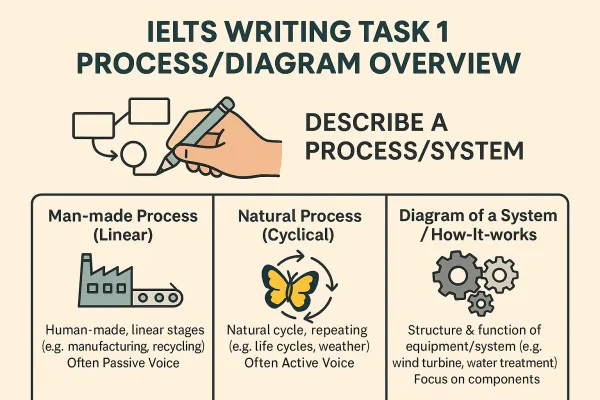
Process/Diagram tasks present information through diagrams with arrows, images, or labels, describing a sequence of steps or how a system functions. There are three main types you will likely encounter:
- Man-made Process (Linear Process): Describes the production of a product or the delivery of a service involving human intervention. These processes usually have a clear beginning and end, following a linear path.
- Characteristics: Often uses the passive voice because the agents performing the actions (people, machines) are typically not specified or are not the focus.
- Examples: Cement production, plastic bottle recycling, brick making.
- Natural Process (Cyclical Process): Describes the life cycle of a living organism (e.g., butterflies, frogs, salmon) or the formation of a natural phenomenon (e.g., the water cycle, rainfall formation). These processes are usually cyclical and repetitive.
- Characteristics: Often uses the active voice because natural elements perform the actions themselves.
- Examples: The honeybee life cycle, how water evaporates and condenses to form rain.
- Diagram of a System / How-it-works: Describes the structure and function of a device, a building, or how a complex system operates. This type may not be a sequence of steps but rather an interaction between various components.
- Characteristics: Can combine both active and passive voice depending on the component performing the action. The focus is on describing structure and function.
- Examples: How a wind turbine works, a water treatment plant diagram.
Correctly identifying the process type from the start is key to choosing the appropriate language and grammatical structure, helping you avoid unnecessary point deductions.
II. 3 Key Elements to Master Process/Diagram Tasks
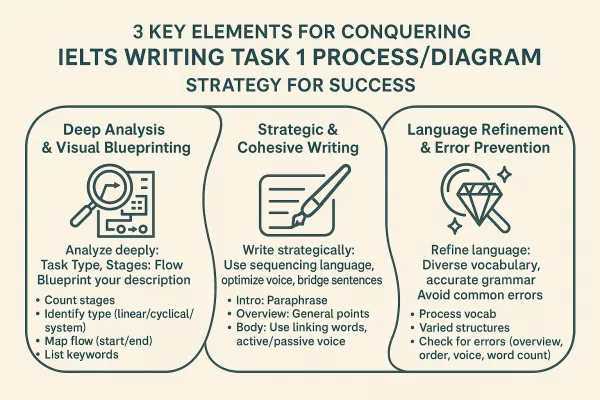
To achieve a high score, you must describe the process not just accurately, but intelligently and coherently. Approach the task using these three key elements:
1. Deep Analysis & Visual Blueprinting
This is the most critical step, where you “decode” the diagram. Spend 3–5 minutes performing these tasks thoroughly before writing a single word:
- Read and understand the prompt:
- What (What is the process/system?): Grasp the main subject. It could be a production process, a life cycle, or how a device functions.
- How many stages/components?: Count the main stages or parts. This helps you estimate the length of your response and how to divide your body paragraphs.
- What type of process?: This determines your choice of tense and voice (active/passive). Identify this early to ensure grammatical accuracy.
- Visual Blueprinting: This technique turns a complex diagram into a simple “script” for your writing.
- Numbering and identifying the flow:
- If the diagram is already numbered, follow that sequence.
- If not, number the steps or components yourself in the logical order you intend to describe (e.g., 1, 2, 3…).
- Draw small arrows or underline parts of the prompt to track the flow of information or materials. For example, where do raw materials enter, what do they transform into, which devices do they pass through, and what is the final product? This ensures you don’t miss a step or describe the sequence incorrectly.
- Identifying the start and end points:
- For Linear Processes: The start (raw materials) and end (finished product) are usually clear.
- For Cyclical Processes: There is no absolute start or end. Choose a logical starting point (e.g., the first stage clockwise, or the “egg-laying” stage in a life cycle). Then, conclude by emphasizing the cyclical, repetitive nature of the process.
- Listing keywords/labels:
- Quickly jot down keywords, labels, equipment names, and material names from the diagram onto your scratch paper. This is the “raw material” for your essay, helping you use precise vocabulary and avoid searching for words while writing.
- Example: Limestone, clay, crusher, mixer, kiln, grinding machine, cement, bags.
- Grouping steps/stages:
- This is vital for logical paragraph division and avoiding a fragmented essay. Instead of describing every single step, group closely related steps into larger stages.
- Example:
- Paper production can be divided into: “Raw material preparation,” “Pulp production,” and “Paper formation and finishing.”
- A frog’s life cycle can be divided into: “Egg and tadpole stage,” and “Froglet and adult stage.”
- Each group corresponds to a body paragraph, giving your essay a clear, easy-to-follow structure.
- Numbering and identifying the flow:
- Outlining: After “decoding” the diagram, quickly outline your paragraphs:
- Introduction: Paraphrase the prompt to create your opening sentence.
- Overview: State the total number of main steps/stages (e.g., The process consists of 5 main steps…) and the start/end points (or the general outcome). Note: Do not include specific details or data here.
- Body 1 & Body 2:
- Based on your groups, divide the content into two body paragraphs. Aim for relatively equal length and logical flow.
- Briefly note the main actions and materials/products after each step.
2. Strategic & Cohesive Writing
With an outline and visual blueprint in hand, writing becomes much smoother.
2.1. Introduction – 1 sentence
Your task is to paraphrase the prompt in your own words. The goal is to rewrite the prompt while maintaining its meaning, using different vocabulary and sentence structures.
- Use synonyms and vary sentence structure:
- Replace verbs like “shows” or “illustrates” with “depicts,” “outlines,” or “describes.”
- Replace key nouns with synonyms or equivalent phrases.
- You can switch between active and passive voice or use relative clauses to enrich your sentences.
- Suggested formulas:
- “The diagram/chart illustrates/shows/describes/depicts how [Subject] + [Action/Process] + [Object/Result].”
- “The diagram outlines the stages involved in the [Process Name].”
- “The flow chart details the various steps required for the [Process Name].”
- Example:
- Prompt: The diagram below shows the recycling process of plastics.
- Paraphrase: The given diagram illustrates the multi-stage process by which plastic waste is recycled.
2.2. Overview – 1-2 sentences
This is crucial for Task Achievement. Without an overview, your Task 1 band score is unlikely to exceed 5.0.
- Never include specific details or data here. This is the “big picture.”
- State the most general features:
- Total number of main stages/steps (e.g., The process consists of five main stages.).
- Start and end points (or final outcome).
- Linear process example: “…beginning with the collection of raw materials and ending with the distribution of the finished product.”
- Cyclical process example: “…starting with the laying of eggs and completing a cycle as the adult creature reproduces, restarting the process.”
- Nature of the process: e.g., cyclical, linear, involves several complex stages, a relatively simple process.
- Example (plastic recycling):
- “Overall, there are essentially six distinct stages in the plastic recycling process, beginning with the initial consumption of plastic products and ending with newly recycled items re-entering the market for purchase.”
2.3. Body Paragraphs – 2 paragraphs (3-5 sentences each)
This is where you describe the steps in detail, following the logical order from your outline.
- Use sequencing language: This is key for Coherence & Cohesion.
- Starting a paragraph/stage: First, Firstly, To begin with, Initially, The process commences with/starts when…
- Transitioning between steps: Next, Then, After this, Following this/that, Subsequently, At the next stage, Once [Action] is complete/has been completed, From there…
- Describing parallel steps: Meanwhile, Simultaneously, At the same time… (Very useful if two or more activities happen at once).
- Concluding the process: Finally, Lastly, Ultimately, The final step involves/is when…
- Optimize Active/Passive Voice:
- Man-made Process: Prioritize Passive Voice to describe actions on materials/products, as the agent is often unclear or unimportant.
- Example: “The raw materials are collected.” “The plastic is heated in a furnace.” “New products are then produced.”
- Natural Process: Prioritize Active Voice to describe the development/actions of natural subjects.
- Example: “The eggs hatch into larvae.” “The larvae feed on leaves.” “The adult salmon migrates back to the river.”
- Avoid overusing the passive: To boost your Grammatical Range score, intersperse other structures, even in man-made processes.
- Example: “This leads to the formation of…” “The result is a fine powder.” “X then undergoes Y.” “X is responsible for Y.”
- Man-made Process: Prioritize Passive Voice to describe actions on materials/products, as the agent is often unclear or unimportant.
- Bridging Sentences: Instead of just using transition words, create stronger sentences to connect ideas between steps or paragraphs, making the writing flow logically.
- Example: “Once this initial sorting is complete, the collected plastic is then transported to a processing plant for further treatment.”
- “Following this stage, which involves the removal of impurities, the refined material is ready for the next phase, which is heating.”
- Handling “Hotspots” in the diagram:
- Decision Points: If there are conditions (e.g., if A, then do B; if not, do C), use conditional structures: “if… then…”, “depending on…”, “whether… or…”, “After which, if X, then Y; otherwise, Z.”
- Parallel Processes: If two or more processes happen simultaneously, use appropriate connectors.
- Example: “Meanwhile, as the clay is being mixed, the oven is simultaneously preheated to 1000 degrees Celsius.”
- Special Equipment/Materials: Name them and briefly describe their function.
- Example: “The liquid is fed into a distillation unit, which separates it into different components based on their boiling points.”
3. Language Refinement & Error Prevention
Using diverse vocabulary and accurate grammar will make your writing stand out.
3.1. High-scoring vocabulary
a) General process vocabulary:
- Starting: initiate, commence, embark on, originate, begin.
- Transformation/Processing: transform, convert, refine, purify, process, reshape, modify, prepare, treat, separate.
- Result/Production: result in, lead to, produce, yield, generate, form, create.
- Composition: constitute, comprise, consist of, involve.
b) Man-made Process vocabulary (Passive voice focus):
- Raw materials/Finished goods: raw materials, components, impurities, end-product, finished goods.
- Production actions: collected, sorted, cleaned, filtered, heated, crushed, molded, transported, packaged, sealed.
- Equipment/Locations: processing plant, conveyor belt, furnace, kiln, mixer, warehouse, production line.
c) Natural Process vocabulary (Active voice focus):
- Life cycle: hatch, feed on, grow into, develop into, mature, undergo, lay eggs, shed skin, migrate, emerge.
- Natural phenomena: evaporate, condense, precipitate, accumulate, flow, collect, form, absorb, release.
3.2. Diverse grammatical structures
- Relative clauses: “The water is then pumped into a large storage tank, which holds up to 500 liters and is kept at a constant temperature.”
- Participle clauses: “After being collected, the bottles are sorted by color.”
- Nominalization: “The production of cement involves several stages.”
- Complex sentences with conjunctions: as, while, before, after, by the time, as soon as, when.
3.3. Common errors to avoid
- Missing Overview: Always include 1-2 sentences summarizing the process.
- Incorrect sequence: Use “Visual Blueprinting” to track the flow.
- Wrong voice: Man-made = Passive; Natural = Active.
- Lack of linking words: Use a variety of transition words.
- No “Bridging”: Explain the relationship between steps (e.g., “A leads to B”).
- Personal opinion: Stick strictly to the diagram.
4. Final Checklist
- Length: At least 150 words?
- Structure: 4 clear paragraphs (Introduction, Overview, Body 1, Body 2)?
- Introduction: Paraphrased naturally?
- Overview: General summary included, no data?
- Sequence: Logical order followed?
- Voice: Correct active/passive usage?
- Linking: Varied transition words and bridging sentences?
- Vocabulary: Specialized and varied?
- Grammar/Spelling: Checked for errors?
- Content: No outside information or personal opinions?
Conclusion
Process/Diagram tasks in IELTS Writing Task 1 are not as daunting as they seem with a clear strategy. By applying these “3 key elements”—Deep Analysis, Strategic Writing, and Language Refinement—along with consistent practice, you will confidently handle any diagram and achieve a high band score.
ECE wishes you effective preparation and success!
Related topics:
How to write IELTS Writing Task 1 Bar Chart
Tips for writing Table tasks in IELTS Writing Task 1





 Khai giảng Khóa học Hè cực HOT.
No comments yet!