


Tóm Tắt Nội Dung Bài Viết
Are you “struggling” with Summary/Notes/Table/Flow-chart/Diagram Completion tasks in IELTS Reading? Don’t worry! These question types are very common, and you can absolutely master them to boost your band score. This article from ECE English provides a detailed guide on how to understand them, avoid common mistakes, and apply effective strategies to confidently achieve your best results.
I. Overview of Summary/Notes/Table/Flow-chart/Diagram Completion tasks
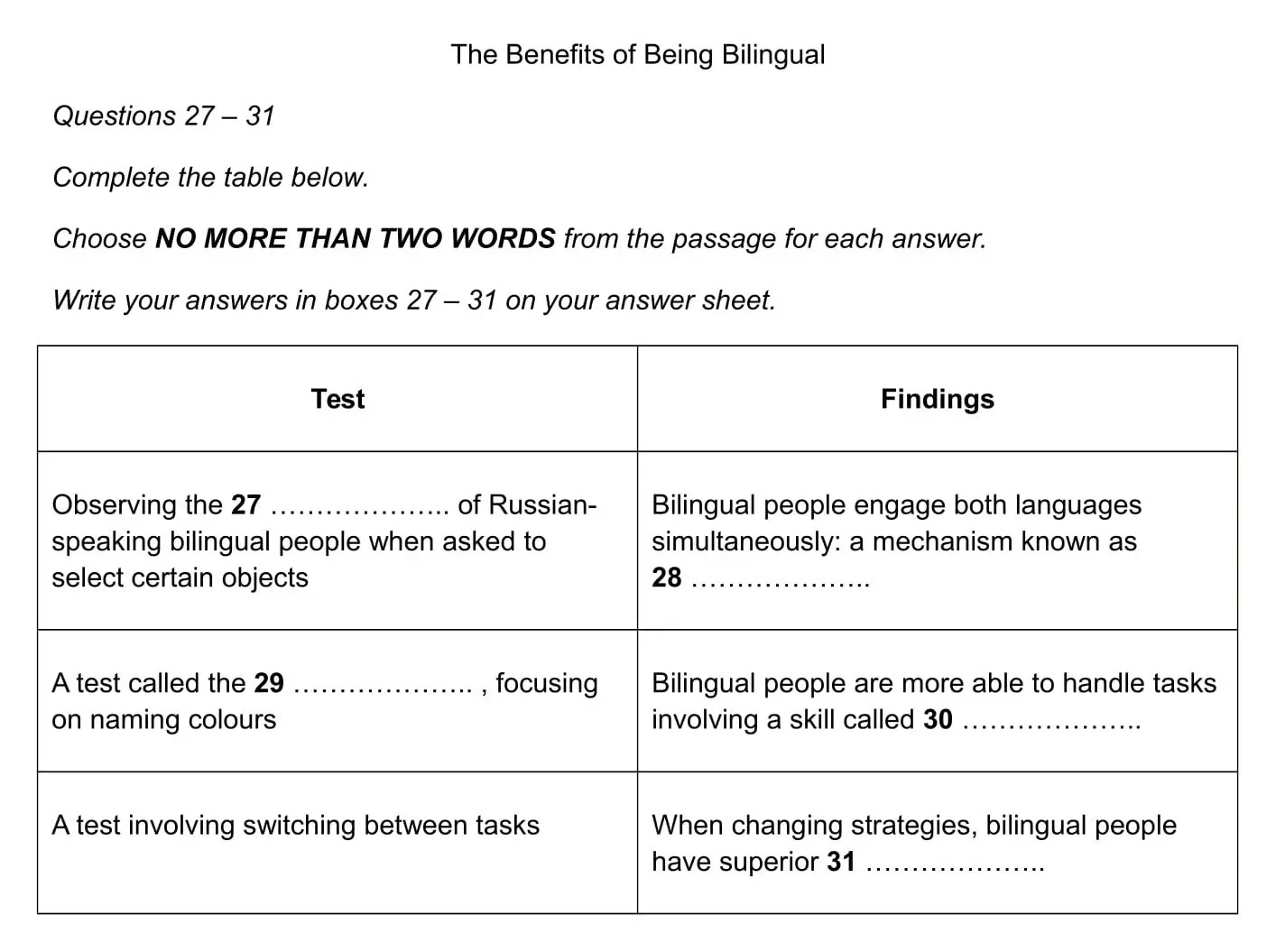
Completion tasks require candidates to complete a summary, notes, a table, a flow-chart, or a diagram by filling in words or numbers taken directly from the reading passage.
1. The nature of Completion tasks
Common features:
- All require you to fill in blanks.
- The information needed is usually concentrated in one or a few specific paragraphs of the passage, rather than scattered throughout.
- Word count requirements (e.g., “NO MORE THAN TWO WORDS AND/OR A NUMBER”) are critical.
- There are usually two formats: filling in the word/number directly or selecting an answer (A, B, C…) from a provided list.
Difference from Summary Completion (as a standalone task):
- While they share the “Completion” label, Summary Completion usually involves a paragraph summarizing the main ideas of the entire passage or a large section, requiring a holistic understanding.
- Notes/Table/Flow-chart/Diagram Completion tasks typically focus on specific details, data, procedural steps, or structures, and may only relate to a shorter segment of text. The blanks are often not “complete sentences” but rather phrases or single words.
2. Common types of Completion tasks in IELTS Reading
- Notes Completion: Completing bulleted notes, usually with a title and bullet points describing main ideas or characteristics.
Example: Notes on product features or factors affecting a phenomenon.
- Table Completion: Completing a table with columns and rows, categorizing information based on different criteria.
Example: A table comparing animal characteristics or statistical data by year/region.
- Flow-chart Completion: Completing a process diagram, usually describing sequential steps in a process or chain of events. Steps are often connected by arrows.
Example: Manufacturing processes or the life cycle of an organism.
- Diagram Completion/Labelling: Completing or labeling parts of a diagram illustrating the structure of an object, machine, or system.
Example: The anatomy of a body part or a diagram of an architectural structure.
II. Common mistakes and how to fix them
Identifying and avoiding these errors is the key to improving your score.
1. Exceeding the word limit
Problem: The instructions often specify a limit like “NO MORE THAN TWO WORDS AND/OR A NUMBER.” If you write three words when the limit is two, the answer will be marked wrong. Hyphenated words (e.g., well-known, long-term) count as one word.
Fix: Always underline or circle the word count requirement as soon as you start. After filling in your answer, count the words carefully. Prioritize using the fewest words possible while maintaining the meaning.
2. Using words not in the passage / Using synonyms
Problem: Many candidates change words or paraphrase on their own. For these tasks, you are almost always required to take the exact words from the passage.
Fix: Once you find the information, select the exact word or phrase from the text. Unless the instructions ask you to choose from a provided list, do not change or invent words.
3. Failing to recognize Paraphrasing and Synonyms
Problem: Information in the questions rarely repeats exactly as it appears in the text. It is usually paraphrased using synonyms, antonyms, or different sentence structures. If you only “blindly” scan for keywords, you will likely miss the information.
Fix:
- Expand your vocabulary: Master synonyms and antonyms of academic terms.
- Practice identifying structures: Read the question carefully and look for equivalent sentence structures in the text. Don’t just focus on a single word; read the whole phrase or sentence to grasp the meaning.
- Example: If the question says “rapid increase,” the text might use “swift growth” or “quick expansion.”
4. Getting trapped by Distractors
Problem: The passage often contains a lot of related information, but only a small part is the correct answer. Distractors can be minor details, examples, or negated elements.
Fix:
- Read the question carefully: Understand exactly what is being asked.
- Watch for qualifiers: Words like only, main, primary, most significant, however, but, instead can help you eliminate irrelevant information.
- Check the context: Read the paragraph containing the potential information and ensure your chosen word fits perfectly into the context of the blank in the question.
III. A 6-step strategy for effective completion
Step 1: Read the instructions carefully
- Underline/circle immediately:
- The type of Completion task (Notes, Table, Flow-chart, Diagram).
- The maximum word count (e.g., “NO MORE THAN TWO WORDS”). This is the most important part.
- The required format (filling in words directly or choosing from a list).
Step 2: Analyze the structure of the chart/notes/table/diagram
- Read the Title: Understand the main topic.
- Read the Headings/Sub-headings: For Notes/Tables, these help you organize the information.
- Observe the overall structure:
- Flow-chart: Look at the arrows and sequential steps. Note: The order of questions in a flow-chart usually follows the order of information in the text.
- Notes: Look at bullet points and groupings. Information usually follows the order of the text.
- Table/Diagram: May not follow a strict order in the text. You need to rely on column/row headings or labels to locate information.
- Skim existing information: This helps you grasp the general context and predict the type of missing information.
Step 3: Predict the word type and information needed
- Analyze the blank: Based on the grammar of the sentence or phrase containing the blank:
- After a preposition, you usually need a noun/noun phrase.
- Before a noun, you often need an adjective.
- After the verb “to be,” you might need an adjective, noun, or V-ing/V-ed.
- The blank could be a figure, date, or proper noun.
- Predict the meaning: From the context, you can guess the category of information (e.g., location, time, person’s name, action, characteristic).
Step 4: Skimming and Scanning
- Skimming: Read titles, subtitles, and topic sentences quickly to grasp the main idea and locate the paragraph likely to contain the relevant information.
- Scanning: Use keywords from the question to scan the located paragraph. Keywords can be:
- Proper nouns: Names, places, organizations, years, figures.
- Key nouns, verbs, adjectives: Words carrying the core meaning of the question.
- Paraphrased keywords: This is where your ability to recognize synonyms is tested.
Step 5: Contextual Reading
- Read the paragraph containing the keywords: Once you’ve located the potential paragraph, read the entire sentence or the surrounding text carefully.
- Compare information: Carefully cross-reference the question’s meaning with the text. Ensure your chosen word matches not just the keyword, but also the meaning and grammar of the blank. This is the most important step to avoid traps.
- Take the exact word: Once confirmed, copy the word/phrase exactly into the blank.
Step 6: Review your answers
- Word count: Count the words again to ensure they don’t exceed the limit.
- Spelling: Check for typos.
- Grammar: Ensure the word fits grammatically (e.g., singular/plural nouns, verb tenses).
- Meaning: Read the question with your answer filled in to ensure it makes logical sense and matches the text.
- Source: Confirm the word exists in the text (unless choosing from a list).
IV. Detailed example
Let’s apply these strategies to a Table Completion example.
The History of Chocolate
Chocolate, derived from the cacao bean, has a rich and complex history. Its origins can be traced back to ancient Mesoamerican civilizations, particularly the Olmecs, Mayans, and Aztecs. The Olmecs, around 1500 BC, were likely the first to domesticate the cacao tree and ferment, roast, and grind its beans. They consumed chocolate as a bitter, frothy beverage, often mixed with spices and chilies, primarily for ritualistic and medicinal purposes. It was considered a sacred drink, believed to have mystical properties.
The Mayans, who inherited cacao traditions from the Olmecs, further refined its use. By 600 AD, cacao was widely cultivated and used not only as a drink but also as a form of currency. Cacao beans were valuable enough to be used to purchase goods and services. For the Mayans, chocolate remained a revered drink, consumed by the elite during ceremonies and feasts. They often flavored it with vanilla, chili peppers, or honey.
When the Spanish arrived in the Aztec Empire in the 16th century, they encountered xocolatl, a bitter drink made from cacao. Initially, the Europeans found the taste unappealing. However, when sugar was added to the mixture, chocolate quickly transformed into a popular sweet treat. It arrived in Spain around 1528 and gradually spread across Europe. By the 17th century, chocolate houses became fashionable social venues, particularly in England. The invention of the cocoa press in 1828 by Coenraad Johannes van Houten revolutionized chocolate production, making it smoother and more accessible. This paved the way for solid chocolate bars, first produced in 1847 by Fry and Sons, leading to its widespread popularity as a confectionary item.
Questions 1-4 Complete the table below. Choose NO MORE THAN TWO WORDS from the passage for each answer.
Step-by-step analysis:
Step 1: Read instructions
- Task: Table Completion.
- Word count: NO MORE THAN TWO WORDS. Underline it!
Step 2: Analyze table structure
- 4 columns: Civilization/Period, Main Use, Key Flavorings/Additions, Other Significant Aspect.
- 3 rows corresponding to Olmecs, Mayans, and Europeans.
- Important: Information usually follows the chronological order of the text.
Step 3: Predict word types
- Question 1 (Olmecs): “…Spices and 1 _________”. Needs a noun/noun phrase, another flavoring.
- Question 2 (Olmecs): “Considered 2 _________”. Needs an adjective or noun phrase describing the Olmecs’ view of chocolate.
- Question 3 (Mayans): “Vanilla, chili peppers, or 3 _________”. Another flavoring.
- Question 4 (Mayans): “Used as 4 _________”. A noun phrase indicating another use for chocolate.
Step 4 & 5: Skim, Scan, and Read
- For Questions 1 & 2 (Olmecs):
- Scan for “Olmecs” (Paragraph 1).
- Text says: “…often mixed with spices and chilies… It was considered a sacred drink…”
- Answer 1: chilies
- Answer 2: sacred drink
- For Questions 3 & 4 (Mayans):
- Scan for “Mayans” (Paragraph 2).
- Text says: “They often flavored it with vanilla, chili peppers, or honey.” and “…used not only as a drink but also as a form of currency.”
- Answer 3: honey
- Answer 4: currency
Step 6: Review
- All answers are 1-2 words, taken directly from the text, and fit the context perfectly.
V. Advanced tips and time management
- Don’t try to understand every word: Focus on locating information and context.
- Handle question order: Flow-charts and Notes usually follow the text order; Tables and Diagrams may be more flexible.
- Practice Paraphrasing: Keep a log of synonyms you encounter.
- Time management: Spend about 1–1.5 minutes per question. If stuck, move on and come back later.
- Stay calm: If you don’t find the answer immediately, don’t panic. Be patient and follow the steps.
We hope this guide from ECE helps you conquer Summary/Notes/Table/Flow-chart/Diagram Completion tasks. Mastering these is not just about scoring points; it’s about developing the core reading skills needed for IELTS. Good luck with your studies!





 Khai giảng Khóa học Hè cực HOT.
No comments yet!