


Tóm Tắt Nội Dung Bài Viết
Are you preparing for the IELTS and feeling anxious about the Matching Sentence Endings task in the Reading section? Don’t worry! ECE Language Center understands that this is one of the most “tricky” question types, requiring not only strong reading comprehension but also a keen eye for grammar, vocabulary, and—most importantly—the ability to identify paraphrasing.
This article serves as your comprehensive guide to mastering this task step-by-step. We will dive deep into the definition, explore detailed strategies, identify common pitfalls, and share advanced tips to help you confidently achieve your target score.
I. Overview of the Matching Sentence Endings Task in IELTS Reading
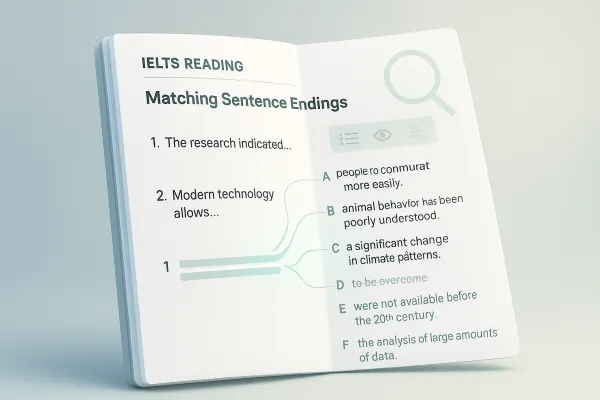
Matching Sentence Endings is a task that requires you to match a list of incomplete sentences (usually the first half) with a list of available endings, based on information provided in the reading passage. The primary goal of this task is to test your ability to:
- Understand main ideas and details: Beyond skimming, you need a deep understanding of the content to find the logical connection between ideas.
- Identify Paraphrasing: Information in the passage is rarely copied verbatim. You need to recognize synonyms, rephrased expressions, or structural changes.
- Analyze grammar and sentence structure: Ensure that when the two halves are joined, they form a complete, grammatically correct, and meaningful sentence.
Key points to note:
- Order of information: The questions (first halves) will always appear in the same order as the information in the passage. This is a golden rule that helps you locate information efficiently.
- Number of Endings: The list of endings is usually longer than the number of questions. This creates “distractors” that you must learn to eliminate.
- No word limit: Unlike Sentence Completion, this task does not restrict the number of words you can use, as you are simply selecting the letter of the ending. However, you must ensure the ending matches the information in the passage perfectly.
II. A 6-Step “Fast-Track” Strategy to Conquer Matching Sentence Endings
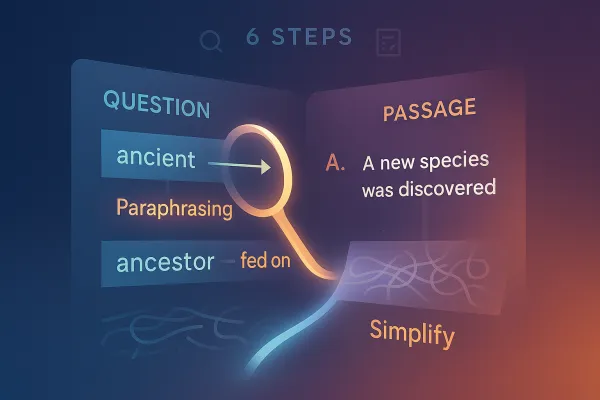
Apply the following 6-step strategy to optimize your chances of finding the correct answers:
Step 1: Read the incomplete sentences carefully & underline keywords
This is the starting point to guide your search.
- Read only the first half: Don’t rush to look at the list of endings or the passage. Focus on understanding the meaning of the question stems (1, 2, 3…) and underline key terms.
- Categorize Keywords:
- Unchangeable Keywords: Proper nouns (people, places), numbers, dates, and scientific/technical terms. These are solid “anchors” that help you scan the passage quickly.
Example: In the sentence “The ancient species of crocodile ate marine creatures that…”, the bolded words are the keywords you will look for.
-
- Changeable Keywords: Common nouns, verbs, adjectives, and adverbs. These are highly likely to be paraphrased in the passage.
- Predict the type of information and grammar needed: From the first half of the sentence, try to predict the word class or grammatical structure the second half should provide.
Example: “The ancient species of crocodile ate marine creatures that…” -> After “that” (relative pronoun), you need a verb that agrees with “marine creatures” to describe their actions, or a clause describing their characteristics.
Step 2: Skim & Scan to locate information in the passage
Use the underlined keywords to search for information in the passage.
- Skimming: Glance over the title, subheadings, and topic sentences of paragraphs to grasp the main idea and identify which paragraph likely contains the relevant information.
- Scanning: Use unchangeable keywords (proper nouns, numbers, etc.) to scan the entire passage quickly. Once you find a keyword, read the surrounding sentence or paragraph carefully.
- Utilize the “Order” rule: Remember that the answer to question 1 will appear before question 2, question 2 before question 3, and so on. This saves you from re-reading the passage from the beginning for every question, saving significant time.
Step 3: Read & analyze information in the passage (apply “Simplify”)
Once you have narrowed down the paragraph containing the information, it is time to read deeply to determine the correct answer.
- Simplify sentence structure: Many sentences in IELTS Reading have complex structures. Try to break them down to find the core meaning:
- Identify the main Subject (S), Verb (V), and Object (O).
- Remove secondary components: Relative clauses, long adverbial phrases, and non-essential modifiers.
- Example:
– Original: “The ancestor of today’s crocodiles belonged to a group of animals that developed a tail fin and paddle-like limbs for life in the sea, resembling dolphins more than crocodiles. These slender animals, which fed on fast-moving prey such as squid and small fish, lived during the Jurassic era in shallow seas and lagoons in what is now Germany.”
– Simplified: “These slender animals (crocodiles’ ancestors) fed on fast-moving prey like squid and small fish.”
– Core meaning: Crocodile ancestors ate fast-moving prey.
- Recognize Paraphrasing (The key to success): Test makers will use various ways to rephrase information.
- Synonyms: ancient species = ancestor; ate = fed on; marine creatures = squid and small fish.
- Word form changes: Instead of a noun, it might be a verb, adjective, or prepositional phrase.
- Sentence structure changes: Active to passive, simple to complex sentences.
- Definitions/Explanations: Instead of a single word, the passage might explain its meaning.
- Generalization/Specification: The question asks about a general concept, while the passage provides a specific example, or vice versa.
– Question: In fairy tales, details of the plot…
– Passage: “People of every culture tell each other fairy tales but the same story often takes a variety of forms in different parts of the world.”
– Analysis: “a variety of forms in different parts of the world” paraphrases “show considerable global variation” (C).
- Pay attention to linking words/discourse markers: Words like however, but, although, therefore, as a result, in contrast, moreover, consequently can signal shifts in meaning, cause-and-effect, or additional information. They help you understand the relationship between ideas.
Step 4: Read the list of Endings & underline keywords
After understanding the information in the passage and the meaning of the question stems, return to the list of endings (A, B, C…).
- Skim each ending to grasp the general idea.
- Underline the keywords in each ending.
Step 5: Compare & Eliminate to choose the correct answer
This is the verification and decision-making step.
- Compare core meanings: Compare the core meaning of the information you analyzed from the passage with the meaning of each ending.
- Check grammar: This is an extremely effective elimination tool.
- Example: If the first half ends with “that” (relative pronoun) and requires a singular verb, you can immediately eliminate endings that start with a plural verb or have an unsuitable grammatical structure.
- Example: Question “The ancient species of crocodile ate marine creatures that…“
– Endings C (resembled dolphins) and F (swam fast through the water) both start with past tense verbs, fitting “that” and the plural subject (“creatures”).
– Eliminate A (is believed to be 150 million years ago) and B (was laid down when the area was under water) because the verbs is/was are singular and do not agree with the plural subject “creatures”.
- Eliminate unsuitable endings: Based on meaning and grammar, cross out endings that are definitely wrong.
- Strategy for extra endings: Since the number of endings is always greater than the number of questions, eliminating wrong endings helps narrow down your choices for the remaining questions. Once you select an answer, cross that ending off the list to avoid confusion.
Step 6: Review and finalize
After matching the sentence halves, take a moment to review.
- Check logic and overall meaning: Read the complete sentence. Does it make logical sense and match the content of the passage perfectly? This is how you avoid falling for “distractors” (endings that seem correct but are wrong in detail).
- Check grammar: Ensure the grammar of the complete sentence is accurate.
- Spelling: Even though you are only filling in a letter, correctly understanding the words in the passage remains crucial.
III. Common Pitfalls & How to Avoid Traps
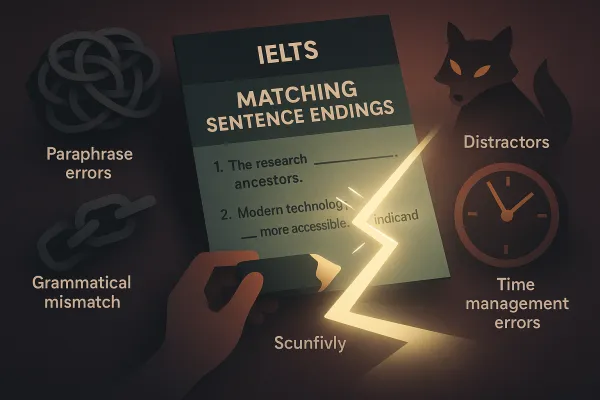
The Matching Sentence Endings task can lead candidates into several common traps:
- Relying solely on grammar and logic: This is a major trap. While grammar is important, this task tests your ability to understand the passage, not just your ability to assemble sentences. Test makers often create endings that are grammatically correct but incorrect in meaning or not present in the passage.
- Failing to recognize Paraphrasing: If you only look for exact keywords or simple synonyms, you will miss information. Focus on understanding the core meaning.
- Being misled by “Distractors”: Extra endings or endings that contain keywords but refer to different information in the passage are common traps. Always cross-check carefully with the main idea of the question.
- Misunderstanding context or details: Skimming too quickly without diving into details can lead to choosing an ending that seems correct but is not entirely accurate.
- Focusing too much on one question: Spending too much time on a difficult question will affect your overall timing. Use the “move on” strategy if you get stuck.
IV. Advanced Tips to Optimize Your Score
To truly master this task, apply these tips:
- Practice identifying extensive paraphrasing: This is the core skill of IELTS Reading. Practice regularly with various types of tasks, paying attention to how ideas are rephrased using different words and structures.
- Allocate time effectively: This task can be time-consuming due to the number of options. Try not to spend more than 1.5 – 2 minutes per question. If you are unsure, make your best guess and move on to the next one.
- Build academic vocabulary: A rich vocabulary will help you understand the passage more easily and identify paraphrases more effectively.
- Read diverse topics: IELTS reading passages cover many fields such as science, history, culture, and society. Reading widely helps you become familiar with various types of vocabulary and contexts.
- Cross-check: After completing all questions, re-read all the completed sentences. Ensure they form a logical flow of information and that no sentences have nonsensical overlapping meanings.
While the Matching Sentence Endings task is challenging, it is entirely conquerable with the right strategy and persistent practice. ECE believes that with the detailed guidance and advanced techniques shared here, you will no longer feel anxious but instead gain the confidence to achieve your dream band score in the IELTS Reading test. Start practicing today and turn this challenge into an opportunity!





 Khai giảng Khóa học Hè cực HOT.
No comments yet!