


Tóm Tắt Nội Dung Bài Viết
The Identifying Writer’s Views/Claims task, commonly presented as Yes/No/Not Given (Y/N/NG), is one of the most significant challenges in the IELTS Reading test. This task requires you to determine whether a statement is consistent with, contradicts, or is not mentioned in relation to the author’s views, claims, or opinions. It demands deep reading comprehension and the ability to analyze the writer’s line of reasoning.
1. What is the Yes/No/Not Given task?
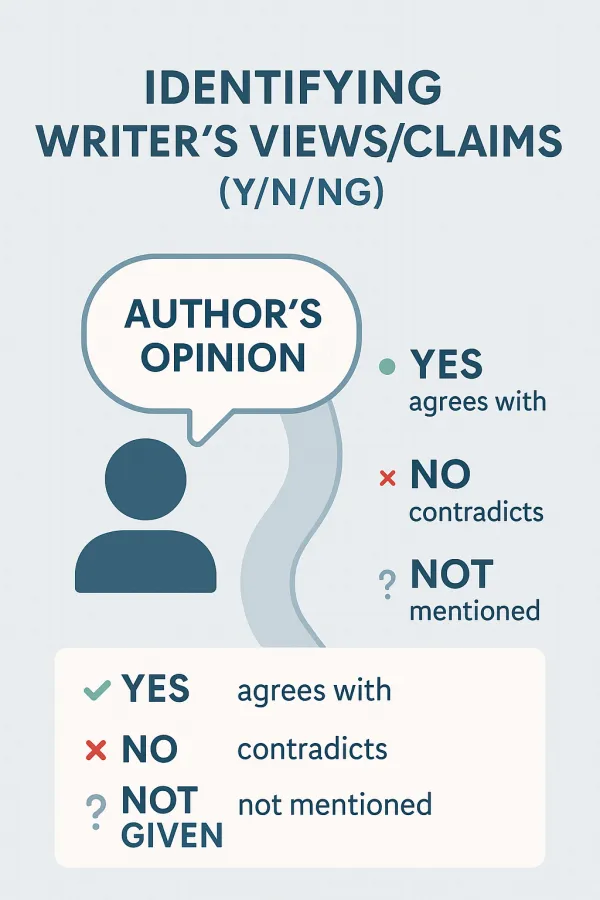
The Yes/No/Not Given task requires you to evaluate a statement based on the author’s perspective in the text:
- YES: The statement in the question matches the author’s view or claim in the text. The author expresses agreement, support, or proposes the idea.
- NO: The statement in the question directly contradicts the author’s view or claim in the text. The author expresses opposition, disagreement, or offers a clearly opposing opinion.
- NOT GIVEN: The statement is not mentioned in the text, or there is insufficient information to determine whether the author agrees, disagrees, or holds any opinion on the matter.
Key takeaway: Always remember that you are evaluating the author’s perspective, not objective facts. This requires you to pay close attention to language that expresses the writer’s attitude, stance, or opinion.
2. Distinguishing Yes/No/Not Given from True/False/Not Given
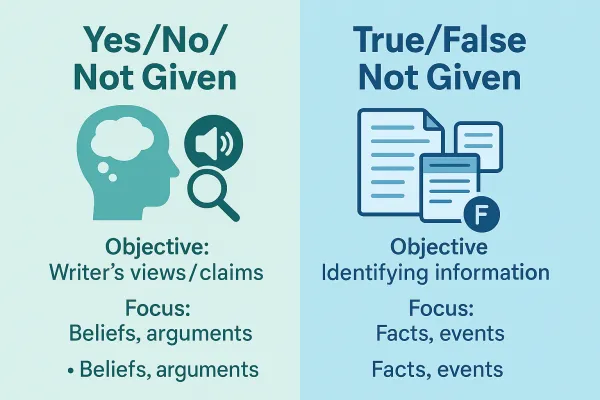
This is the crucial point to avoid confusion between these two seemingly similar tasks:
Yes/No/Not Given (Identifying Writer’s Views/Claims)
- Goal: Determine if a statement reflects the author’s views, opinions, or arguments.
- Focus: You are looking for what the author believes, proposes, argues, or feels about an issue. This is often expressed through subjective or evaluative language.
- Examples of how the author expresses views:
- “The author argues that…”
- “It is clear the writer believes…”
- “The article suggests that…”
- “The author is convinced that…”
- Use of modal verbs such as should, must, may, might to express recommendations, possibilities, or necessity.
- Type of information: Always the writer’s subjective opinion.
True/False/Not Given (Identifying Information)
- Goal: Determine if a statement reflects an objective fact or specific information stated in the text.
- Focus: You are looking for what is stated as true or false based on data, descriptions, or objective events.
- Examples of how the text expresses facts:
- “The study found that…”
- “Data shows…”
- “The event occurred in…”
- “The number increased to…”
- Type of information: Always objective information, data, or events.
Summary of differences:
Important note: The test will always specify whether you need to answer with YES/NO/NOT GIVEN or TRUE/FALSE/NOT GIVEN. Reading these instructions carefully is the first and most important step to avoid losing points due to format errors.
3. Distinguishing “NO” and “NOT GIVEN” – The biggest challenge
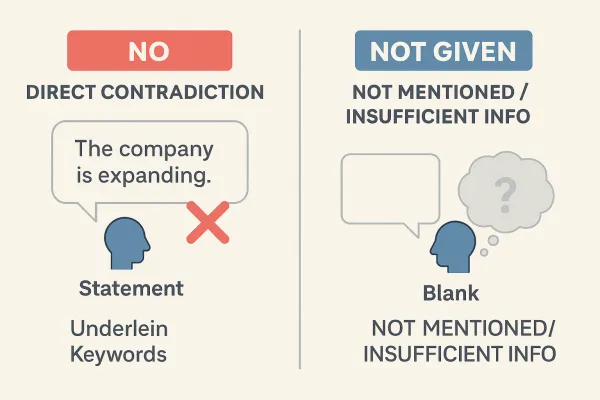
This is the hardest hurdle in this task. To distinguish them clearly:
- Choose NO when: You find relevant information in the text, and that information directly negates or presents a view contrary to the statement in the question. Look for clear contradictions.
Example:
– Question: The author believes that renewable energy sources are the only viable solution to climate change.
– Text: While renewable energy is a crucial part of the solution, the author also emphasizes the importance of nuclear power and carbon capture technologies.
– Explanation: The author does not believe renewable energy is the “only” solution, as they also mention other options. There is a direct contradiction with the word “only.” NO
- Choose NOT GIVEN when:
- You cannot find any information related to the statement in the text.
- You find partial information, but it is not enough to confirm or deny the author’s view on the entire statement. The author has not expressed a stance on that opinion.
Example:
– Question: The author recommends that governments should invest more in space exploration than in public healthcare.
– Text: The author discusses the benefits of space exploration and its scientific advancements. They also mention the growing challenges in public healthcare systems globally.
– Explanation: The author discusses both topics but never compares them or advises prioritizing one over the other. NOT GIVEN.
4. Common traps to avoid
- Qualifier Words:
- Frequency/degree adverbs: always, never, only, all, most, some, rarely, often, primarily, probably, certainly.
- Modal verbs: can, could, may, might, should, must, would.
- Opinion verbs: believe, suggest, argue, claim, assert, recommend, think, agree, disagree.
- Tip: Always be extremely cautious with these words. They are often the deciding factor in the accuracy of a statement. A small change in degree or possibility can turn a YES into a NO or vice versa.
- Paraphrasing and Synonyms:
- The question will rarely use the exact words from the text. The author will use synonyms or paraphrase ideas.
- Tip: Don’t just look for exact keyword matches. Focus on understanding the overall meaning of the question and finding the paragraph with an equivalent meaning.
- Changes in Tense or Time:
- Tip: Pay close attention to time markers and verb tenses. Changes between past/present/future, or specific timeframes (e.g., in the 19th century vs. today) can change the answer from YES to NO.
- External Knowledge:
- Tip: Do not use personal knowledge or logical inferences from real life to answer. The answer must be based solely on what the author has written or implied in the text.
5. A 5-step strategy to master Identifying Writer’s Views/Claims
Step 1: Read the instructions and questions carefully
- Clearly identify that this is a YES/NO/NOT GIVEN task.
- Skim all questions to grasp the main ideas and get a rough idea of the information needed.
Step 2: Analyze the question and underline keywords
- For each question, underline key terms (proper nouns, figures, technical terms) to use as “anchors” when scanning the text.
- Pay special attention to words expressing opinions or attitudes (e.g., believe, argue, recommend, should, may) and “trap” words (e.g., only, always, most).
- Think of potential synonyms or paraphrases that might appear in the text.
Step 3: Locate information in the text (Scanning)
- Use the underlined keywords to scan the text quickly and find the paragraph likely to contain the relevant information.
- Y/N/NG questions usually follow the order of information in the text. Use this to your advantage.
- If you cannot find clear information after a few scans, mark the question and move on to the next one.
Step 4: Read in detail and compare views
- Once you have narrowed down the paragraph, read it carefully to grasp the author’s argument and perspective.
- Compare the meaning of the question with the information in the text:
- YES: If the author’s view matches perfectly.
- NO: If the author’s view contradicts it completely.
- NOT GIVEN: If the author does not mention the opinion, or there is insufficient information to determine their stance.
- Be especially careful with the “trap” words mentioned above. They are often the key to distinguishing YES/NO from NOT GIVEN.
Step 5: Review and record your answer
- After choosing an answer, re-read the question and the paragraph to be sure of your choice.
- Write the full answer (YES/ NO/ NOT GIVEN); avoid abbreviations.
- Never leave an answer blank. If it is too difficult, make your best guess.
6. Illustrative example
Let’s practice with a passage and questions from ECE English:
READING PASSAGE
You should spend about 20 minutes on Questions 1-6 which are based on Reading Passage below.
The Future of Urban Farming
Urban farming, the practice of cultivating, processing, and distributing food in or around urban areas, has gained significant attention in recent years as a sustainable solution to various urban challenges. Proponents argue that it offers a multitude of benefits, from enhancing food security and reducing carbon footprints to fostering community engagement and providing educational opportunities.
However, the practicalities of widespread urban farming face considerable obstacles. One common claim is that urban farms can feed an entire city. While theoretically possible in a dense vertical farm setting, it is unrealistic to assume that traditional rooftop gardens or community plots could ever provide the bulk of a large city’s dietary needs. The sheer scale of food production required, coupled with limited available urban space, makes this a challenging proposition. The author suggests that urban farming will only ever be a supplementary food source for cities, not a primary one.
Furthermore, the economic viability of many urban farming projects is often overestimated. Starting and maintaining an urban farm, especially those aiming for commercial production, involves substantial initial investment in infrastructure, soil remediation, and specialized equipment. Some argue that without significant government subsidies or niche markets, many urban farms would struggle to compete with large-scale agricultural operations that benefit from economies of scale and extensive land availability. Critics often highlight the energy consumption of high-tech indoor farms, which can sometimes outweigh the carbon savings from reduced transportation.
Despite these challenges, the author firmly believes that urban farming has a vital role to play in future urban sustainability. It encourages local food systems, educates citizens about food origins, and creates green spaces that improve air quality and biodiversity. While it may not solve all food security issues, its contributions to urban resilience and environmental well-being are undeniable. The author advocates for policies that support small-scale urban agriculture for its community and environmental benefits, rather than solely for its potential to replace conventional food supply chains.
Questions 1-6 Do the following statements agree with the views/claims of the writer in Reading Passage? In boxes 1-6 on your answer sheet, write:
YES if the statement agrees with the views/claims of the writer NO if the statement contradicts the views/claims of the writer NOT GIVEN if it is impossible to say what the writer thinks about this
- The author believes that urban farming is a fully sustainable solution to all urban problems.
- The author claims that traditional urban farms cannot meet the primary food requirements of a large city.
- The author argues that government subsidies are essential for the commercial success of most urban farming projects.
- The author believes that the environmental benefits of urban farming are less significant than its economic challenges.
- The author is convinced that urban farming will play a crucial role in the sustainability of future cities.
- The author suggests that urban farming should replace conventional food supply chains entirely.
Analysis and explanation:
1. The author believes that urban farming is a fully sustainable solution to all urban problems.
- Keywords: “author believes”, “fully sustainable solution”, “all urban problems”.
- Scanning: Look for “sustainable solution” and absolute degree words.
- Detailed Reading: “Urban farming… has gained significant attention… as a sustainable solution to various urban challenges.” The text lists many benefits but never claims it solves “all” problems. The author only says “various.”
- Comparison: The word “all” in the question contradicts “various” in the text.
- Answer: NO
2. The author claims that traditional urban farms cannot meet the primary food requirements of a large city.
- Keywords: “author claims”, “traditional urban farms”, “cannot meet”, “primary food requirements”, “large city”.
- Scanning: Look for “traditional urban farm”, “feed city”, “primary food”.
- Detailed Reading: “…it is unrealistic to assume that traditional rooftop gardens or community plots could ever provide the bulk of a large city’s dietary needs. The author suggests that urban farming will only ever be a supplementary food source for cities, not a primary one.”
- Comparison: The text confirms it is “unrealistic to assume… provide the bulk” and emphasizes it is only “supplementary… not a primary one.” This matches the question.
- Answer: YES
3. The author argues that government subsidies are essential for the commercial success of most urban farming projects.
- Keywords: “author argues”, “government subsidies”, “essential”, “commercial success”, “most urban farming projects”.
- Scanning: Look for “subsidies”, “commercial success”.
- Detailed Reading: “Some argue that without significant government subsidies or niche markets, many urban farms would struggle to compete…”
- Comparison: The text says “Some argue,” not the author’s own view. The author is merely presenting someone else’s argument.
- Answer: NOT GIVEN
4. The author believes that the environmental benefits of urban farming are less significant than its economic challenges.
- Keywords: “author believes”, “environmental benefits”, “less significant”, “economic challenges”.
- Scanning: Look for “environmental benefits”, “economic challenges”, “significant”.
- Detailed Reading: The text mentions “economic viability… often overestimated” and “struggle to compete,” but also says “its contributions to urban resilience and environmental well-being are undeniable.” The author never compares them or states that environmental benefits are “less significant.”
- Comparison: Insufficient information to determine the author’s view on the comparison.
- Answer: NOT GIVEN
5. The author is convinced that urban farming will play a crucial role in the sustainability of future cities.
- Keywords: “author is convinced”, “crucial role”, “sustainability”, “future cities”.
- Scanning: Look for “sustainability”, “future cities,” and strong belief words.
- Detailed Reading: “Despite these challenges, the author firmly believes that urban farming has a vital role to play in future urban sustainability.”
- Comparison: “Firmly believes” and “vital role” match “is convinced” and “crucial role.”
- Answer: YES
6. The author suggests that urban farming should replace conventional food supply chains entirely.
- Keywords: “author suggests”, “should replace”, “conventional food supply chains”, “entirely”.
- Scanning: Look for “replace”, “conventional food”.
- Detailed Reading: “…While it may not solve all food security issues, its contributions to urban resilience and environmental well-being are undeniable. The author advocates for policies that support small-scale urban agriculture for its community and environmental benefits, rather than solely for its potential to replace conventional food supply chains.”
- Comparison: The text says it “may not solve all food security issues” and supports it for other reasons, “rather than solely for its potential to replace conventional food supply chains.” This contradicts the idea of replacing them “entirely.”
- Answer: NO
7. Tips for success
- Expand your vocabulary on attitudes/opinions: Learn verbs, adverbs, and adjectives used to express a stance (e.g., assert, contend, dispute, essential, unlikely, possibly).
- Practice with diverse sources: Read essays and academic articles to get used to how authors present arguments and views.
- Pay attention to topic and concluding sentences: The author’s view is often clearly expressed in the topic sentence of a paragraph or in concluding sentences that summarize the main point.
- Develop critical thinking: Ask yourself, “Why does the author say this?”, “What evidence supports this view?”, “Are there any contradictions?”. This helps you read deeper and understand the writer’s intent.
ECE wishes you effective practice and success in conquering the Identifying Writer’s Views/Claims task in IELTS Reading!





 Khai giảng Khóa học Hè cực HOT.
No comments yet!