


Tóm Tắt Nội Dung Bài Viết
The **Identifying Information** task, often referred to by its familiar names True/False/Not Given (T/F/NG) and Yes/No/Not Given (Y/N/NG), is a frequent challenge and is widely considered one of the most “tricky” sections of the IELTS Reading test. While it may not be overly complex in terms of vocabulary or grammar, accurately identifying information and distinguishing between the answer choices requires meticulous attention to detail and a clear strategy. This article will provide you with a comprehensive overview and effective strategies to “ace” this question type.
1. What is the Identifying Information task?
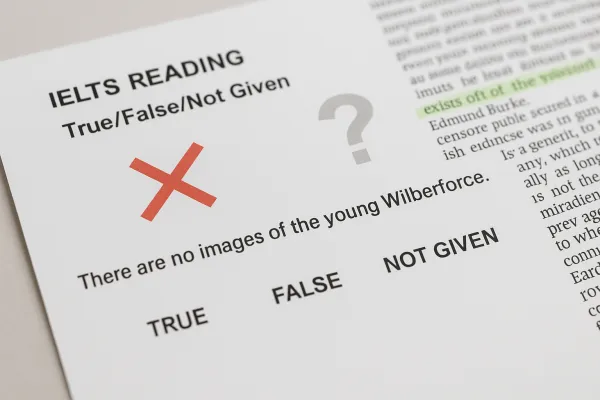
Essentially, the Identifying Information task requires you to determine the relationship between a given statement and the information provided in the passage. There are two main types:
- True/False/Not Given (T/F/NG): You must determine whether a fact or objective piece of information in the question is:
- TRUE: Completely consistent with the information in the reading passage.
- FALSE: Directly contradicts the information in the reading passage.
- NOT GIVEN: The information is not mentioned in the passage, or there is insufficient information to determine whether it is true or false.
- Yes/No/Not Given (Y/N/NG): You must determine whether an opinion, viewpoint, or theory of the author in the question is:
- YES: Consistent with the author’s viewpoint in the reading passage.
- NO: Contradicts the author’s viewpoint in the reading passage.
- NOT GIVEN: The viewpoint is not mentioned in the passage, or there is insufficient information to determine whether the author agrees or disagrees.
Crucial note: Never confuse T/F/NG with Y/N/NG! Answering “YES” for a T/F/NG question or “TRUE” for a Y/N/NG question will result in losing points for that entire item. Always read the instructions carefully.
2. Common mistakes made by test-takers
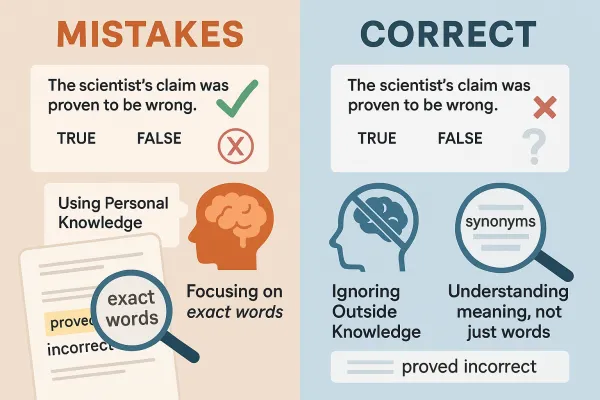
Mistakes in this task often stem from poor habits or a lack of caution:
- Failing to distinguish between FALSE and NOT GIVEN:
- The mistake: This is the most common error. Test-takers often get “stuck” when they cannot find the information and rush to conclude it is NOT GIVEN, when in fact the information may have been altered to make it FALSE.
- The fix: FALSE occurs when you find relevant information in the passage, but it directly contradicts the question. NOT GIVEN occurs when you cannot find any information to confirm or deny the question. Keep searching for synonyms/paraphrases until the end. If there are no clues to compare for opposition, it is likely NOT GIVEN.
- Using personal inference/knowledge:
- The mistake: Applying outside knowledge to reach an answer. For example, you know that “smoking is harmful to health,” but if the passage does not mention it, you cannot choose TRUE.
- The fix: Every answer must be based solely on the information provided in the passage. If the text doesn’t say it, don’t infer it.
- Relying solely on word matching:
- The mistake: Trying to find the exact words from the question within the passage.
- The fix: The IELTS exam requires the use of synonyms and paraphrasing. Focus on understanding the meaning of the question and finding the paragraph with an equivalent meaning, rather than matching identical words.
- Not fully understanding the meaning of the statement:
- The mistake: Looking only at a few keywords without grasping the overall meaning of the question.
- The fix: Read the question carefully and slowly to ensure you grasp the main point it intends to convey. Changing one word can completely alter the meaning of the sentence.
- Falling for traps involving frequency/quantity/modality (Extreme Words/Quantifiers/Modals):
- The mistake: Words like “always,” “never,” “only,” “all,” “most,” “some,” “can,” “could,” “should,” “might,” and “probably” are often traps. For example: “All students passed the exam” versus the passage saying “Most students passed the exam.”
- The fix: Always be extremely vigilant with these words. They can completely change the accuracy or universality of the information.
3. A 5-step strategy to conquer Identifying Information
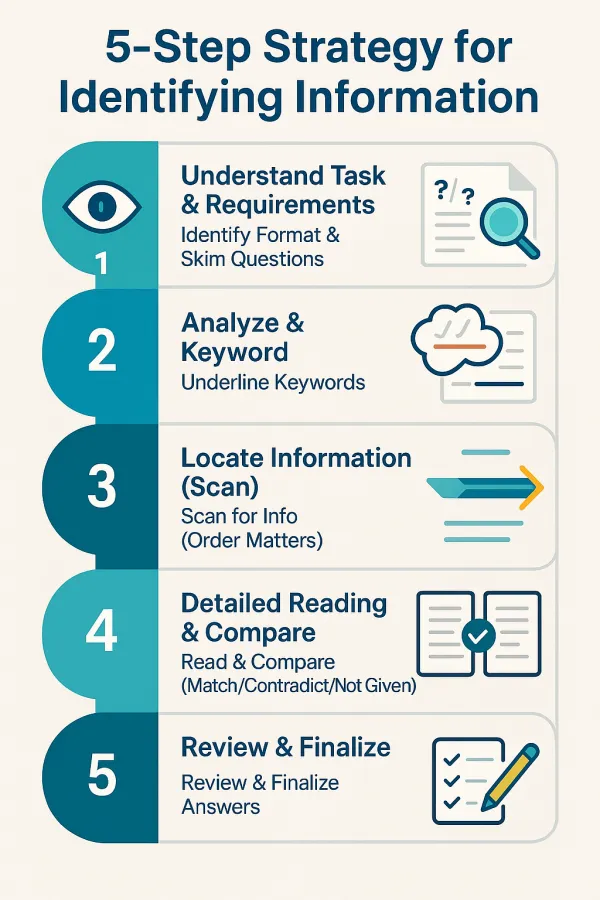
To handle this task effectively, you can apply the following 5-step strategy:
Step 1: Identify the task type and read the instructions carefully
- Check whether you need to fill in TRUE/FALSE/NOT GIVEN or YES/NO/NOT GIVEN. This is the first and most important step to avoid losing points unnecessarily.
- Skim through all the questions to get an overview of the information you need to find.
Step 2: Analyze the question and underline keywords
- Read each question carefully.
- Underline the main keywords in the question. Prioritize keywords that are difficult to paraphrase, such as:
- Proper nouns: (people, places, organizations, scientific names)
- Numbers/Dates/Years: (dates, figures, percentages)
- Technical terms: (technical terms)
- For keywords that are easy to paraphrase, proactively think of synonyms or alternative ways the passage might express them.
- Pay special attention to “trap” words like “all, none, only, always, never, sometimes, often, primarily, probably, possible, must, should,” etc. They are often the deciding factor for True/False answers.
Step 3: Locate the information (Scanning)
- Use the underlined keywords to scan quickly through the passage. The goal is to find the paragraph containing information related to the question.
- This task type usually follows the order of the passage. This means the answer to question 2 usually appears after the answer to question 1 and before the answer to question 3. Use this rule to locate information faster.
- If you don’t find the keywords after a few quick scans, don’t panic. The information might have been paraphrased, or it could be Not Given. Move on to the next question and return later if time permits.
Step 4: Read the relevant paragraph carefully and compare (Detailed Reading & Comparison)
- Once you have identified the paragraph containing the relevant information, read it carefully (detailed reading).
- Compare each word and idea in the question with the information in the passage.
- If the meaning is completely consistent (same direction, same degree), choose TRUE/YES.
- If the meaning is contradictory or conflicting (different direction, opposite), choose FALSE/NO.
- If there is not enough information to confirm or deny (missing details, not mentioning a specific aspect), choose NOT GIVEN.
Step 5: Review and fill in your answers
- After providing an answer, quickly double-check to ensure there is no confusion, especially for questions with “trap” words.
- Write your answers clearly and fully (TRUE/FALSE/NOT GIVEN or YES/NO/NOT GIVEN); do not use abbreviations to avoid losing points.
- Never leave a question blank. If you are unsure, make your best educated guess.
See more here:
How to handle Short Answer Questions in IELTS Reading
How to handle Matching Information in IELTS Reading
4. Illustrative example of Identifying Information in IELTS Reading
READING PASSAGE
You should spend about 20 minutes on Questions 1-6 which are based on Reading Passage below.
The History of the Pencil
The humble pencil, an indispensable tool for writers, artists, and students worldwide, has a surprisingly rich and complex history. For centuries, people used various implements for marking, from charcoal to metal styluses. However, the modern pencil as we know it began to take shape in the 16th century.
In 1564, a large deposit of graphite was discovered near Borrowdale, Cumbria, England. Initially, the locals, mistaking it for lead, used it to mark their sheep. This “plumbago” (Latin for “lead ore”) was incredibly pure and easily cut into sticks. Its dark mark and ease of use quickly made it popular, especially among artists and craftsmen who needed a precise, erasable marking tool. However, pure graphite was brittle and messy, leading to the search for ways to encase it.
Early attempts involved wrapping the graphite in string or sheepskin, but these methods were impractical. The first known wooden pencil was invented in Italy in 16th century, though it was a crude design. It wasn’t until 1662 that a practical method for encasing graphite in wood was developed in Germany, involving carving out a graphite stick and fitting it into a wooden casing.
The French Revolution inadvertently played a key role in the pencil’s evolution. As Great Britain dominated the graphite market, France faced a shortage due to trade blockades. This prompted Nicolas-Jacques Conté, a French chemist and inventor, to seek an alternative. In 1795, Conté patented a process for mixing powdered graphite with clay, firing it in a kiln, and then encasing the hardened mixture in wood. By varying the ratio of graphite to clay, he could create pencils of different hardness, revolutionizing the industry and leading to the standardized grading system (HB, 2B, etc.) we use today. This innovation made France self-sufficient in pencil production and set the global standard.
Questions 1-6 Do the following statements agree with the information given in the Reading Passage? In boxes 1-6 on your answer sheet, write:
TRUE if the statement agrees with the information FALSE if the statement contradicts the information NOT GIVEN if there is no information on this
- People began using modern pencils for writing in the 15th century.
- The graphite discovered in England was initially believed to be a type of metal.
- Artists were among the first groups to widely adopt the use of graphite for drawing.
- The earliest wooden pencils were developed in Germany.
- Conté’s invention allowed for the production of pencils with varying degrees of hardness.
- Today, most pencils used globally are manufactured in France.
Analysis and explanation of answers:
1. People began using modern pencils for writing in the 15th century.
- Keywords: “modern pencils”, “15th century”.
- Scanning: Search for “modern pencil” and time markers.
- Detailed Reading: “However, the modern pencil as we know it began to take shape in the 16th century.”
- Comparison: The question says “15th century,” the passage says “16th century.” There is a contradiction in time.
- Answer: FALSE
2. The graphite discovered in England was initially believed to be a type of metal.
- Keywords: “graphite”, “England”, “initially believed”, “metal”.
- Scanning: Search for “graphite”, “England”.
- Detailed Reading: “In 1564, a large deposit of graphite was discovered near Borrowdale, Cumbria, England. Initially, the locals, mistaking it for lead, used it to mark their sheep. This ‘plumbago’ (Latin for ‘lead ore’) was incredibly pure…”
- Comparison: The passage says “mistaking it for lead” and “lead ore.” Lead is a type of metal. The question says “a type of metal.” The information matches.
- Answer: TRUE
3. Artists were among the first groups to widely adopt the use of graphite for drawing.
- Keywords: “Artists”, “first groups”, “widely adopt”, “graphite”, “drawing”.
- Scanning: Search for “artists” and “graphite.”
- Detailed Reading: “…Its dark mark and ease of use quickly made it popular, especially among artists and craftsmen who needed a precise, erasable marking tool.”
- Comparison: The passage confirms that graphite quickly became popular, especially with “artists.” The question says “among the first groups to widely adopt.” The information matches.
- Answer: TRUE
4. The earliest wooden pencils were developed in Germany.
- Keywords: “earliest wooden pencils”, “developed”, “Germany”.
- Scanning: Search for “wooden pencil” and country names.
- Detailed Reading: “The first known wooden pencil was invented in Italy in 16th century, though it was a crude design. It wasn’t until 1662 that a practical method for encasing graphite in wood was developed in Germany…”
- Comparison: The passage says the “first known wooden pencil was invented in Italy,” while a “practical method… developed in Germany.” The question says “earliest wooden pencils were developed in Germany.” This contradicts “first known… in Italy.”
- Answer: FALSE
5. Conté’s invention allowed for the production of pencils with varying degrees of hardness.
- Keywords: “Conté’s invention”, “varying degrees of hardness”.
- Scanning: Search for “Conté.”
- Detailed Reading: “In 1795, Conté patented a process for mixing powdered graphite with clay, firing it in a kiln, and then encasing the hardened mixture in wood. By varying the ratio of graphite to clay, he could create pencils of different hardness…”
- Comparison: The passage directly confirms that varying the ratio of graphite to clay allowed for the creation of different hardness levels. The information matches.
- Answer: TRUE
6. Today, most pencils used globally are manufactured in France.
- Keywords: “Today”, “most pencils”, “globally”, “manufactured in France”.
- Scanning: Search for “today,” “globally,” “France” in the context of manufacturing.
- Detailed Reading: The final paragraph only states that Conté’s invention “made France self-sufficient in pencil production and set the global standard.” There is no information stating that “most pencils used globally are manufactured in France” at the present time. The passage only discusses France’s historical role in standardization.
- Comparison: There is not enough information to confirm or deny this.
- Answer: NOT GIVEN
5. Tips for success in Identifying Information
- Practice regularly: There is no better way to master this task than by practicing consistently with real exam materials.
- Analyze your mistakes: After each practice session, spend time carefully analyzing the questions you got wrong or were unsure about. Why did you get it wrong? Was it an issue with keywords, paraphrasing, or distinguishing between False/Not Given?
- Build your synonym vocabulary: Note down synonyms and phrases that are frequently paraphrased in the reading passages you practice with.
- Read English news: Regularly reading English newspapers and magazines will help you get used to how ideas are expressed, making it easier to recognize paraphrasing.
ECE English wishes you effective practice and success in conquering the Identifying Information task in IELTS Reading!





 Khai giảng Khóa học Hè cực HOT.
No comments yet!