


Tóm Tắt Nội Dung Bài Viết
Listening transcripts are no longer a foreign concept to IELTS candidates. However, many learners still haven’t figured out how to fully leverage this powerful tool to reach their target band score. Using a transcript isn’t just about checking your answers; it’s the key to deeply understanding the recording, improving your pronunciation, and familiarizing yourself with common “traps.”
In this article, ECE provides a comprehensive guide—from definitions and roles to a detailed, advanced practice routine—to help you master your Listening skills as effectively as possible.
What is a Listening Transcript?
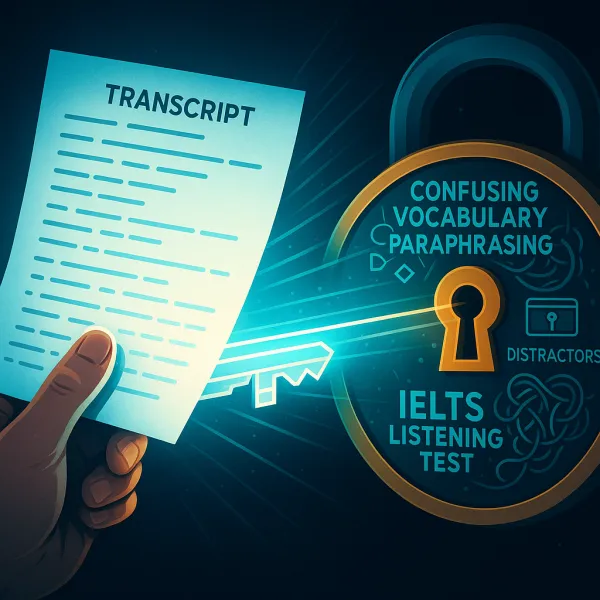
A listening transcript is a complete and accurate word-for-word record of an audio clip. In the context of IELTS Listening preparation, this document accompanies the audio tracks, allowing you to cross-reference what you heard with the original text.
If you only focus on completing tests and checking answer keys while ignoring the transcript, you are missing out on 80% of your potential progress. The transcript is your best “teacher”—it helps you understand exactly why you made a mistake so you can fix the root cause and avoid repeating it.
The Indispensable Role of Transcripts in IELTS Prep
Contrary to popular belief, transcripts aren’t just for checking right or wrong answers. They are a multi-dimensional analytical tool that offers several core benefits:
1. Contextual Vocabulary and Paraphrasing Mastery
The IELTS Listening test is designed to evaluate comprehension rather than simple word recognition. Consequently, keywords in the questions and answers are often paraphrased in the audio. Transcripts help you:
- Learn vocabulary in context: You see how a new word is used within a complete sentence, making it much easier to remember.
- Learn synonyms and equivalent expressions: By comparing the question to the transcript, you will discover the synonyms and alternative phrasing used by the examiners.
Example: A question might use the phrase “has no plans to move,” while the transcript says “moving to a new location has never been necessary.” Analyzing the transcript helps you recognize these as equivalent meanings.
2. Analyzing Distractors in the Test
This is a vital skill for achieving a high band score. In formats like Multiple Choice, examiners intentionally include “noise” or misleading information, but the transcript helps you “unmask” them:
- Eliminate wrong answers with confidence: You will see exactly why a seemingly correct option is actually wrong.
- Understand question-setting patterns: Transcripts reveal how distractors (e.g., names, dates, or figures) are placed near the correct answer to trick the listener.
3. Improving Pronunciation and Intonation
This is an advanced benefit that many learners overlook. A transcript isn’t just text; it’s a bridge that connects sound to the written word. By reading while listening to the transcript, you can:
- Identify connected speech: For example, “get on a bus” might sound like “get’on’a’bus.”
- Mimic native intonation, stress, and rhythm: This not only improves your listening but also significantly boosts your Speaking skills.
3 Steps to Mastering Listening with Transcripts
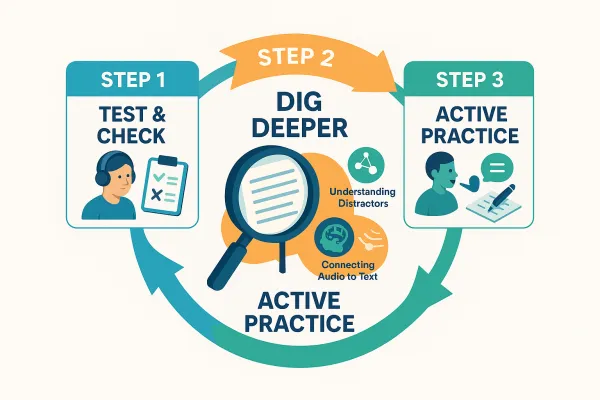
Instead of just listening and checking answers passively, apply this effective practice cycle to get the most out of every transcript.
Step 1: Test & Check
- First Listen: Complete the listening test under exam conditions—no pausing, no looking at the transcript.
- Record and Check: Compare your answers with the official key. Don’t just look at what you got right; mark every wrong answer and any questions you were unsure about.
Step 2: Analyze with the Transcript
This is the most critical step, where you turn mistakes into knowledge. Take the time to analyze the transcript thoroughly.
- Identify the reason for the error: Why did you mishear it? Did you confuse one word for another? Did you miss a crucial keyword?
- Analyze Paraphrasing: Underline keywords in the question and find how they were rephrased in the transcript. Keep a log of the synonym pairs you discover.
- Analyze Distractors: Especially for Multiple Choice questions, read the transcript carefully to understand why the wrong options were included. They often contain information mentioned in the audio that doesn’t actually answer the specific question.
Step 3: Active Practice
Once you understand your mistakes, don’t just move on. Use the transcript for active practice to reinforce your learning:
- Dictation: Listen to the audio sentence by sentence, pause, and write down exactly what you hear. Then, compare it to the transcript. This method sharpens your ear for detail and improves spelling.
- Shadowing: Listen to the audio and read the transcript aloud simultaneously, trying to match the speaker’s intonation, speed, and pronunciation. This is a fantastic way to improve fluency and linguistic reflexes.
Recommended High-Quality Practice Resources
To make your practice effective, choosing the right materials is essential. You should combine official prep materials with diverse free sources to enrich your learning experience.
Official Materials
These are indispensable because they most accurately simulate the structure and difficulty of the actual exam.
- Cambridge IELTS Series (1–18):
Pros: The “gold standard” for every candidate. The tests follow the exact exam format, from accents and speed to question types. The transcripts at the back of the book are the perfect reference for in-depth analysis.
Pro Tip: Start with the most recent editions (Book 14 and up) as they reflect the most current exam trends.
- British Council and IDP Websites:
Pros: They offer free online practice tests to help you get used to the interface and time pressure. Transcripts are provided, making it easy to review immediately after finishing.
Pro Tip: Use these as “mini-exams” to track your progress.
Free Resources
Once you’ve mastered the test format, listening to various sources will help you get used to different accents and topics, building your confidence for exam day.
- TED Talks:
Pros: Thousands of high-quality talks on academic and social topics. They offer full transcripts and often bilingual subtitles. You’ll hear a range of accents, from British and American to international speakers. This is an excellent source for those aiming for a Band 7.0+ and wanting to learn specialized vocabulary.
Pro Tip: Choose topics you enjoy to stay motivated. After analyzing the transcript, practice shadowing a short segment to improve your delivery.
- ELLLO (English Listening Lesson Library Online):
Pros: A massive library of free listening lessons categorized by level, from Low Beginner to Advanced. Each lesson includes a transcript, exercises, and vocabulary explanations.
Pro Tip: Ideal for all levels. If you’re just starting out, choose Low Beginner tracks with slower speaking speeds to build your confidence.
- Listen a Minute:
Pros: Perfect for those with a busy schedule or beginners. Each clip is only 1–2 minutes long, features simple content, and has the transcript right below the player.
Pro Tip: Spend 5–10 minutes a day on this to maintain a consistent listening habit.
- Lyricstraining:
Pros: Turns listening practice into a fun game through music. You listen to a song and fill in the missing lyrics, which helps with detailed listening and spelling.
Pro Tip: Pick songs with a moderate tempo that match your level to avoid getting discouraged. It’s a great way to “learn while you play.”
Conclusion
Using transcripts in IELTS Listening isn’t just a study tip; it’s a comprehensive strategy to improve your listening ability from the ground up. By following a systematic routine—combining deep analysis with active practice—you won’t just see your scores go up; you will truly master the art of listening.




 Khai giảng Khóa học Hè cực HOT.
No comments yet!